Qingdao Travel Guide 2026
Qingdao is a port city on the Shandong Peninsula famous for its German colonial old town, the Tsingtao Brewery (founded 1903 by German settlers), the sacred Taoist Laoshan mountain, the Eight Great Passes coastal scenery, sandy beaches, seafood restaurants, and the annual Qingdao International Beer Festival.
Last updated:
Quick Answer
Qingdao sits on the western shore of the Shandong Peninsula on the Yellow Sea, 700 km east of Beijing and a 4-hour high-speed rail journey. The citys identity was forged by a 17-year German colonial occupation from 1898 to 1914, which left behind a remarkable concentration of German Jugendstil and Baroque architecture in the Old Town, the Tsingtao Brewery (still Chinas most famous beer), and the Jiao Zhou German-era prison and governor residence. The city is also the gateway to Laoshan, the 1,133-meter coastal mountain sacred to Taoism and one of Chinas great mountain destinations, with 200+ ancient Taoist temples and the famous Laoshan Green Tea. The Eight Great Passes (Ba Da Guan) is a 6-km coastal scenic reserve with 8 named promontories and beaches, including the famous No. 2 Beach (Shi Lao Ren). The annual Qingdao International Beer Festival in August is Asias largest beer event. Most travelers visit on a 3-4 day stopover from Beijing, easily reached by HSR; visa-free entry of 30 days applies to most Western passports.
| Best time to visit | May-June and September-October for mild weather and the Tsingtao beer season; August for the Qingdao International Beer Festival (but expect crowds); avoid late January to mid-February (Spring Festival) and early October (Golden Week) |
|---|---|
| Daily budget | $250 (backpacker) / $700 (mid-range) / $2500+ (luxury) |
| Currency | CNY (¥); Visa, Mastercard, and American Express accepted at hotels, malls, and most restaurants via Alipay and WeChat Pay Tour Card |
| Language | Mandarin (Putonghua) with the local Qingdao dialect among older residents; English is widely spoken in hotels, the Old Town, Tsingtao Brewery, and Laoshan tourist areas |
| Time zone | China Standard Time (UTC+8), no daylight saving time |
| Last updated | 2026-06-14 |
What is Qingdao: Why Qingdao Deserves a Visit?
Qingdao is one of Chinas most distinctive coastal cities, sitting on the western shore of the Shandong Peninsula on the Yellow Sea and facing Korea across the water. The citys identity was forged by a 17-year German colonial occupation from 1898 to 1914, which left behind a remarkable concentration of German Jugendstil and Baroque architecture in the Old Town and gave the world Tsingtao Beer, Chinas most famous export brew. Most visitors know Qingdao for two images: the red-tiled German facades lining the cobblestone streets of the Old Town, and the sandy beaches and forested headlands of the Eight Great Passes coastal reserve. Both images are well-deserving of the hype. But Qingdao is far more than a colonial postcard. It is a working port of 50+ million tons a year, the host of the worlds largest ship-to-ship oil terminal, the home of the Sifly Sifang and Haier corporations, and the gateway to Laoshan — the 1,133-meter coastal mountain sacred to Taoism and one of Chinas great mountain destinations. For independent travelers, Qingdao offers something Beijing cannot: a slower coastal pace, German colonial architecture preserved almost intact, the finest beer in China, a 200+ temple Taoist mountain within an hours drive, the largest beer festival in Asia, and a working seafood culture anchored by clams, oysters, scallops, and crabs from the Yellow Sea. Three to four days is the ideal length of stay — one day for the German Old Town and Tsingtao Brewery, a second for the Eight Great Passes and the beaches, a third for Laoshan, and an optional fourth for the Beer Festival in August or for the additional heritage sites.
What is the history of Qingdao: From Fishing Village to German Colony to Modern Port?
Qingdao began as a small fishing village called Jiao Ao at the mouth of the Jiao Zhou River. Its recorded history reaches back to the Eastern Zhou dynasty (770-256 BC), when it was part of the Qi states maritime frontier. The Qingshan (Green Island) fortress, now known as the Zhanqiao Pier area, served as a coastal defense post for the Qi, Han, and Tang dynasties. The citys modern history pivots in 1891, when the Qing governor Zhang Yanfan built the Zhanqiao Pier and established Jiaoao as a coastal defense base. Two years later, Germany forced the Qing government to sign the Treaty of Kiautschou in 1898, ceding a 112-square-kilometer concession around Jiaoao Bay to Germany for a 99-year lease. The Germans invested massively in the new colony: they built a modern port, a European-style city with sewage and electricity, the Tsingtao Brewery (1903), the Jiao Zhou Governor Residence, and the German Street (Yishan Road) with restored Jugendstil facades. Japan captured Qingdao in 1914 during World War I and held it until 1922, when it was returned to China. The Japanese occupation resumed from 1937 to 1945 during the Second Sino-Japanese War. After 1949 the city industrialized rapidly under the Communists, becoming a major shipbuilding and textile center. The 2008 Beijing Olympics brought international attention when Qingdao hosted the Olympic sailing regatta in Fushan Bay, and the 2018 Shanghai Cooperation Organization summit was held here. Today Qingdao is one of Chinas wealthiest cities by GDP per capita, the headquarters of Haier and Hisense, and a UNESCO City of Film (2017).
What is the geography and climate of Qingdao, and when should I visit?
Qingdao sits on the western shore of the Shandong Peninsula on the Yellow Sea, 700 km east of Beijing and 600 km north of Shanghai. The municipality covers 11,282 square kilometers, although the urban core clusters along Jiaozhou Bay and the Eight Great Passes coastline. The terrain is unusually varied for a Chinese coastal city: the Laoshan range rises to 1,133 meters in the east, the Zhongshan Hill and Taiping Hill rise to 200+ meters in the city center, and the western and northern coasts are a mix of sandy beaches, rocky headlands, and shallow bays. The citys highest natural point is the Jufeng Peak of Laoshan at 1,133 meters. The coastline stretches 730 km in total, with over 40 named beaches. Qingdao has a temperate monsoon climate with four distinct seasons and is on the same latitude as Madrid, Naples, and New York. Summers (June-August) are warm and humid but moderated by the Yellow Sea, with average July highs of 28°C and lows of 22°C; this is the peak tourist season and the time of the Beer Festival. Winters (December-February) are mild by northern Chinese standards, with January averaging daytime highs of 3°C and nighttime lows of -2°C; snow is possible but rarely accumulates. Spring (March-May) is short and cool, with the East Asian dust storms affecting air quality in late March and April. Autumn (September-November) is the best season by a wide margin: warm dry days, cool nights, the autumn foliage, and the Tsingtao Beer Festival season winding down. The best months are May-June and September-October, with the caveat that August brings enormous domestic crowds for the Beer Festival; the first week of October (National Day Golden Week) is similarly busy.
How to Get There: Flights, Trains, and the Beijing-Qingdao HSR
Qingdao Jiaodong International Airport (TAO) is 39 km northwest of the city center in the Jiaodong Economic Zone and is one of Chinas newest major airports, opened in 2021. The airport handles 25+ million passengers a year with direct flights to London Heathrow, Frankfurt, Sydney, Melbourne, Tokyo Narita, Tokyo Haneda, Seoul Incheon, Singapore Changi, Bangkok, and Kuala Lumpur, plus a dense domestic network including daily flights to Beijing, Shanghai, Guangzhou, Shenzhen, Hong Kong, Chengdu, Kunming, Xian, and Wuhan. The airport is connected to the city center by a metro extension (line 8) and a 60-minute airport shuttle bus service; a taxi to central Qingdao takes 60-75 minutes and costs ¥150-200. For many international travelers, however, the Beijing-Qingdao HSR is the most popular entry route. The Beijing-Qingdao HSR connects Beijing South Railway Station directly to Qingdao North Railway Station and Qingdao Railway Station (the central station on metro line 3), with journey times of 4 hours from Beijing South and frequent service every 10-30 minutes during peak hours. Second-class tickets cost ¥314, first-class ¥503, business class ¥1,047. The HSR runs from 6am to 10pm, with up to 50 daily services. From Shanghai, the HSR takes 6 hours 30 minutes and costs ¥450 second class (faster via Jinan, 5 hours total). From Jinan, the HSR takes 1 hour 30 minutes and costs ¥120 second class. Qingdao has four main railway stations: Qingdao Railway Station (central, on metro line 3, in the heart of the city), Qingdao North Railway Station (the largest HSR hub, on metro line 8, in the Licang District), Qingdao West Railway Station (in the Huangdao District, serving high-speed services), and Qingdao East Railway Station (mostly conventional rail). Within the city, the metro has 8 operational lines and 150+ stations covering the main attractions. The German Old Town is on Line 3 at Qingdao Station, the Eight Great Passes on Line 3 at Huiquan Square Station, and Laoshan on Line 11 plus bus 304.
How do I get around Qingdao: Metro, Taxi, DiDi, and Bike Share?
Qingdao has a modern, well-organized public transport system. The metro is the workhorse: 8 lines, 150+ stations, ¥2-9 per ride depending on distance, English and Chinese signage, and clean air-conditioned cars. The metro runs from roughly 6am to 11pm, with frequencies of 3-7 minutes during peak hours and 8-12 minutes at off-peak times. A reloadable Qingdao Tong transportation card can be bought at any station for ¥20 (refundable deposit) and works on the metro, buses, the tourist ferries, and the city bike share. Taxis in Qingdao are metered and reasonable; flag-fall is ¥11 for the first 3 km and ¥2.5 per additional km (¥3.5 at night), and an average cross-city ride costs ¥30-60. DiDi operates throughout the city and is the safest and most foreigner-friendly option; the English-language app works smoothly, fares are typically 10-20% lower than taxi meters, and the GPS tracking means you cannot be overcharged. Always insist on the meter or use DiDi; unmarked cabs at the railway stations and the Old Town occasionally overcharge tourists. Qingdao is one of the best Chinese cities for cycling: the flat coastal terrain around the Eight Great Passes, the dedicated 6-km coastal bike path, and the greenways through Zhongshan Park and Taiping Hill all reward two wheels. Bike share is available through Meituan Bike and HelloRide (¥1.5 per 30 minutes via the WeChat app). For day trips to Laoshan, tourist coaches depart from the Qingdao Tourism Distribution Center (¥60-100 round-trip) or you can hire a private driver for ¥500-700 per day. The Huangdao District (across the bay) is now connected by the Qingdao Jiaozhou Bay Subsea Tunnel (¥10 one way for cars, free for cyclists) and the Jiaozhou Bay Bridge (one of the worlds longest sea bridges at 36.5 km).
Where should I stay in Qingdao?
Qingdaos accommodation is concentrated in four areas, each with a distinct character. The German Old Town area (Yishan Road and Minjiang Road) is the most atmospheric and the best for first-time visitors. Boutique hotels in restored German colonial buildings cluster here: the Princess Hostel Qingdao (¥120, in a restored 1903 German villa), the Qingdao Housing International Hotel (¥600), the Holiday Inn Qingdao City Center (¥500), and the luxurious Shangri-La Hotel Qingdao (¥1,500) are all within walking distance of the Zhanqiao Pier, the St. Michaels Cathedral, and the Tsingtao Brewery. Mid-range options include the Ibis Qingdao Ningxia Road (¥300), the Hanting Express Qingdao Zhanqiao (¥350), and the Qingdao Kaiyue Hostel (¥200). The Eight Great Passes area east of the Old Town is the scenic beach district, with international beachfront resorts. The Crowne Plaza Qingdao (¥900), the Le Meridien Qingdao (¥1,100), the Hilton Qingdao Golden Beach (¥1,000), and the Grand Regency Hotel (¥1,200) are all on or near the No. 2 Beach. The Huangdao District across the Jiaozhou Bay is the modern skyline, with the Marriott Qingdao Huangdao (¥900), the Renaissance Qingdao (¥800), and the Howard Johnson Qingdao (¥600). For backpackers, the Qingdao International Youth Hostel (¥60-120 per bed) in the Old Town and the Lazy Cat Hostel (¥80-150) near the Eight Great Passes are the best options. Book at least 2 weeks ahead during the Spring Festival, Golden Week, and the August Beer Festival. Whatever you choose, request a sea-view room if available — they cost ¥100-200 more but transform the stay.
What are the top attractions in Qingdao?
Qingdaos signature attraction is the German Old Town, a 2-square-kilometer preserved district of German colonial architecture from 1898-1914, with over 200 protected heritage buildings including the Gothic St. Michaels Cathedral, the Baroque Governor Residence, the German-era Jiao Zhou Prison, and the German Street (Yishan Road) with restored Jugendstil facades. Free to enter; many buildings house museums, cafes, and craft shops. The Tsingtao Brewery, founded in 1903 by Anglo-German Brewery GmbH under the German colonial administration, is Chinas most famous beer and the citys defining product. The brewery is open to visitors with a museum of beer history, the original German-era brewing hall, and a tasting room. Entry ¥60 includes a glass of fresh beer. The Eight Great Passes (Ba Da Guan) is a 6-km protected coastal scenic reserve in eastern Qingdao with 8 named promontories and beaches, including the famous No. 2 Beach (Shi Lao Ren, the most photographed beach in China), the Huilan Pavilion (the No. 1 Pass), and the Taiping Hill overlook. Best explored by bike along the dedicated coastal path. Laoshan Mountain, 40 km east of central Qingdao, is a 1,133-meter coastal mountain range sacred to Taoism and home to 200+ ancient Taoist temples. Famous for the Taiqing Palace (the largest Taoist temple complex on the Chinese coast), the Jufeng Peak (the highest summit), and the Laoshan Green Tea. Cable car to the summit ¥80-160. Other standouts include Zhanqiao Pier (a 440-meter-long pier extending into Jiaozhou Bay with the Huilan Pavilion at the end, free), the May Fourth Square (a modern civic plaza with the 30-meter-tall Monument to the Wind), the Qingdao Underwater World (a modern aquarium in the No. 1 Beach area, ¥150), and the Badaguan Scenic Area (a historic residential district in the Eight Great Passes area featuring 200+ villas in 8 different national styles, often called the Worlds Architecture Expo).
What local food should I try in Qingdao?
Qingdao cuisine is a coastal sub-tradition of Shandong cooking, one of the eight great traditions of Chinese cuisine. It emphasizes fresh seafood, natural flavor, and a lighter hand than Sichuan or Hunan. Qingdao cuisine specifically, known as Lu cai, is characterized by fresh Yellow Sea seafood (clams, oysters, scallops, crabs, prawns, sea cucumbers, abalone), light seasoning with ginger, scallion, and garlic, and an emphasis on braising and quick-frying. The most famous local dish is spicy stir-fried clams (chao ge zi), served in dozens of street-side restaurants along the Yunxiao Road Food Street; the clams are cooked with garlic, ginger, soy sauce, and Sichuan peppercorns. Other classics include braised sea cucumber with green onions (lu shen shao cong), steamed prawns with garlic (qing zheng da xia), braised mackerel with fermented soybeans (kao qing yu), seafood dumplings (yu xian jiao), and the Qingdao-style chicken with green onions. For street food, Yunxiao Road Food Street and the Taidong Pedestrian Street have dumpling stalls, scallion pancake shops, the famous Wangjie Shaokao (BBQ) stalls, and dozens of seafood restaurants. The local restaurant scene has a handful of standouts: the Chuange Fish Dumplings (founded 1925, the most famous seafood dumpling restaurant), the Kaihai Hongdao Seafood City (a casual seafood hall with market pricing), the Longmen Lou (a refined Lu cai restaurant in the Old Town), the Beer Street restaurants around the Tsingtao Brewery, and the Hotel Equatorial (for formal seafood buffets). The Tsingtao Brewery Beer Museum includes a tasting room with fresh-from-the-vat beer and a beer-themed restaurant; the local craft brewery scene includes the Lanshan Brewery and the Slow Boat Brewery taproom.
What is a good 1- to 3-day itinerary for Qingdao?
One Day in Qingdao: Start at the Zhanqiao Pier at sunrise to watch the Huilan Pavilion glow in the dawn light, then walk south along Minjiang Road to the St. Michaels Cathedral (¥0) for the German Gothic exterior. Continue to the Tsingtao Brewery (¥60) for the brewing hall tour and the tasting room. Lunch at Chuange Fish Dumplings (founded 1925) for seafood dumplings and braised sea cucumber. In the afternoon, take a taxi to the Eight Great Passes area for a bike ride along the 6-km coastal path, stopping at the Huilan Pavilion (No. 1 Pass), the No. 2 Beach, and the Princess Tower. End the day at the German Old Town for dinner at Longmen Lou (Lu cai) and a walk along the lit-up Yishan Road. Three Days in Qingdao: Day 1 as above. Day 2: Take a taxi or metro line 11 to Laoshan Mountain for a full-day Taoist mountain excursion. Start at the Taiqing Palace (the largest Taoist temple complex on the Chinese coast), then take the cable car to the Jufeng Peak (¥80-160) for panoramic views of the Yellow Sea. Have lunch at a Taoist temple vegetarian restaurant. In the afternoon, visit the Laoshan Green Tea plantations and the Laoshan Mineral Water springs. Return to central Qingdao by 5pm and have dinner at Beer Street near the Tsingtao Brewery. Day 3: Spend the morning at the Badaguan Scenic Area and the Eight Great Passes villa district for the 200+ villas in 8 different national styles. Have lunch at the Yunxiao Road Food Street for spicy stir-fried clams and seafood dumplings. In the afternoon, visit the May Fourth Square for the modern skyline and the Qingdao Center. End the day at the Qingdao Beer Festival in August (the largest beer festival in Asia, free entry; ¥30-50 per beer), or attend a spring or autumn sailing regatta if you time it right. Optional Day 4: Visit the Jimo Ancient City (an old Song-dynasty walled town 40 km west of central Qingdao) for the Ming-era architecture, or take a boat cruise around the Jiaozhou Bay to see the worlds largest ship-to-ship oil terminal.
What practical information do I need for Qingdao: Visa, Money, Connectivity, and Language?
Visa: Most Western passport holders (US, UK, EU, Australia, Canada, Japan, South Korea, New Zealand, Singapore) can visit China visa-free for up to 30 days. Qingdao is covered under the same policy. China also offers 240-hour visa-free transit through Qingdao Jiaodong Airport or other major airports if you are continuing to a third country. Check the latest rules with your nearest Chinese consulate before booking. Money and Payment: The currency is the Chinese Yuan Renminbi (CNY, ¥), with an exchange rate of roughly ¥7.2 to US$1. Cash works everywhere. Alipay and WeChat Pay both accept foreign Visa, Mastercard, and American Express cards via the Tour Card feature — set this up before arrival through the Alipay app. WeChat Pay works similarly. Most mid-range and luxury hotels, restaurants, and shops accept both. The Yunxiao Road Food Street stalls and some seafood restaurants are cash-only. ATMs are widespread and accept foreign cards; ICBC, Bank of China, and 7-Eleven ATMs all work. SIM Cards and Connectivity: Buy a China Unicom or China Mobile tourist SIM at the airport arrivals hall for ¥80-150 with 10-30 GB of data valid for 7-30 days. eSIM is supported on most modern iPhones and Androids. Public Wi-Fi is patchy; hotel Wi-Fi is reliable. A VPN is needed to access Google, Gmail, Facebook, Instagram, YouTube, and Western news sites — install and test yours before arrival. Language: Standard Mandarin (Putonghua) is the official language and is understood everywhere. The local Qingdao dialect is a variant of Jiaoliao Mandarin with a distinctive singsong quality. English is widely spoken in hotels, the Old Town, Tsingtao Brewery, and the major tourist sites; elsewhere it is less common than in Shanghai or Beijing. Keep a translation app on your phone. Electricity and Plugs: 220V, 50Hz, with Type A, C, and I plugs. Bring a universal adapter. Time zone is China Standard Time (UTC+8), with no daylight saving time. Tap water is not drinkable.
What are the best day trips from Qingdao?
Qingdaos location on the Shandong Peninsula makes it an ideal base for several rewarding day trips. The most popular is Laoshan Mountain, 40 km east of central Qingdao — a 1,133-meter coastal mountain range sacred to Taoism and home to 200+ ancient Taoist temples. A full day covers the Taiqing Palace, the Jufeng Peak cable car, the Laoshan Green Tea plantations, and the Laoshan Mineral Water springs. Tours from ¥300 with transport and guide; independent travel via metro line 11 plus bus 304 is cheaper (¥80 round trip). Yantai, 200 km north, is the Shandong Peninsulas other major port, famous for the Changyu Wine Culture Museum (China's first winery, founded 1892), the Penglai Pavilion (the mythical location of the Eight Immortals crossing the sea), and the Yangma Island beach resort. Weihai, 300 km northeast, is a smaller port with the Liugong Island National Forest Park and the 甲午中日战争纪念馆 (Museum of the Sino-Japanese War of 1894-1895). Jinan, the capital of Shandong Province, is 400 km west and famous for its 72 springs (including the UNESCO-listed Baotu Spring) and Daming Lake. For travelers with more time, a day trip to Beijing by HSR takes 4 hours and opens the Forbidden City, the Temple of Heaven, the Great Wall, and the hutongs. Shanghai is 6 hours by HSR. Nanjing is 5 hours by HSR. Weifang, 250 km west, is the home of the Weifang International Kite Festival (held in April) and the Shihu Garden. Penglai, 200 km north on the Bohai Strait, is the mythical location of the Eight Immortals crossing the sea, with the Penglai Pavilion (one of Chinas four famous pavilions) and the Three Immortals Mountain. For families, the Qingdao Fantawild Dreamland theme park in the Huangdao District is a major amusement park with roller coasters, water rides, and the Fantawild Animation Museum.
What cultural etiquette and practical tips should I know?
Qingdao is one of the easiest Chinese cities in which to navigate cultural differences. As a long-standing port city with strong German, Japanese, and Korean influences, it is cosmopolitan and tolerant. A few practical pointers help visitors blend in. Tipping is not customary in restaurants or taxis; some high-end restaurants add a 10-15% service charge. Round up the fare or hand the driver the small change if you want to acknowledge good service, but do not insist. Chopsticks should never be stuck vertically into a bowl of rice — this is associated with funeral incense. Use the serving chopsticks or the reverse end of your own to take food from shared plates. Smoking is restricted indoors and at tourist sites but still common on the street; most restaurants have smoking sections. The legal drinking age is 18; Qingdao is the beer capital of China and Tsingtao is on tap everywhere. Bargaining is expected at the Yunxiao Road Food Street and the seafood market stalls but not in restaurants or shops with fixed prices; Tsingtao Brewery merchandise prices are generally fixed. When entering a temple, cross the threshold with one foot only (not both), avoid pointing at the Buddha statues, and ask before photographing worshippers. The Laoshan Taoist temples (Taiqing Palace, Shangqing Palace, Chaoyang Temple) have functioning Taoist communities; visitors are welcome at services and the morning chanting. Personal space is closer than in the West, especially in markets and on the metro, but staring is not considered rude. Qingdaos Beer Festival halls expect audience interaction — heckling, singing, and applauding are all part of the experience. Finally, always carry your passport: hotels must register foreign guests with the local police within 24 hours of check-in, and you may need to show your passport when buying train tickets, entering certain museums, or registering for a SIM card.
Top attractions
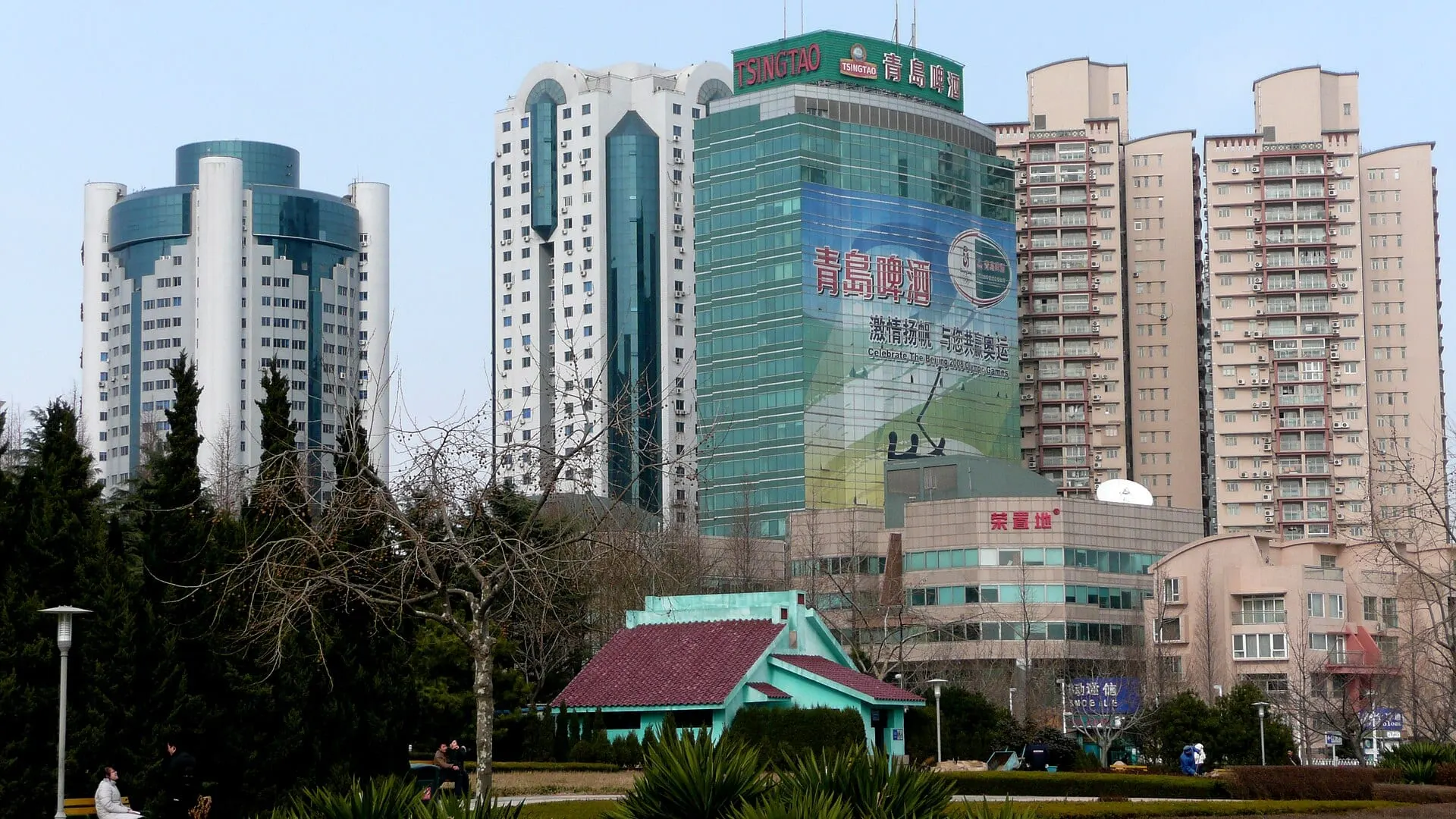
Tsingtao Brewery (Qingdao Beer)
Founded in 1903 by Anglo-German Brewery GmbH under the German colonial administration, Tsingtao is Chinas most famous beer and the citys defining product. The brewery is open to visitors with a museum of beer history, the original German-era brewing hall, and a tasting room. Entry ¥60 includes a glass of fresh beer.
Wikimedia Commons · CC
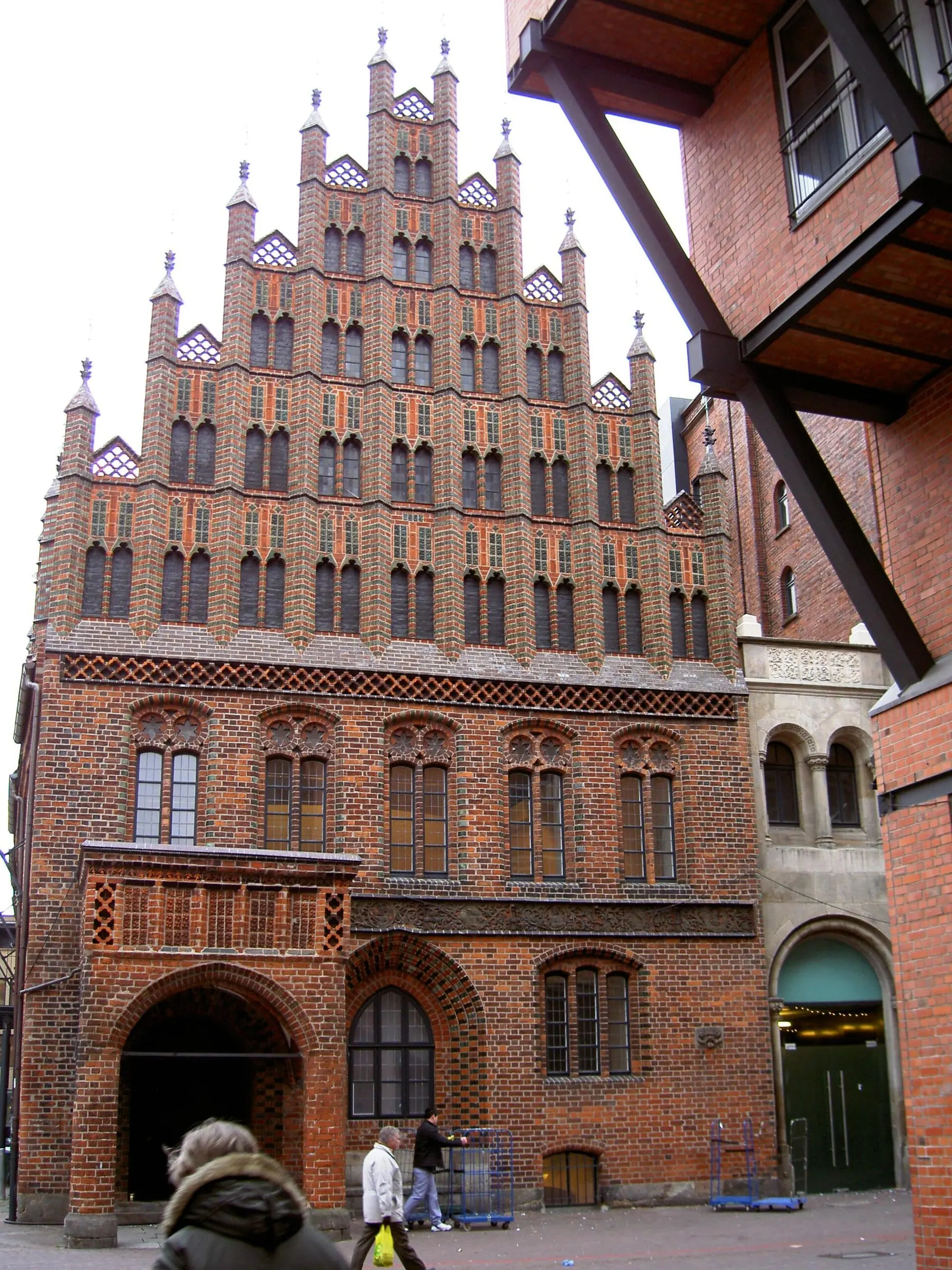
German Old Town (Old Qingdao)
A 2-square-kilometer preserved district of German colonial architecture from 1898-1914, with over 200 protected heritage buildings including the Gothic St. Michaels Cathedral, the Baroque Governor Residence, the German-era Jiao Zhou Prison, and the German Street (Yishan Road) with restored Jugendstil facades. Free to enter; many buildings house museums, cafes, and craft shops.
Wikimedia Commons · CC
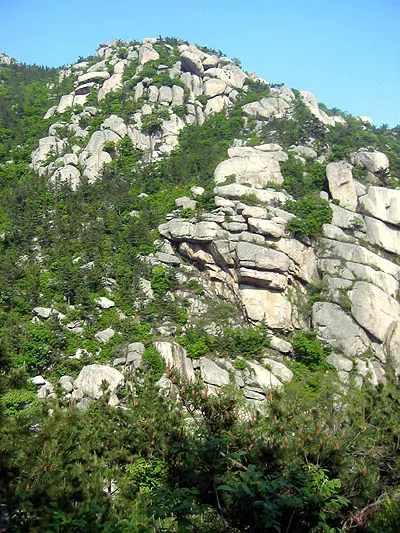
Laoshan Mountain (Lao Shan)
A 1,133-meter coastal mountain range 40 km east of central Qingdao, sacred to Taoism and home to 200+ ancient Taoist temples. Famous for the Taiqing Palace (the largest Taoist temple complex on the Chinese coast), the Jufeng Peak (the highest summit), and the Laoshan Green Tea. Cable car to the summit ¥80-160. Full day for the highlights.
Wikimedia Commons · CC

Eight Great Passes (Ba Da Guan)
A 6-km protected coastal scenic reserve in eastern Qingdao with 8 named promontories and beaches, including the famous No. 2 Beach (Shi Lao Ren, the most photographed beach in China), the Huilan Pavilion (the No. 1 Pass), and the Taiping Hill overlook. Best explored by bike along the dedicated coastal path.
Wikimedia Commons · CC
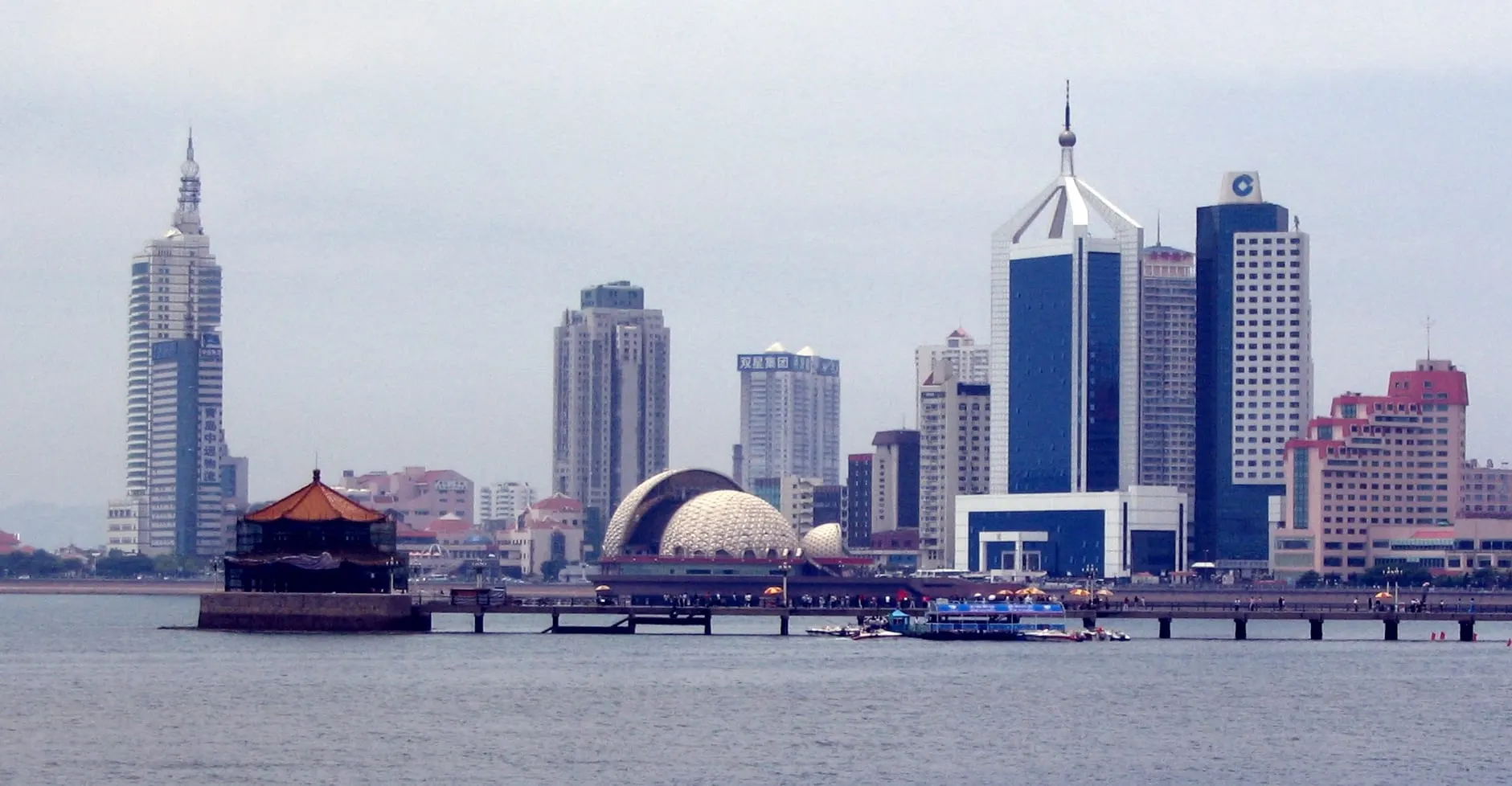
Zhanqiao Pier (Zhan Qiao)
A 440-meter-long pier extending into Jiaozhou Bay, built in 1891 by the Qing governor Zhang Yanfan as the citys first pier. Famous for the Huilan Pavilion (Hui Lan Ge) at the end of the pier, an octagonal Chinese pavilion that is the citys defining landmark. Free to enter; best at sunset when the light catches the bay.
Wikimedia Commons · CC
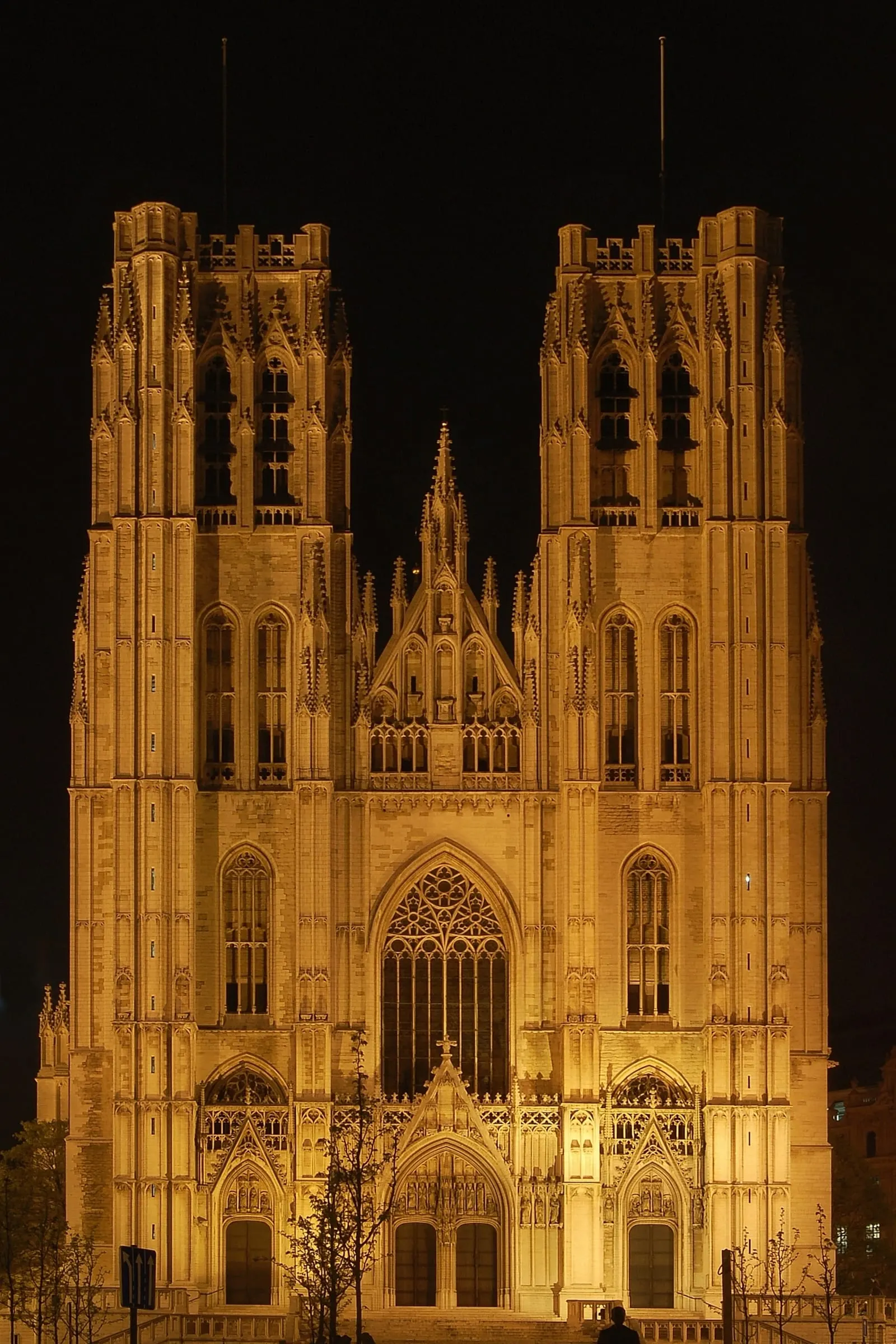
St. Michaels Cathedral (Qingdao Cathedral)
A Roman Catholic cathedral built in 1932-1934 in German Gothic Revival style, with twin 60-meter spires and stained-glass windows imported from Germany. Mass is held in Chinese and English; the cathedral is open to visitors daily. Free entry; donations welcome.
Wikimedia Commons · CC
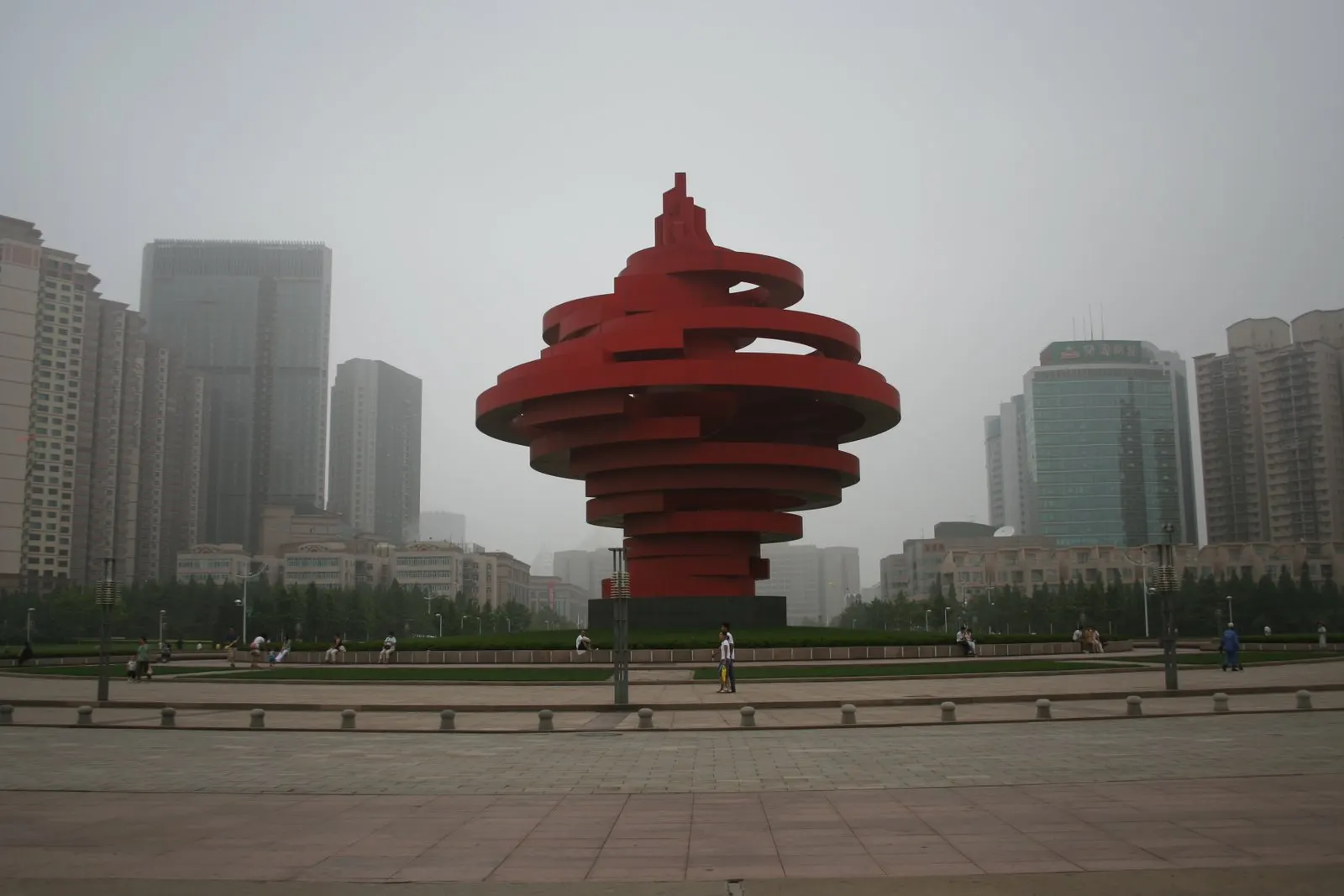
May Fourth Square (Wu Si Guang Chang)
A modern civic plaza in central Qingdao named for the May Fourth Movement of 1919, with the 30-meter-tall Monument to the Wind (May Wind) sculpture by Qingdao sculptor Huang Yongyu. Surrounded by the modern skyline of the central business district and the 270-meter Qingdao Center. Free.
Wikimedia Commons · CC
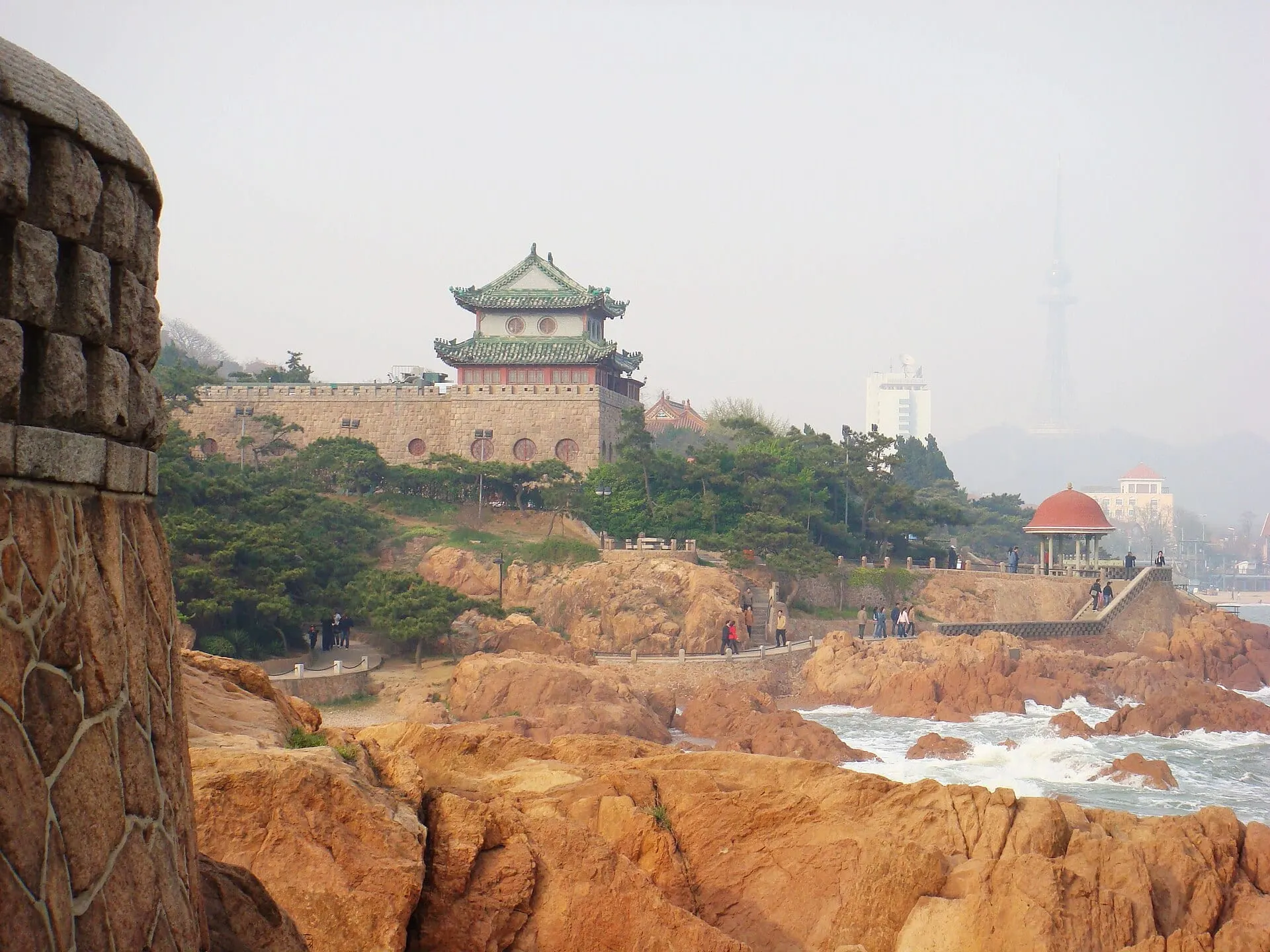
Qingdao Underwater World
A modern aquarium in the No. 1 Beach area, with 100+ species of marine life including whale sharks, sea turtles, and a 90-meter underwater viewing tunnel. Also features dolphin and sea lion shows. Entry ¥150; popular with families.
Wikimedia Commons · CC

Qingdao Beer Festival (Guoji Pijiu Jie)
The largest beer festival in Asia, held annually in late August in the western Shuangyuan Park, with 10+ days of beer tastings, German beer halls, international food vendors, live music, and a parade. Free entry; beer tokens ¥30-50 per glass; expect crowds of 2+ million.
Wikimedia Commons · CC
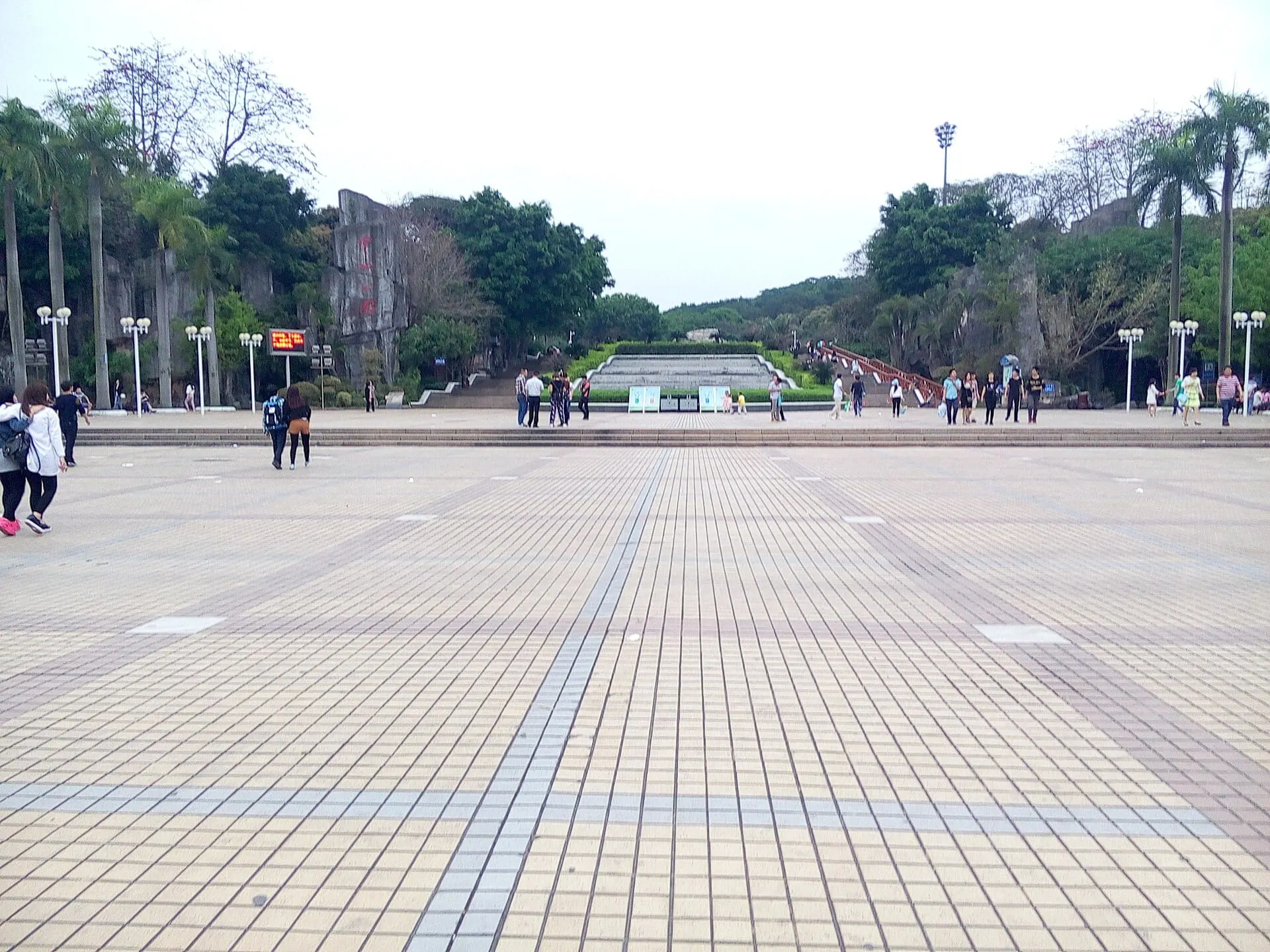
Zhongshan Park (Zhongshan Gongyuan)
A 75-hectare urban park at the foot of Taiping Hill, founded in 1903 by the German colonial administration as the Bismarck Park. Famous for the Cherry Blossom Avenue (2 km of cherry trees planted during the Japanese occupation 1914-1922), the Chrysanthemum Festival in autumn, and the Taiping Hill cable car to the summit. Entry ¥10.
Wikimedia Commons · CC
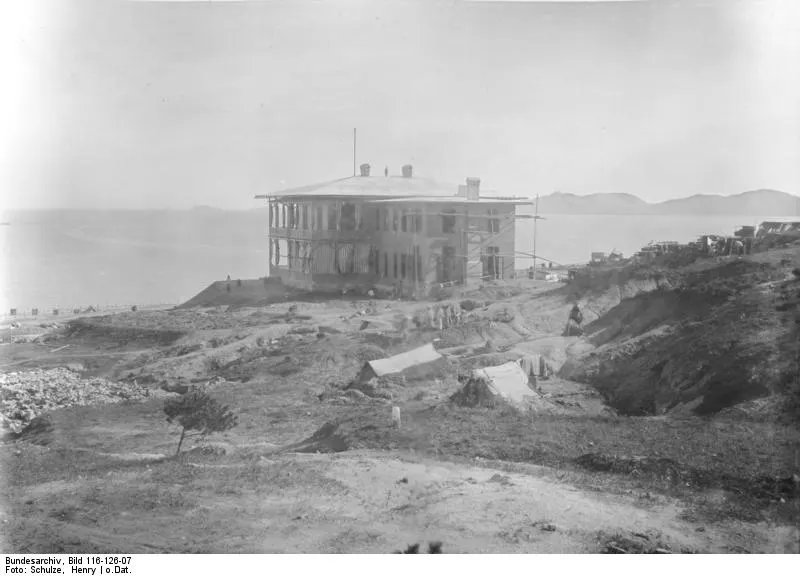
Jiaozhou Governor Residence (Guan Fu)
The 19th-century German Governor Residence and administrative center of the Kiautschou Bay concession (1898-1914), now a museum of German colonial history with original furnishings, archives, and a restored colonial garden. Entry ¥20; combined ticket with the German Prison ¥40.
Wikimedia Commons · CC
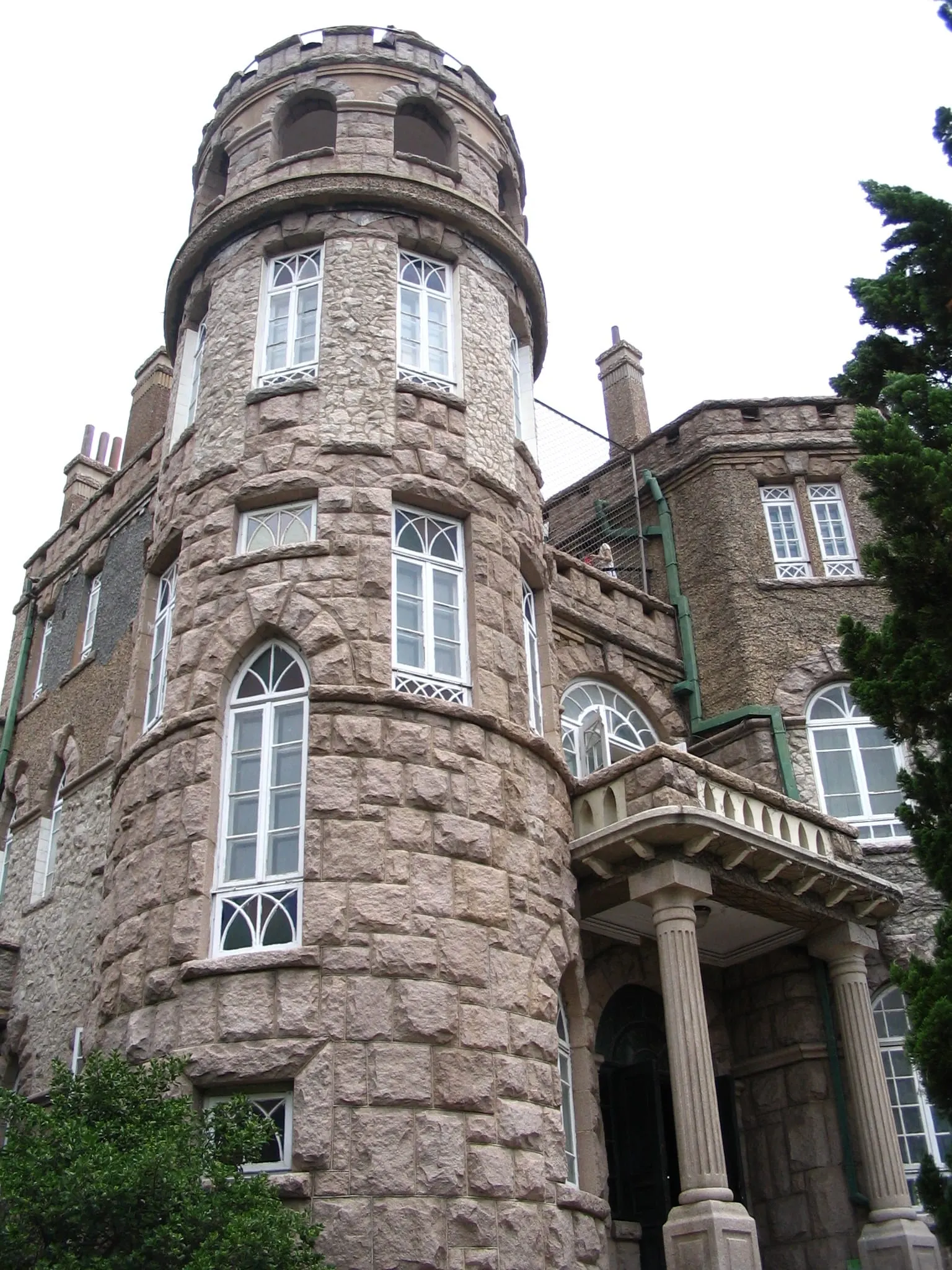
Badaguan Scenic Area
A historic residential district in the Eight Great Passes area featuring 200+ villas built in 8 different national styles in the 1930s (British, French, German, Italian, Spanish, Russian, Japanese, and Chinese). Often called the Worlds Architecture Expo. Best explored by bike or on foot; free to enter.
Wikimedia Commons · CC
Frequently asked questions
- Do I need a visa to visit Qingdao?
- Most Western passport holders (US, UK, EU, Australia, Canada, Japan, South Korea, New Zealand, Singapore) can visit China visa-free for up to 30 days. Qingdao is covered under the same policy. China also offers 240-hour visa-free transit through Qingdao Jiaodong Airport or other major airports if you are continuing to a third country. Check the latest rules with your nearest Chinese consulate before booking, as the policy is updated frequently. Most travelers combine Qingdao with a Beijing or Shanghai trip.
- How many days do I need in Qingdao?
- Three days covers the highlights: one day for the German Old Town and Tsingtao Brewery, a second for the Eight Great Passes and the beaches, a third for Laoshan Mountain. Four days adds the Badaguan Scenic Area, the May Fourth Square, and the Beer Festival in August. Most travelers visit Qingdao on a 3-4 day stopover from Beijing or Shanghai; the city is compact enough that even 2 days is rewarding.
- When is the best time to visit Qingdao?
- May-June and September-October for mild weather and the Tsingtao beer season. August brings the Qingdao International Beer Festival (the largest in Asia) but also the largest crowds. Avoid the first week of October (Golden Week) and the late-January to mid-February Spring Festival. Summer (June-August) is warm and humid but moderated by the Yellow Sea; winter (December-February) is mild but cold at night.
- How do I get from Beijing to Qingdao?
- The Beijing-Qingdao HSR from Beijing South Railway Station to Qingdao North Railway Station (the largest HSR hub) or Qingdao Railway Station (in the city center). Journey time 4 hours, second-class ticket ¥314. Trains run every 10-30 minutes from 6am to 10pm. From Beijing Capital Airport, the airport express to Beijing South plus HSR takes about 4.5 hours. From Shanghai, the HSR takes 6 hours 30 minutes via Jinan (5 hours if you change at Jinan).
- How do I pay for things without a Chinese bank account?
- Foreigners can link a Visa, Mastercard, or American Express to Alipay via the Tour Card feature without a Chinese bank account — set this up before arriving in China through the Alipay app (download, tap Tour Card, verify your passport, add a card). WeChat Pay works similarly with the Pay International feature. Most mid-range and luxury hotels, restaurants, and shops accept both. Cash still works everywhere, especially in the Yunxiao Road Food Street and the seafood market stalls. ATMs from ICBC, Bank of China, and 7-Eleven accept foreign cards.
- Is Qingdao safe for tourists?
- Yes. Qingdao is one of the safest major cities in China, with violent crime against foreigners being very rare. The main risks are petty theft in crowded markets (Yunxiao Road, the Beer Festival), taxi overcharging at the railway stations and the Old Town, and occasional food hygiene issues at the street food stalls. Use DiDi (Chinese Uber) instead of unmarked taxis. The US State Department rates Qingdao at Level 2 (Exercise Increased Caution) for political reasons rather than tourist safety. Women traveling alone report feeling safe day and night in the central districts.
- What is the best local food in Qingdao?
- Spicy stir-fried clams (chao ge zi) is the signature dish, served at dozens of street-side restaurants along Yunxiao Road Food Street. Other Lu cai classics include braised sea cucumber with green onions, steamed prawns with garlic, braised mackerel with fermented soybeans, and seafood dumplings. For street food, Yunxiao Road Food Street and Taidong Pedestrian Street have dumpling stalls, scallion pancake shops, and Wangjie Shaokao BBQ. Chuange Fish Dumplings (founded 1925) and the Kaihai Hongdao Seafood City are the most famous restaurants.
- What is Tsingtao Beer and how is it made?
- Tsingtao Beer is Chinas most famous beer, founded in 1903 by Anglo-German Brewery GmbH under the German colonial administration. The brewery is in central Qingdao and produces around 8 million hectoliters a year, with about 50% exported to over 75 countries. The classic Tsingtao is a pale lager with a crisp, slightly hoppy flavor; it is brewed with Laoshan spring water and a mix of German and Czech hops. The Tsingtao Brewery Museum in Qingdao (¥60 entry) includes the original German-era brewing hall, the museum of beer history, and a tasting room with fresh-from-the-vat beer.
- How does Qingdao compare to Dalian for tourism?
- Both cities are major northern Chinese coastal resorts. Qingdao is famous for its German colonial architecture and Tsingtao Beer; Dalian for its Russian and European architecture, the Xinghai Square, and the Jinshitan beach resort. Qingdao is closer to Beijing (4 hours by HSR); Dalian is closer to the Russian border and Korea (2 hours by HSR to Dandong). Qingdao has the Eight Great Passes coastal scenery and Laoshan Mountain; Dalian has the Bangchui Island and the Tiger Beach Ocean Park. Both have excellent seafood; Qingdaos beaches are slightly more developed for swimming.
- Is Laoshan Mountain worth a day trip?
- Yes — Laoshan is one of Chinas great mountain destinations and the most scenic mountain within a days drive of any Chinese coastal city. The 1,133-meter coastal range is sacred to Taoism and home to 200+ ancient Taoist temples, including the Taiqing Palace (the largest Taoist temple complex on the Chinese coast). Highlights include the Jufeng Peak (the highest summit, with panoramic Yellow Sea views via cable car ¥80-160), the Laoshan Green Tea plantations, and the Laoshan Mineral Water springs. Full day for the highlights; two days for a more thorough exploration. Tours from ¥300 with transport and guide; independent travel via metro line 11 plus bus 304 is cheaper.
- Where should I stay in Qingdao?
- The German Old Town area (Yishan Road and Minjiang Road) is the most atmospheric and the best for first-time visitors. The Shangri-La Hotel Qingdao (¥1,500), the Holiday Inn Qingdao City Center (¥500), and the Qingdao Housing International Hotel (¥600) are popular choices. The Eight Great Passes area east of the Old Town has the international beachfront resorts (Crowne Plaza, Le Meridien, Hilton). For backpackers, the Qingdao International Youth Hostel in the Old Town is the best option at ¥60-120 per bed. Book 2 weeks ahead during the August Beer Festival and Golden Week.
- How much does a trip to Qingdao cost?
- A backpacker can do Qingdao on ¥250-400 per day (hostel bed ¥60-120 + street food ¥30-50 + metro ¥20-30 + attractions ¥100-200). A mid-range budget is ¥700-1,200 (4-star hotel ¥400-700 + sit-down meals ¥100-200 + attractions ¥150-250). A luxury budget starts at ¥2,500 (5-star beach resort ¥1,500+ + fine dining ¥500+ + private guides and tours). A 3-day stopover from Beijing typically costs ¥2,500-5,000 per person excluding the ¥628 round-trip HSR from Beijing.
- Can I visit Qingdao on a cruise stop?
- Yes — Qingdao is one of Chinas major cruise ports and home port to several international cruise lines. Most cruise lines offer Qingdao shore excursions combining the German Old Town, Tsingtao Brewery, the Eight Great Passes, and the Zhanqiao Pier. Cruise passengers with 240-hour Qingdao visa-free transit can independently explore by taxi and metro. Many cruise passengers prefer Qingdao over Shanghai or Beijing because of the slower coastal pace, the German architecture, and the smaller crowds. The Qingdao Cruise Terminal is in the Old Town, walking distance to the Zhanqiao Pier.
- What is Laoshan Green Tea?
- Laoshan Green Tea is a famous Chinese green tea grown on the slopes of the Laoshan Mountain range. The tea is harvested between April and October, with the spring harvest (pre-Ching Ming, before April 5) being the most prized. The tea has a distinctive flavor with a slight sea-salt note from the maritime terroir, with leaves that are flat, smooth, and bright green. The Laoshan Tea Museum (free) is the best place to learn about tea production; family tea houses in the Laoshan village serve tastings for ¥30-80 per session. Laoshan Green Tea prices range from ¥200 to ¥2,000 per kilogram depending on grade and harvest timing.
- Is Qingdao worth visiting with kids?
- Yes — Qingdao is one of the best Chinese coastal cities for families. The beaches (No. 1 Beach, No. 2 Beach, No. 6 Beach, Golden Beach) are clean and well-managed with lifeguards and play areas; the Qingdao Underwater World has whale sharks and a 90-meter underwater viewing tunnel; the Qingdao Fantawild Dreamland theme park has roller coasters and water rides; the Badaguan Scenic Area has bike rentals; and the Laoshan cable car is a thrill. The Beer Festival in August is family-friendly during the day. Hotels routinely provide cribs and rollaway beds.
- What is the Qingdao Beer Festival?
- The Qingdao International Beer Festival is the largest beer festival in Asia, held annually in late August in the western Shuangyuan Park. The 10+ day event features beer tastings from Tsingtao and 30+ international breweries, German beer halls, international food vendors, live music, a parade, and a fireworks finale. Free entry; beer tokens ¥30-50 per glass. The festival draws 2+ million visitors and is one of the most important events on the Chinese tourism calendar. It began in 1991 as a local celebration of Tsingtao Beer and has grown into an international event with sister festivals in Munich and Portland.
- Can I see Qingdao in winter?
- Yes — winter is one of Qingdaos quieter seasons, with mild temperatures (averaging 3°C high, -2°C low in January), rare snowfall, and the beaches almost empty. The German Old Town has a different beauty in winter, with the cobblestone streets dusted with snow and the German cafes serving Gluhwein. Indoor attractions — the Tsingtao Brewery Museum, the St. Michaels Cathedral, the Governor Residence Museum — work well in cold weather. Pack a heavy coat, hat, scarf, and gloves. The seafood restaurants are at their best in winter, with peak clam and oyster season.
- What is the Eight Great Passes (Ba Da Guan)?
- The Eight Great Passes (Ba Da Guan) is a 6-km protected coastal scenic reserve in eastern Qingdao with 8 named promontories and beaches, established during the German colonial period as the diplomatic and military zone. The 8 passes are Huilan (No. 1, with the Huilan Pavilion), Shilaoren (No. 2, the most photographed beach in China), Taiping (No. 3), Fushan (No. 4, with the Fushan Bay 2008 Olympic sailing venue), Taipingjiao (No. 5), Zhanqiao (No. 6), Xiaoyu (No. 7), and Jinmen (No. 8). Best explored by bike along the dedicated coastal path; entry is free but bike rental is ¥20 per hour.
- What is the best time of year to visit Qingdao?
- May-June and September-October are ideal, with warm dry days, cool nights, and thinner crowds than summer. August is peak season because of the Qingdao International Beer Festival, but expect heavy domestic crowds and higher hotel rates. Late January to mid-February (Spring Festival) and the first week of October (Golden Week) are best avoided. Summer is humid but sea-breezed; winter is mild, with daytime highs around 3°C in January.
- How do I get from Qingdao Jiaodong International Airport to the city center?
- Qingdao Jiaodong International Airport (TAO) sits 39 km northwest of the center. Metro Line 8 connects the airport to central Qingdao in roughly 50-60 minutes. The airport shuttle bus runs about 60 minutes to the main city stops. A taxi or DiDi takes 60-75 minutes and costs ¥150-200. Allow 90 minutes total between bags, transit, and traffic, especially during the August Beer Festival or Golden Week rush.
- What is the Tsingtao Brewery Museum and is it worth visiting?
- The Tsingtao Brewery Museum (¥60) occupies the original 1903 Anglo-German Brewery site in central Qingdao and traces the story of Chinas most famous beer. You walk through the historic brewing hall, red-brick fermentation tanks, vintage bottling lines, and advertising archives, then finish with a fresh-from-the-vat pour in the tasting room. Allow 90 minutes. It pairs naturally with the German Old Town and Beer Street restaurants nearby — worth it for anyone curious about Qingdaos defining brand.
- What is the Badaguan Scenic Area and why should I visit?
- Badaguan, inside the Eight Great Passes reserve, is a leafy historic villa district where 200+ mansions were built in the 1930s in eight distinct national styles — British, French, German, Italian, Spanish, Russian, Japanese, and Chinese — earning it the nickname Worlds Architecture Expo. Tree-lined lanes, walled gardens, and quiet cobblestone make it Qingdaos most photogenic neighborhood. Walk or cycle the grid; entry is free, and its at its best in autumn foliage or spring blossom season.
- Can I do a day trip to Mount Lao (Laoshan) from Qingdao?
- Yes. Laoshan sits 40 km east of central Qingdao and is doable as a full-day trip via Metro Line 11 plus bus 304, or a tourist coach from the Qingdao Tourism Distribution Center (¥60-100 round trip). Plan to hit the Taiqing Palace (the largest Taoist temple complex on the Chinese coast), ride the cable car to Jufeng Peak for Yellow Sea panoramas, and stop at a Laoshan Green Tea farmhouse. Return to the city by early evening.
- What is the must-try food in Qingdao?
- Spicy stir-fried clams (chao ge zi) lead the menu — wok-tossed with garlic, ginger, soy, and Sichuan peppercorn at dozens of stalls on Yunxiao Road Food Street. Add braised sea cucumber with scallions, garlic steamed prawns, mackerel with fermented soybeans, and seafood dumplings at Chuange Fish Dumplings (founded 1925). Street snackers should hunt scallion pancakes, Wangjie BBQ skewers, and roast squid (kao you yu). Wash it all down with fresh Tsingtao, often served cold in a plastic bag.
- Is Qingdao worth visiting in winter?
- Yes, if you prefer quiet streets and lower prices. January averages a daytime high of 3°C and a low of -2°C, with rare snow that lightly dusts the cobblestones of the German Old Town. Indoor draws — the Tsingtao Brewery Museum, St. Michaels Cathedral, the Governor Residence Museum — work year-round. Beaches empty out, hotels drop to shoulder-season rates, and the seafood restaurants peak for winter clams and oysters. Pack a heavy coat, hat, scarf, and gloves.
- Which are the best beaches in Qingdao, ranked?
- No. 2 Beach (Shi Lao Ren, also called Second Beach) is the most photographed beach in China and the best all-rounder — wide golden sand, gentle waves, lifeguards in summer, showers and changing rooms, and the Badaguan villa district as a backdrop. No. 1 Beach (Huiquan Bay) is the closest to the Old Town, the busiest, and best for people-watching but can feel crowded in July and August. No. 6 Beach (Zhanqiao Beach) sits right next to Zhanqiao Pier, framed by the Old Town skyline, and is best for sunset photos rather than swimming. Golden Beach (Jin Sha Tan) in the Huangdao District across the bay is the longest at 3.5 km, with the softest sand and fewer crowds, but requires a 30-minute taxi ride through the Jiaozhou Bay tunnel. Silver Beach (Yin Sha Tan) sits next to Golden Beach and is even quieter. Shi Lao Ren Beach (distinct from the named No. 2) is a surfing spot east of the city center with stronger waves. For swimming, stick to No. 1, No. 2, or Golden Beach between late June and early September when the water is warmest (22–25°C). Most beaches are free; a few charge ¥10–30 in peak season for showers and lockers.
- What is the best walking route for Qingdao's German colonial architecture?
- Start at Qingdao Railway Station (itself a 1901 German building with a clock tower and red-tiled roof), then walk east along Taiping Road to the Zhanqiao Pier for the Huilan Pavilion view. Head north up Zhongshan Road to the St. Michaels Cathedral (corner of Zhejiang Road and Qufu Road) — the twin-spired 1934 Gothic church is the centerpiece. From the cathedral, walk east along Hubei Road to the former German Governor's Residence (Guan Fu) on Longshan Road, a Baroque mansion built 1905–1907 with a restored colonial garden. Continue northeast to Yishan Road (German Street), the best-preserved stretch, with cobblestones, Jugendstil facades, craft-beer bars, and sidewalk cafes housed in restored German-era buildings. From Yishan Road, walk east to the former Jiao Zhou Prison on Changzhou Road, which now houses a museum. End the walk at the Tsingtao Brewery on Dengzhou Road, roughly 15 minutes northeast of the prison, for a fresh beer in the original 1903 brewing hall. The full route is about 4 km and takes 3–4 hours at a relaxed pace with stops. Pick up the free German Architecture Walking Map from the Old Town tourist information center on Zhongshan Road.
- Where are the best seafood streets and night markets in Qingdao?
- Yunxiao Road Food Street (Yunxiao Lu) in the Shinan District is the city's most famous seafood strip — roughly 1 km of restaurants and street stalls specializing in spicy stir-fried clams (chao ge zi), garlic steamed prawns, braised sea cucumber, and the Qingdao-style BBQ squid (kao you yu). Most stalls cook to order from tanks of live seafood; point at what you want and agree on a price before they cook. Taidong Pedestrian Street (Taidong San Lu) in the Shibei District is the city's largest night market, with 200+ food stalls, skewer vendors, scallion pancake shops, and beer stands serving fresh Tsingtao in plastic bags — the traditional local takeaway method. The Beer Street (Pijiu Jie) near the Tsingtao Brewery on Dengzhou Road has a dozen open-air seafood restaurants that pair grilled oysters, clams, and prawns with fresh-from-the-vat Tsingtao. For a sit-down meal, Chuange Fish Dumplings (founded 1925, multiple locations) serves the city's most famous seafood dumplings, and the Kaihai Hongdao Seafood City operates market-style — you pick live seafood from tanks at market price and the kitchen cooks it to order. Minjiang Road near the Old Town has a cluster of mid-range Lu cai seafood restaurants with English-picture menus. Budget ¥60–150 per person for a full seafood meal with beer.
- What is there to see at May Fourth Square and the Olympic Sailing Center?
- May Fourth Square (Wu Si Guang Chang) is Qingdao's central civic plaza, named for the 1919 May Fourth Movement that began partly in protest of the Treaty of Versailles handing German rights in Shandong to Japan. The centerpiece is the 30-meter-tall Monument to the Wind (May Wind), a spiraling red steel sculpture by Qingdao artist Huang Yongyu that has become the symbol of modern Qingdao. The square faces Fushan Bay and is flanked by the modern CBD skyline, including the 270-meter Qingdao Center. From the square, walk east along the waterfront promenade for 10 minutes to the Qingdao Olympic Sailing Center, the venue for the 2008 Beijing Olympics sailing regatta. The marina still operates, with 700+ berths, a yacht club, and a sailing museum. You can book a 40-minute sailing trip on a J/80 keelboat from the marina for ¥200–300 per person, or simply walk the breakwater for views of the bay and the modern skyline. The Olympic Sailing Center is also the starting point for the Fushan Bay coastal walk, a 3-km paved path connecting to the Eight Great Passes. Both the square and the sailing center are free, open 24 hours, and best visited at sunset when the light catches the bay and the skyscrapers. The area has several waterfront cafes and a craft beer taproom with terrace seating.
- How do I hike Laoshan Mountain — what are the best trails and routes?
- Laoshan has three main hiking zones. The Taiqing Palace zone (southern slope) is the most popular and the easiest: a mostly paved, gently graded path connects the Taiqing Palace (the largest Taoist temple complex on the Chinese coast, ¥27) to the Longtan Waterfall and the Shangqing Palace, with the Laoshan Green Tea terraces on either side. Allow 2–3 hours for the full circuit; it is suitable for all fitness levels. The Jufeng Peak zone (central summit area) is accessed by cable car (¥80 round-trip, ¥160 for the higher summit extension) and has a 1-hour summit loop with panoramic views over the Yellow Sea, Qingdao city, and on clear days as far as the Korean Peninsula. The Beijiushui zone (northern valley) is a river-valley hike following the Nine Waters (Jiu Shui) stream through 18 pools and waterfalls, best in late summer when the water is flowing. Allow 3–4 hours one way; it is moderately steep in sections. The full traverse from the Taiqing Palace to Jufeng Peak and down to Beijiushui takes 8–10 hours and requires a good fitness level; most hikers do one zone per day. Trail maps are posted at the park entrance but are mostly in Chinese; download a GPS track beforehand. The park entrance fee is ¥130 (peak season April–October) or ¥100 (off-peak November–March), which covers all three zones for one day. Start early — the park gates open at 6am and the cable car stops running at 5pm. Bring water, snacks, and sun protection; there are limited vendors beyond the main temple zones.
- What is a good family itinerary for Qingdao with children?
- Day 1 — Old Town and Underwater World: Start at Zhanqiao Pier (kids love walking out over the water), then visit the Qingdao Underwater World (¥150, the 90-meter transparent tunnel with sharks and rays overhead is the highlight; dolphin shows run at 10:30am, 1pm, and 3pm). Lunch at a family-friendly restaurant on Minjiang Road. In the afternoon, walk the flat, stroller-friendly section of the German Old Town — Yishan Road and the cathedral square — and end with ice cream at a German-style cafe. Day 2 — Beaches and Badaguan: Spend the morning at No. 2 Beach (Shi Lao Ren), the most family-friendly with gentle waves, lifeguards, clean sand, and showers. Rent a family bike (four-wheel surrey, ¥40 per hour) on the Badaguan coastal path. Lunch at a beachfront cafe. In the afternoon, ride the Taiping Hill cable car (¥100 round-trip) for city and sea views without the long hike. Day 3 — Laoshan by cable car: Take metro line 11 to the Laoshan visitor center and ride the Jufeng cable car (¥80) to the summit for panoramic views with minimal walking required. Visit a Laoshan Green Tea farmhouse for a tea-picking demonstration (children can participate). Return by mid-afternoon. If you have a fourth day and visit in August, spend the morning at the Beer Festival (family-friendly during the day with carnival rides and non-alcoholic stands) and the afternoon at Qingdao Fantawild Dreamland in Huangdao. Hotels in the Eight Great Passes area (Crowne Plaza, Le Meridien) have connecting rooms and kids' menus; the Shangri-La has a children's pool. Strollers work well in the Old Town, Badaguan, and on the metro, but cobblestones on Yishan Road and the Laoshan trails are challenging.
- How do I get from Qingdao to other Shandong cities?
- Jinan (the provincial capital, 400 km west) is the most popular connection: the HSR from Qingdao North or Qingdao Station takes 1 hour 30 minutes (¥120 second class) with 30+ daily services, or 2 hours 15 minutes on conventional trains (¥55). Jinan is famous for its 72 springs including Baotu Spring, Daming Lake, and the Thousand Buddha Mountain. Yantai (200 km north on the peninsula's northern coast) is reached by HSR in 1 hour 15 minutes (¥80 second class); it has the Changyu Wine Culture Museum (China's oldest winery, founded 1892), the Penglai Pavilion, and Yangma Island beach. Weihai (300 km northeast, at the peninsula's eastern tip) takes 1 hour 45 minutes by HSR (¥100); it is a smaller, quieter coastal city with Liugong Island and the Sino-Japanese War Museum. Weifang (250 km west) is the kite capital of China; HSR takes 1 hour (¥65) and the Weifang International Kite Festival runs in late April. Qufu (the hometown of Confucius, 450 km southwest) takes about 2 hours 30 minutes by HSR with a transfer at Jinan (¥160 total); it has the Temple of Confucius (UNESCO), the Confucius Family Mansion, and the Confucius Forest cemetery. Rizhao (120 km south) is a smaller beach city served by HSR in 45 minutes (¥45). For all Shandong HSR trips, book tickets on Trip.com or at the station; second class is comfortable enough for these short legs. Long-distance buses depart from the Qingdao Long-Distance Bus Station near Qingdao North Station and serve every Shandong city, but HSR is faster, more comfortable, and only marginally more expensive.
- Is there a ferry from Qingdao to Dalian or South Korea?
- There is no direct Qingdao–Dalian passenger ferry. The closest Dalian ferry departs from Yantai (200 km north of Qingdao, 1 hour 15 minutes by HSR) and takes 7 hours overnight to Dalian (¥200–600 depending on cabin class). Another option is the Weihai–Dalian ferry, which takes 7–8 hours. For South Korea, Qingdao has direct international ferries to Incheon (Seoul) operated by Weidong Ferry, taking 14–16 hours and costing roughly ¥800–1,200 one way for a four-berth cabin. A second operator, the Korea-China International Ferry, runs between Qingdao and Incheon on a slightly different schedule. There is also a Qingdao– Gunsan (Kunsan) ferry on Korea's west coast. These ferries are popular with Korean tourists visiting Shandong and with Chinese tourists heading to Korea; book through a travel agency or directly at the Qingdao International Ferry Terminal near the Old Town. If your goal is Dalian, flying is usually faster: Qingdao to Dalian flights take 1 hour and cost ¥400–800 one way on Shandong Airlines or China Eastern, with 10+ daily departures.
- How English-friendly is Qingdao for foreign travelers?
- English is moderately available in Qingdao — better than in most second-tier Chinese cities but not as widespread as in Beijing or Shanghai. Hotels from 4-star upward have English-speaking front-desk staff and English signage. The major attractions (Tsingtao Brewery Museum, St. Michaels Cathedral, Governor Residence Museum, Qingdao Underwater World) have English audio guides, English signage, or English-speaking ticket counters. The metro has full English signage and announcements for station names and transfers. Restaurants in the Old Town and Badaguan areas often have picture menus with English translations; seafood stalls on Yunxiao Road mostly do not, so bring a translation app. Taxi drivers rarely speak English — have your destination written in Chinese characters or use DiDi, where you can type the destination in English and the app translates for the driver. Tour guides who speak English can be hired through the Qingdao Tourism Distribution Center or via Ctrip (Trip.com) for ¥500–800 per day. The Tsingtao Brewery offers English-language guided tours at 10am and 2pm daily (book at the ticket counter). Laoshan has limited English signage but the cable car and main temple zones have enough to navigate. Download Pleco or Google Translate with the Chinese offline pack before arrival; it will bridge every gap.
- What should I pack for a Qingdao trip?
- Pack for a coastal city with a temperate climate and 730 km of coastline. Comfortable walking shoes are the single most important item — you will walk extensively in the Old Town, along the Eight Great Passes, and on Laoshan trails. Bring layers: a light jacket or sweater for evenings even in summer, when sea breezes can make the waterfront chilly after sunset. For summer (June–August), pack light clothing, a wide-brimmed hat, sunscreen (SPF 30+), sunglasses, and swimwear. The sun on the beach and the Laoshan trails is strong. For spring (March–May) and autumn (September–November), bring a mid-weight jacket, long pants, and a scarf for windy days along the coast. For winter (December–February), bring a heavy coat, scarf, hat, and gloves; indoor heating is universal but outdoor sightseeing is cold. Year-round items: a compact umbrella (sudden rain showers are common), a reusable water bottle, a universal power adapter (Type A, C, or I, 220V), and your passport (required for hotel check-in and train tickets). A light scarf or buff is useful for the occasional dust storm in March and April. Mosquito repellent is helpful in summer, especially around the Laoshan tea terraces and the Badaguan greenery.
- What are the best photo spots in Qingdao?
- The Huilan Pavilion at the end of Zhanqiao Pier is the classic postcard shot — arrive at sunrise (5am in summer) for the pavilion silhouetted against the dawn sky with no crowds. The red-tiled roofs of the Old Town are best photographed from the bell tower of St. Michaels Cathedral (climb the tower for ¥10) or from the rooftop terrace of the Qingdao Post Office Museum on Zhongshan Road. The Badaguan villa district delivers European-style shots of 1930s mansions under plane-tree canopies; visit in autumn (late October to mid-November) when the gingko and maple trees turn gold and red. The Eight Great Passes coastal path yields sea-and-cliff compositions, especially at the Huilan Pass (No. 1) and the Taipingjiao promontory (No. 5) at sunset. The Laoshan summit (Jufeng Peak) offers panoramic views of the Yellow Sea on clear days, best photographed in the early morning before haze builds. The Tsingtao Brewery's original red-brick fermentation hall and copper kettles make strong interior shots; the museum allows photography without flash. May Fourth Square is best photographed at blue hour (30 minutes after sunset) with the Monument to the Wind illuminated and the CBD skyline reflected in Fushan Bay. The Qingdao Olympic Sailing Center marina looks best at sunset with yachts in the foreground and the skyline behind. The Jiaozhou Bay Bridge (36.5 km, one of the world's longest sea bridges) can be photographed from the Huangdao shore near Golden Beach or from a boat tour of the bay.
- How do I get a SIM card and set up internet access in Qingdao?
- Buy a China Unicom or China Mobile tourist SIM at Qingdao Jiaodong International Airport's arrivals hall for ¥80–150, with 10–30 GB of data valid for 7–30 days. Bring your passport — SIM cards are tied to your identity document by law. Both China Unicom and China Mobile have counters in the domestic arrivals area; staff speak basic English. eSIM is supported on most modern iPhones and recent Android phones; China Unicom sells eSIM plans for tourists at the airport counter. If you miss the airport desk, China Mobile and China Unicom retail stores in the city center (look for their logos on Zhongshan Road and Minjiang Road) sell tourist SIMs but may have less English support than the airport. A VPN is essential to access Google, Gmail, Facebook, Instagram, WhatsApp, YouTube, and most Western news sites — install and test it before you depart for China, as VPN provider websites are blocked once you arrive. Public Wi-Fi exists in hotels, airports, and some cafes but is unreliable and often requires a Chinese phone number for SMS verification. Hotel Wi-Fi is generally fast and stable but still subject to the Great Firewall; your VPN works on hotel Wi-Fi. Mobile data coverage is excellent throughout Qingdao city, the beaches, and along the Laoshan access roads, but drops to patchy in the Laoshan mountain valleys. Download offline maps (Maps.me or Google Maps with offline area) before heading to Laoshan or rural areas.
- Is it safe to swim at Qingdao's beaches?
- Yes, with caveats. The main swimming beaches — No. 1 Beach (Huiquan Bay), No. 2 Beach (Shi Lao Ren), and Golden Beach (Jin Sha Tan) — are clean, have lifeguards in summer (late June to early September), designated swimming zones marked by buoy lines, and shower and changing facilities. Water quality is tested regularly during the summer season and results are posted on boards at beach entrances. Swimming outside the designated summer season is not recommended: there are no lifeguards, and the water temperature drops below 18°C by late September. The best swimming months are July and August, when the water reaches 22–25°C. Currents are generally mild on the main beaches, but Golden Beach has occasional rip currents at the eastern end — swim in the central zone where lifeguards are stationed. Avoid swimming at unpatrolled beaches (Silver Beach, the rocky coves east of Badaguan, and the beaches near the Jiaozhou Bay industrial area). Jellyfish appear in late August and September; lifeguards post warnings when they are present. After rainstorms, water quality can degrade for 24–48 hours due to urban runoff. Wear water shoes on No. 1 Beach, which has pebbly patches near the shoreline. All major beaches are free to enter; showers and lockers cost ¥10–30.
- What is Qingdao's craft beer and nightlife scene beyond the Tsingtao Brewery?
- Qingdao's craft beer scene has grown significantly since 2015 and now includes a dozen small breweries and taprooms. The Lanshan Brewery (Lanshan Jingniang) in the Old Town brews IPAs, stouts, and wheat beers in small batches, with a taproom on Yishan Road in a restored German building. Slow Boat Brewery, originally a Beijing craft pioneer, operates a Qingdao taproom near the May Fourth Square with 12 taps and a terrace overlooking Fushan Bay. The Beer Street (Pijiu Jie) cluster near the Tsingtao Brewery has several basement-level craft bars that have opened in the last five years, pouring local microbrews alongside the fresh Tsingtao. Qingdao Beer Box is a shipping-container beer garden on the No. 2 Beach boardwalk, open May through October, pouring Tsingtao and a rotating craft selection. For nightlife beyond beer, the Minjiang Road bar strip near the Old Town has cocktail bars, live-music venues, and Korean-style noraebang (karaoke rooms). The May Fourth Square area has several rooftop bars in the CBD towers with city-and-sea views, including the Sky Bar at the Shangri-La and the InterContinental's lounge. The Huangdao university district has a younger, student-driven nightlife scene with cheap beer bars and BBQ joints. Most bars open from 5pm until 1–2am; last call is typically midnight on weeknights and 2am on weekends. A craft beer costs ¥35–60; a cocktail ¥50–90. Nightlife is concentrated in the Shinan District and is safe to walk between venues.
- What does the Tsingtao Brewery Museum tour include, and is it worth the entry fee?
- The Tsingtao Brewery Museum (¥60-90 depending on ticket type) occupies the original 1903 Anglo-German Brewery buildings on Dengzhou Road in central Qingdao. The standard ticket (¥60) includes a self-guided walk through three buildings: Building A (the centennial history hall, with original copper kettles, vintage bottles, advertising posters from the 1920s-1940s, and photographs of the German colonial brewing team), Building B (the production line — a glass-walled corridor overlooking the active bottling line that fills 60,000 bottles per hour), and the Tasting Room (one glass of fresh-from-the-vat Tsingtao draft, plus a small packet of beer nuts). The premium ticket (¥90) adds a second pour of Tsingtao's unpasteurised "raw" beer (原浆, yuanjiang, available only at the brewery) and a souvenir glass. The guided tour (¥120, English available at 10:00 and 14:00) adds a 45-minute guide-led walk with more depth on the German engineering, the Japanese occupation-era management, and the post-1949 nationalisation. Allow 90 minutes for the standard visit, 2 hours for the guided tour. The museum is well-designed, informative, and genuinely interesting — not just a corporate showroom. The original 1903 copper brewing kettles are the highlight, still gleaming after 120+ years. The museum shop sells Tsingtao merchandise (T-shirts ¥80-150, glassware ¥30-80, bottled gift sets ¥100-300) and is one of the best places in Qingdao for beer souvenirs. The on-site Tsingtao Brewery restaurant serves German-style sausages, pork knuckle, and fresh beer (¥80-150 per person), and the Beer Street (Pijiu Jie) just outside the brewery gate has a dozen open-air seafood-and-beer restaurants. The museum is a 10-minute walk from the Old Town and pairs naturally with a morning visit followed by lunch on Beer Street.
- What is Little Qingdao Island and how do I visit it with Zhanqiao Pier?
- Little Qingdao Island (小青岛, Xiao Qingdao) is a small, pine-covered island in Qingdao Bay connected to the mainland by a 300-metre causeway, just 1.5 km southeast of Zhanqiao Pier. The island is famous for its white 15-metre lighthouse built by the Germans in 1900 (still operational), its views back toward the Zhanqiao Pier and the Old Town skyline, and its quiet pine-shaded walking paths. Entry is ¥15. The island is small — you can walk the full perimeter in 20 minutes — but the real draw is the view: from the island's southern tip, you get the classic postcard angle of the Zhanqiao Pier and Huilan Pavilion framed against the Old Town and the modern skyline, a view you cannot get from the pier itself. The best time to visit is late afternoon (15:00-16:30), when the sun is behind you for photos of the city, or at sunset when the lighthouse begins its nightly signal flash. Combine it with Zhanqiao Pier for a 2-hour coastal walk: start at Zhanqiao Pier, walk the full 440 metres to the Huilan Pavilion, return to shore, then walk 15 minutes southeast along the coastal promenade (Taiping Road) to the Little Qingdao causeway. The causeway can flood at extreme high tides — check tide tables if the sea looks rough. The island has a small cafe, clean restrooms, and benches with sea views. It is far less crowded than Zhanqiao Pier and is one of the most peaceful spots in central Qingdao. There is also a small Navy Museum (¥50) adjacent to the causeway entrance, displaying decommissioned Chinese warships, submarines, and naval aircraft that you can board — a hit with children and military-history buffs.
- What is the best day trip to Penglai from Qingdao?
- Penglai (蓬莱), 200 km north of Qingdao on the Bohai Strait, is famous for the Penglai Pavilion (蓬莱阁), one of China's four great ancient pavilions, and its association with the legend of the Eight Immortals crossing the sea. Take the HSR from Qingdao North or Qingdao Station to Penglai Station: 1 hour 15 minutes (¥80, 5-8 daily trains). From Penglai Station, a 15-minute taxi (¥20-30) takes you to the Penglai Pavilion scenic area. The pavilion complex sits on a cliff above the Bohai Sea and includes the main pavilion (a two-story Song-dynasty-style wooden building with sweeping sea views), the Sanqing Hall (a Taoist temple), the Tianhou Palace (a Mazu temple), and the Penglai Water City, a Ming-dynasty naval fortress with restored walls and a small maritime museum. Entry is ¥140 for the combined ticket. Allow 3-4 hours for the full complex. The pavilion is most famous for the occasional "Penglai mirage" — an optical illusion where the sea, islands, and sky merge into a floating-city effect, most likely on calm, hazy mornings in May and June. It is rare and unpredictable, but the pavilion is worth visiting regardless. After the pavilion, walk 15 minutes east to the Penglai Polar Ocean World (¥190, a large aquarium with beluga whales, penguins, and a 100-metre underwater tunnel), or visit the Sanxian Mountain scenic area (三仙山, ¥120), a landscaped park built around the Three Immortals myth. Return trains to Qingdao run until roughly 20:00, giving you a full day. Lunch at one of the seafood restaurants along the Penglai waterfront (fresh clams, scallops, and local Bohai prawns, ¥60-120 per person). The HSR makes Penglai an easy day trip, and the combination of history, mythology, and sea views makes it one of the best excursions from Qingdao.
- What are the main Taoist temples on Laoshan and how do I visit them?
- Laoshan has three main temple zones accessible from the Qingdao side. The Taiqing Palace (太清宫, ¥27) on the southern slope is the largest and most important — a sprawling Taoist temple complex founded in the Western Han dynasty (140 BCE) and rebuilt in the Song, Yuan, and Ming dynasties. The palace has three main halls (the Sanqing Hall for the Taoist trinity, the Sanhuang Hall for the Three Sovereigns, and the Guanyin Hall), a 2,100-year-old cypress tree planted during the Han dynasty, the "Divine Water Spring" (a mountain spring piped into a stone basin, said to have medicinal properties), and a small Taoist museum. Allow 1.5-2 hours. The Shangqing Palace (上清宫, included in the Laoshan entry ticket) sits higher on the mountain at roughly 600 metres elevation and is smaller, quieter, and reached by a 40-minute uphill walk through bamboo groves from Taiqing Palace. It has a single main hall, a 1,000-year-old ginkgo tree, and views down to the sea. The Mingxia Cave (明霞洞) nearby is a natural cave-temple where Taoist hermits lived for centuries. The Taiqing and Shangqing Palaces connect via a well-paved path and can be visited together in half a day. The Huayan Temple (华严寺, included in the ticket) on the eastern slope is a Buddhist temple rather than Taoist, built during the Qing dynasty, but is part of the same scenic area and has a famous 7-metre stone Guanyin statue and a view over the sea. The Laoshan Taoist temples are working religious sites — you will see Taoist priests in traditional robes, hear morning chanting (around 06:30-07:00), and see worshippers burning incense and making offerings. Dress modestly (shoulders and knees covered), do not photograph priests without permission, and step over thresholds rather than on them. The temples are busiest on the first and fifteenth of each lunar month. The best temple-visiting strategy: arrive at Taiqing Palace by 08:00 to see the morning rituals before the tour buses arrive, hike up to Shangqing Palace for the quieter mountain temple experience, and be back at the Laoshan visitor centre by early afternoon.
- Where is the best coffee and cafe culture in Qingdao?
- Qingdao has the most developed cafe culture of any Chinese coastal city outside Shanghai, driven by its German coffeehouse legacy, its Korean expatriate community, and a strong local independent cafe scene in the Old Town and Badaguan. The best concentration is on Yishan Road (German Street) and the surrounding lanes: a dozen cafes occupy restored German-era buildings with cobblestone courtyards, wooden beams, and outdoor terraces. Standouts include: Kafuka (a small specialty roaster pouring single-origin Chinese Yunnan and Ethiopian beans, ¥30-50 for a pour-over), La Vie Coffee (a French-Korean bakery-cafe with excellent croissants and a terrace overlooking a German villa garden), and the Goethe Cafe (inside a restored 1905 German building with original stained-glass windows and a library of German and English books). In the Badaguan villa district, several cafes occupy 1930s mansions: the Spring Cafe occupies a restored British-style villa on Zijingguan Road with a rose garden terrace, and the Coffee Island roastery on Shanhaiguan Road has a tree-shaded courtyard. The May Fourth Square area has modern specialty chains: % Arabica (the Kyoto-based brand, on the waterfront promenade near the Olympic Sailing Center), Manner Coffee (a Shanghai specialty chain with a kiosk on the square), and the Starbucks Reserve overlooking Fushan Bay. The Korean coffee influence is visible in the Chengyang District (north of the city centre), where Korean-style "cafe-bakeries" serve bingsu (shaved ice), dalgona coffee, and Korean pastries — authentic but out of the way for most tourists. A Qingdao coffee costs ¥25-45 for a latte, ¥35-60 for a single-origin pour-over. Most Old Town cafes open from 09:00 to 21:00 and have English menus. The cafe scene is one of Qingdao's underrated pleasures and the best way to rest between sightseeing stops in the Old Town and Badaguan.
- What are the best seafood restaurants in Qingdao by budget tier?
- Budget (¥30-80 per person): Yunxiao Road Food Street (云霄路美食街) is the go-to — dozens of casual seafood restaurants and street stalls where you point at live seafood in tanks, agree on a price, and the kitchen cooks it to order. Specialities: spicy stir-fried clams (chao ge zi, ¥25-40), garlic steamed prawns (¥40-60 per plate), and BBQ squid (kao you yu, ¥15-25). Wangjie Shaokao on Yunxiao Road is the most popular BBQ skewer stall. Chuange Fish Dumplings (船歌鱼水饺, multiple locations) is the city's most famous seafood dumpling chain, founded 1925, with a plate of 12 mixed dumplings for ¥35-55 — sit at the counter and watch the dumplings being made. Mid-range (¥80-200 per person): The Beer Street (Pijiu Jie) cluster near the Tsingtao Brewery has a dozen open-air seafood restaurants that pair grilled oysters, clams, prawns, and whole fish with fresh-from-the-vat Tsingtao. Jingkelong (京客隆) on Minjiang Road is a reliable mid-range Lu cai restaurant with an English picture menu, built around braised sea cucumber (¥128-188) and steamed whole fish (¥88-168). Kaihai Hongdao Seafood City (开海红岛海鲜城) operates market-style — you walk through tanks of live seafood, pick what you want at market price, and the kitchen cooks it in the style you specify. The Qingdao Haidilao hotpot (海底捞) on Hong Kong Middle Road does a seafood-focused hotpot with individual pots (¥100-180 per person). High-end (¥250-600 per person): Longmen Lou (龙门楼) near the Old Town is Qingdao's most refined Lu cai restaurant, set in a restored 1930s mansion with private dining rooms and a menu built around abalone, sea cucumber, geoduck, and whole steamed fish. The Shangri-La Hotel's Shang Palace (香宫) serves Cantonese and Lu cai seafood in a formal setting (dim sum lunch ¥150, dinner ¥300-500). The InterContinental Qingdao's Sea Breeze restaurant on the top floor has panoramic Fushan Bay views with a seafood-and-grill menu (¥400-600). Reservations are essential for Longmen Lou and Shang Palace; walk-ins are fine for budget and mid-range. Tipping is not customary.
- Does Qingdao have a winter ice festival or winter-specific attractions?
- Qingdao does not have a dedicated ice festival comparable to Harbin's Ice and Snow World (Harbin is the ice-sculpture capital, 900 km north of Qingdao), but the city has several winter-specific attractions that make a winter visit worthwhile. The Qingdao Ice and Snow Festival (青岛冰雪节) is a smaller event held from late December through February at the Zhongshan Park ice rink and the Qingdao Olympic Sailing Center, featuring an outdoor ice-skating rink (rental skates ¥40-60 per hour), a snow-play area with tubing and snowman-building, and a small ice-sculpture garden with 20-30 illuminated ice carvings — not Harbin scale, but fun for families and children. The event is free to enter; activities are individually priced. The Laoshan Ice Waterfall season runs from late January through late February, when the mountain streams and waterfalls freeze into cascading ice formations — the Beijiushui (Nine Waters) valley is the best viewing area, and the frozen waterfalls are most dramatic in the first two weeks of February. The Laoshan cable car operates year-round (weather permitting) and the summit views in clear winter air are the sharpest of the year. The German Old Town in light snow is Qingdao's most photogenic winter scene: the red-tiled roofs, cobblestone streets, and St. Michael's Cathedral spires dusted with snow are the city's signature winter image. The Zhanqiao Pier in winter is also famous for the gull flocks — thousands of black-headed gulls from Siberia overwinter in Jiaozhou Bay from November through March, and they swarm around the pier for bread and snacks from visitors, creating a classic Qingdao winter photograph. The Tsingtao Brewery Museum, the Governor's Residence Museum, the Naval Museum, and the Qingdao Underwater World are all indoor, heated, and operate year-round. Hotel rates in January and February drop 30-50% from summer peaks, and the sites are uncrowded. Pack a heavy coat, scarf, gloves, and a hat — winter in Qingdao averages 3°C during the day and -2°C at night, with a damp sea wind that makes it feel colder than the thermometer suggests.
- What is the best way to explore the Governor's Mansion and German colonial architecture in depth?
- The Governor's Mansion (德国总督府旧址, Guan Fu) on Longshan Road is the single most important German colonial building in Qingdao and the best place to understand the city's German layer. Built 1905-1907 as the residence and administrative headquarters of the German governor of the Kiautschou Bay concession, the Baroque mansion was designed by German architect Curt Rothkegel and cost 1.5 million gold marks — an astronomical sum at the time, deliberately meant to project Imperial German power. The building has three floors above ground and a basement, with 30 rooms including the governor's office, the grand ballroom, the family living quarters, and the servants' wing. The interior is a time capsule: original German ceramic-tile stoves in every major room, stained-glass windows with German imperial motifs, a grand central staircase with carved oak banisters, and the original governor's desk and furnishings. The basement holds a museum of the German concession with maps, photographs, and bilingual (Chinese-German) interpretive panels. Entry is ¥20; a combined ticket with the nearby German Prison (Jiao Zhou Prison, ¥30) costs ¥40. Allow 90 minutes for the mansion. The German Prison (常州路监狱旧址), a 10-minute walk from the mansion, was built 1900-1903 as the colonial jail and is now a museum covering the German and Japanese occupations, with original cells, interrogation rooms, and historical displays. The German Architecture Walking Route, a well-marked 4 km loop from Qingdao Railway Station (itself a 1901 German building) to the Tsingtao Brewery, connects all the key buildings: start at Qingdao Station, walk to Zhanqiao Pier, north up Zhongshan Road to St. Michael's Cathedral, east along Hubei Road past the former German Consulate to the Governor's Mansion, northeast to Yishan Road (German Street) with its Jugendstil facades, past the German Prison, and end at the Tsingtao Brewery on Dengzhou Road. Pick up a free German Architecture Walking Map from the Old Town tourist information centre on Zhongshan Road. The route covers roughly 15 significant buildings and takes about 3 hours at a relaxed pace with stops. An English-speaking guide can be hired at the Governor's Mansion ticket office for ¥200-300 for 1.5 hours and adds enormous depth on the concession history. The best days for this walk are Tuesday through Thursday, when the streets are quietest.
- What should I do in Qingdao on a rainy day?
- Qingdao's rain typically comes as sudden summer thunderstorms (June-August, 30-45 minutes, then clearing) or as steady spring/autumn drizzle. Five indoor attractions anchor a rainy day. (1) The Tsingtao Brewery Museum (¥60-120, 90 minutes to 2 hours) — all indoor, with the historic brewing hall, production line, and tasting room. (2) The Qingdao Underwater World (¥150, 90 minutes to 2 hours) — the 90-metre underwater tunnel, whale sharks, and dolphin shows are all under cover; ideal for families with children. (3) The Governor's Mansion and German Prison (combined ¥40, 2-2.5 hours) — two indoor museums in the Old Town, best visited together on a rainy morning. (4) The Qingdao Municipal Museum (青岛市博物馆, free, 1.5-2 hours) — on Meiling Road in the Laoshan District, covers Qingdao's full history from Neolithic times through the German and Japanese periods to the modern city, with excellent English signage and a small but good gallery of local folk art. (5) The Naval Museum (¥50, 1-1.5 hours) — indoor ship models, naval history exhibits, and real decommissioned warships you can board if the rain is light. For a rainy-day food crawl, Beer Street's covered seafood restaurants stay open, and the Minjiang Road restaurants all have indoor seating. The MixC shopping mall (万象城) near May Fourth Square has a large food court, international chains, and an indoor ice-skating rink — a good fallback for families. The Qingdao Grand Theatre (青岛大剧院) in the Laoshan District stages concerts, operas, and dance performances most evenings; check the schedule on their website or at your hotel concierge. Rain jackets are more practical than umbrellas in Qingdao's sea wind, which turns umbrellas inside out. A rainy day in Qingdao is a good day to slow down, spend longer in the museums, and settle into a German-style cafe on Yishan Road with a book and a pour-over coffee.
References
Written by
NihaoVisit Editorial