Xi'an Travel Guide 2026
China's 3,100-year-old imperial capital — the Terracotta Army, the best-preserved city wall in China, and the eastern terminus of the Silk Road, layered with the Tang dynasty's golden age.
Last updated:
Quick Answer
Xi'an (西安, Xī'ān, 'Western Peace') is one of the Four Great Ancient Capitals of China and the country's most historically layered city after Beijing — the capital of 13 dynasties over 3,100 years, the eastern terminus of the ancient Silk Road, and the Tang dynasty's golden-age capital that was, in the 8th century, the largest and most cosmopolitan city on earth. The headline sight is the Terracotta Army, the 8,000-life-size-clay-soldier tomb guard of the First Emperor Qin Shi Huang, discovered by a farmer in 1974 and the single most famous archaeological find in Asia. In the city itself, the Ming-dynasty city wall — the best preserved in China and bikeable end-to-end in two hours — the 1,000-year-old Muslim Quarter with its street food and Great Mosque, the Tang-dynasty Big and Small Wild Goose Pagodas, and the new Tang Dynasty Show and Grand Tang Mall bring the Tang golden age to life. Two days covers the Terracotta Army, the city wall, and the Muslim Quarter; a third day adds the Shaanxi History Museum, the Han Yang Ling mausoleum, and a Tang show. Xi'an is the third pillar of the classic 'Golden Triangle' (Beijing–Xi'an–Shanghai) and the unmissable stop for any traveller interested in China's deep history. As of late 2025, citizens of 45+ countries including the US, UK, Canada, Australia, and most of the EU enter China visa-free for up to 30 days, and Xi'an is a 144-hour visa-free transit city.
| Best time to visit | March–May and September–November. Summers (July–August) are hot; winters are cold but dry. |
|---|---|
| Daily budget | $55 (backpacker) / $140 (mid-range) / $380+ (luxury) |
| Currency | CNY (¥) — Alipay and WeChat Pay accept foreign Visa/Mastercard as of 2024 |
| Language | Mandarin (the local Shaanxi dialect is distinct; English in tourist areas and top hotels) |
| Time zone | China Standard Time (UTC+8) |
| Last updated | 2026-06-15 |
Jump to:
Terracotta Army · City Wall · Muslim Quarter · Food & Dining · Getting Around · Where to Stay · Terracotta Army Logistics · Muslim Quarter Food Tour · FAQ
Why is Xi'an the cradle of Chinese civilisation?
Xi'an is, with Beijing and Luoyang, one of the great cradles of Chinese civilisation and arguably the single most historically concentrated city in the country. It served as the capital of 13 dynasties over 3,100 years — including the Zhou, Qin, Han, Sui, and Tang — and was the seat of power when China was first unified under the First Emperor Qin Shi Huang (whose Terracotta Army lies just east of the city), when the Han dynasty opened the Silk Road to the West, and when the Tang dynasty (618–907) made the city, then called Chang'an, the largest, richest, and most cosmopolitan metropolis on earth, with a million people and communities of Sogdian, Persian, Arab, and Turk traders. For a thousand years Xi'an was the eastern terminus of the Silk Road and the window through which Buddhism, Islam, and Western goods entered China, and the Hui Muslim quarter, the Great Mosque, and the foreign-merchant heritage are living remnants of that cosmopolitan Tang age. For a visitor, this depth is the entire appeal. The Terracotta Army is one of the great archaeological sights on earth; the city wall is the finest in China; the Shaanxi History Museum holds the treasures of 13 dynasties; and the layers of Zhou bronzes, Qin engineering, Han openness, and Tang splendour are visible in a way no other Chinese city matches. Xi'an is the unmissable stop for any traveller interested in the deep history behind modern China, the third pillar of the classic Golden Triangle, and a city where you stand on 3,000 years of continuous civilisation at every turn.
What is the history of Xi'an, from Chang'an to the modern city?
Xi'an's recorded history reaches back more than 3,100 years. The area became a political centre with the Western Zhou (1046–771 BCE), whose capital Haojing lay just west of the modern city, and it was here that the Qin state rose to unify China under the First Emperor, Qin Shi Huang, in 221 BCE — his capital Xianyang was adjacent, and his tomb and Terracotta Army lie to the east. The Han dynasty (206 BCE–220 CE) founded Chang'an as its capital in 202 BCE, and it was from here that the envoy Zhang Qian set out west in 138 BCE, opening the overland routes that became the Silk Road and bringing Buddhism, grapes, and new ideas into China. The golden age was the Tang dynasty (618–907), when Chang'an was the capital of a wealthy, confident, outward-facing empire and a city of one million people — the largest in the world — with a grid of walls and avenues, a foreign quarter of Sogdian and Persian merchants, and a flourishing of poetry (Li Bai, Du Fu, Bai Juyi all wrote here), art, and Buddhism (Xuanzang's journey to India and the Big Wild Goose Pagoda date from this era). The Tang collapse and the move of the capital east to Kaifeng and then Beijing reduced Xi'an to a regional city for the next thousand years, but its walls were rebuilt in the Ming (the wall you see today dates from 1370), and its Muslim quarter, temples, and Muslim-Hui community endured. The 1974 discovery of the Terracotta Army by a farmer digging a well transformed the modern city into one of the world's great tourist destinations, and the high-speed rail and the Belt-and-Road revival of Silk Road identity have restored Xi'an's sense of itself as China's bridge to the West.
What is the geography and climate of Xi'an, and when should I visit?
Xi'an sits in the Wei River valley of southern Shaanxi, between the Loess Plateau and the Qinling mountains. The city itself is flat, on the south bank of the Wei River, with the Qinling peaks visible to the south, and it is the major metropolis of northwest China and the regional hub for the whole upper Yellow River basin. The location, on the fertile loess soil and at the eastern end of the Hexi Corridor, is what made it the capital of so many dynasties and the terminus of the Silk Road. The climate is temperate semi-arid, with four distinct seasons and less rain than the coast. Spring (March–May) is mild, dry, and one of the two ideal windows, with blossoms and comfortable walking weather. Summer (June–August) is hot (35°C+ in July) and humid, with occasional heavy rain — the least pleasant season for the outdoor sights. Autumn (September–November) is the second ideal window: cool, dry, clear, and the best light for photography. Winter (December–February) is cold (down to −5°C at night) but dry and sunny, with thin crowds and the city wall especially atmospheric under snow. The single best months for most travellers are April–May and September–October; avoid the first week of October (National Day Golden Week) for the worst crowds of the year. The dust storms of spring (occasionally) and the heat of summer are the main seasonal challenges.
How do I get to Xi'an and get around?
Xi'an is reachable by air and by China's high-speed rail network. The headline connection, though, is the high-speed rail: Xi'an is on the main north-south and east-west HSR axes, putting Beijing 4.5–5.5 hours away, Shanghai 6–7 hours, Luoyang 1.5 hours, Chengdu 3.5–4 hours, and Lanzhou and the start of the Hexi Corridor 3 hours west. The Xi'an North station is the HSR hub; the older Xi'an station (in the city centre) handles conventional trains and the tourist bus 306 to the Terracotta Army. Within the city, the Xi'an Metro is clean, modern, bilingual, and reaches all the main sights; a ride is ¥3–7 and works with Alipay/WeChat Pay QR codes. The city wall, the Bell and Drum Towers, the Muslim Quarter, the Great Mosque, and the Forest of Steles are all within a walkable central core; the Big Wild Goose Pagoda and the Shaanxi History Museum are a short metro ride south; and the Terracotta Army is a 1-hour tourist bus (306 from the station, ¥30 return) or car ride east. Taxis are cheap (flagfall ¥9) and DiDi (China's ride-hailing app, which accepts foreign phone numbers and cards via Alipay/WeChat Pay) is the easiest option for non-Mandarin speakers. Cashless payment is universal — link a foreign Visa/Mastercard in Alipay or WeChat Pay before you arrive.
Where should I stay in Xi'an?
The most convenient base for first-time visitors is inside the city wall near the Bell Tower. The luxury options (the Sofitel, the Hilton, the Crowne Plaza, the soft-opening luxury independents) cluster around the Bell Tower and the South Gate; the mid-range Western chains and good Chinese hotels fill the gaps inside and just outside the wall. For an atmospheric stay, look at the boutique courtyard hotels tucked into the lanes near the South Gate or the Muslim Quarter, where restored traditional architecture gives a taste of old Xi'an. The area around the Big Wild Goose Pagoda and the Grand Tang Mall, south of the wall, is the newer, livelier district with the Tang-style night scene. Budget travellers are well served: Xi'an has one of the best hostel scenes in China, with dorm beds from ¥50–80 in the Bell Tower and Muslim Quarter area, English-speaking staff, and tour-booking desks that arrange Terracotta Army trips and onward travel. A common and effective base is a hotel inside the wall near the Bell Tower for nights 1–2 (walking distance to everything in the core), with the Terracotta Army as a day trip. Book ahead in the peak domestic periods (May and October holidays, the Spring Festival, and the summer school holidays); outside those, supply is generous and prices are moderate. A central base makes the wall bike ride at sunset and the Muslim Quarter street-food crawl effortless — the two signature Xi'an experiences.
What are the top attractions in Xi'an?
The unmissable trio is the Terracotta Army, the city wall bike ride, and the Muslim Quarter. The Terracotta Army, 1 hour east of the city, is the 2,200-year-old clay-army tomb guard of the First Emperor — three great pits of soldiers, chariots, and horses, with Pit 1 the famous one (the vast hangar of thousands of soldiers in battle formation), Pit 2 the tactical unit, and Pit 3 the command headquarters. Allow 3–4 hours, go early to beat the crowds, and consider the smaller Pit 3 and the bronzes-chariot hall for the finer detail. ¥120 entry, plus the optional circular-cinema film. The Ming city wall, a 14-km rectangle around the old city, is the best-preserved ancient city wall in China and the single best activity in the city — rent a bike at the South Gate (¥45, 2 hours) and ride the full circuit at sunset, when the lanterns are lit and the view over the rooftops and the Bell Tower is magical. The Muslim Quarter is the 1,000-year-old Hui Muslim district behind the Drum Tower — a maze of food streets (roujiamo burgers, yangrou paomo lamb soup, biang biang noodles, persimmon cakes, grilled lamb skewers), the remarkable Chinese-architecture Great Mosque (a 1,300-year-old mosque built like a Buddhist temple, with pagodas and gardens), and the night-time lantern atmosphere. Beyond the trio: the Shaanxi History Museum (the treasures of 13 dynasties, one of the great museums of China — book ahead), the Big and Small Wild Goose Pagodas (Tang Buddhist architecture), the Han Yang Ling mausoleum (miniature terracotta figures, uncrowded), the Forest of Steles (3,000 ancient stone inscriptions), the Drum and Bell Towers, and the spectacular Grand Tang Mall night walk. Three full days covers all of it comfortably.
What food should I eat in Xi'an?
Xi'an is one of the great food cities of China and the country's noodle capital. The icons: biang biang mian, the wide hand-pulled belt noodles (the character 'biang' is the most complex in Chinese, 57 strokes) topped with chilli oil, vinegar, and greens; roujiamo, the 'Chinese hamburger' of chopped spiced meat (usually pork or lamb) in a baked wheat bun, a street snack that predates the Western burger by a millennium; and yangrou paomo, the signature Xi'an dish of lamb stew into which you crumble a hard flatbread and eat with pickled garlic and chilli. Beyond the trio, eat the hand-pulled lamian noodles in clear broth, the cold liangpi noodles in sesame-chilli sauce, the persimmon cakes and eight-treasure porridge from the street stalls, the grilled lamb skewers (chuanr) from the Hui grills, and the gourd-shaped chicken and dumplings. The Muslim Quarter is the culinary heart of the city — a maze of food streets behind the Drum Tower, busiest and best from late afternoon through the night, where you graze from stall to stall. For a sit-down meal, the Lao Sun Jia (for paomo) and the De Fa Chang (for dumplings) are the famous old names; the small Hui-run places in the quarter are often better. Xi'an food is not especially spicy (it is savoury, wheaty, and cumin-heavy rather than chilli-heavy), and it is a revelation for visitors who think Chinese food is all rice-and-stir-fry. A food crawl through the Muslim Quarter is one of the great eating experiences in China.
What is a good itinerary for Xi'an?
A standard Xi'an visit is 2–3 days. Day 1 — the city: bike the city wall at sunset (2 hours from the South Gate), explore the Muslim Quarter and the Great Mosque at dusk, eat roujiamo and yangrou paomo, climb the Bell Tower or Drum Tower for the night view, and walk the Grand Tang Mall avenue of illuminated Tang pavilions. Day 2 — the Terracotta Army: take tourist bus 306 from the station or a guided tour to the Army (1 h each way), allow 3–4 hours at the site across the three pits and the bronze-chariot hall, and combine with the Huaqing Palace hot springs and Mount Li on the way back. Day 3 (optional) — the Shaanxi History Museum in the morning (book ahead, the 13-dynasty treasures), the Big and Small Wild Goose Pagodas in the afternoon, and a Tang Dynasty Show and dumpling banquet in the evening. If you have a fourth day, add the Han Yang Ling mausoleum (the miniature terracotta figures, near the airport), the Forest of Steles (the ancient inscriptions), or a day trip to the Famen Temple (the Buddhist relic stupa, 2 h west) or Mount Huashan (one of China's five sacred mountains, a dramatic 2-hour HSR ride east, a full-day hike). Xi'an is the third pillar of the Golden Triangle (Beijing 4.5–5.5 h by HSR, Shanghai 6–7 h), and most first-time China itineraries slot it in for 2–3 days between the two. Build in slow time for the wall bike ride, the Muslim Quarter grazing, and the Tang night scene — those are the experiences that define the city.
What practical information do I need: visa, money, connectivity?
As of late 2025, China's unilateral visa-free policy covers 45+ countries for stays up to 30 days. Xi'an is also a 144-hour (6-day) visa-free transit city for citizens of 54 countries arriving and departing via different international airports, with an onward ticket — useful if Xi'an is a stopover. Check the current list at en.nia.gov.cn. Money: CNY (¥) is the currency; ¥100 ≈ US$14 in mid-2026. Alipay and WeChat Pay both accept foreign Visa and Mastercard as of 2024 — link the card, top up the in-app balance, and scan QR codes everywhere. Carry ¥200–400 in cash for the smallest street-food stalls and temple donations. Tipping is not customary in restaurants or taxis and may be refused. Connectivity: a personal SIM (China Mobile or Unicom, ¥100–200/month, with your passport at the airport) is more reliable than hotel WiFi. Google (including Gmail and Maps), Facebook, Instagram, WhatsApp, X, and YouTube are all blocked by the Great Firewall — install and test a VPN (Astrill, ExpressVPN, NordVPN) before arrival. Apple Maps works without a VPN but is thinner in Xi'an; use Baidu Maps (best coverage) or Amap, and download offline maps. Tap water is not potable; drink bottled or boiled water. English is spoken at top hotels, the Terracotta Army, and major tourist restaurants, but a translation app (Pleco, Baidu Translate) helps for the street food and local shops. Xi'an is very safe; the main challenges are the summer heat, the dust storms of spring, and the crowds at the Terracotta Army in peak season.
What is the Muslim Quarter and the Hui community of Xi'an?
The Muslim Quarter (Huimin Jie) is the 1,000-year-old Hui Muslim district behind the Drum Tower in the centre of Xi'an, and it is one of the most distinctive and atmospheric neighbourhoods in any Chinese city. The Hui are Chinese-speaking Muslims — descendants of Persian, Arab, and Central Asian traders who settled along the Silk Road over the Tang and Song dynasties and intermarried with the local Han — and they are one of China's 55 recognised ethnic minorities. Xi'an's Hui community is one of the oldest and largest in China (around 60,000 people), centred on the Muslim Quarter and its dozen-odd mosques, and it is the living remnant of the Tang-dynasty cosmopolitan age when Chang'an was a Silk Road terminus full of foreign merchants. For a visitor, the Quarter is the culinary and atmospheric heart of the city. By day it is a market of butchers, bakers, and spice shops; from late afternoon through the night it becomes one of the greatest street-food districts in Asia — a maze of lantern-lit lanes selling roujiamo (the meat burger), yangrou paomo (lamb-and-bread soup), biang biang noodles, grilled lamb skewers, persimmon cakes, pomegranate juice, and dozens of other Hui specialities. The Great Mosque, tucked into the quarter, is the architectural wonder: founded in 742 CE and rebuilt repeatedly, it is a mosque laid out and decorated entirely like a Chinese Buddhist temple — pagodas, gardens, pavilions, and calligraphy, with no domes or minarets — and it is one of the most beautiful and unusual mosques in the world (¥25 entry, respect prayer times). Walk the quarter slowly, eat widely, and visit the mosque — it is the window into the Silk Road layer of Chinese history that the Terracotta Army cannot give you.
What are the best day trips from Xi'an?
Xi'an is surrounded by some of the richest day-trip territory in China, much of it along the Wei River valley that was the cradle of the civilisation. The headline is the Terracotta Army itself (1 h east), often combined with the Huaqing Palace hot-spring complex and Mount Li, the site of the Tang emperor Xuanzong's romance with Yang Guifei and of the 1936 Xi'an Incident, with the evening 'Song of Everlasting Sorrow' show. Further east, Mount Huashan (Hua Shan) — one of China's five sacred Taoist mountains, a 2-hour HSR ride or a day tour — offers the famous plank-walk and the most dramatic peaks of the five mountains, a full and exhilarating day for the fit. West of the city, the Famen Temple (2 h) holds a finger bone of the Buddha, recovered in 1987, in a stunning modern stupa complex. Closer in, the Han Yang Ling mausoleum (near the airport, on the way to or from your flight) holds the intimate, uncrowded miniature terracotta figures of the Han emperor Jingdi — a wonderful quieter alternative to the Terracotta Army. The Banpo Museum, within the city, is a 6,000-year-old Neolithic village site, the oldest layer of habitation. The Qianling Mausoleum, the tomb of the Tang empress Wu Zetian, is a longer day trip worth it for serious Tang-history enthusiasts. The Maoling mausoleum (Emperor Wu of Han) and the Zhaoling and Fuling Tang tombs round out the imperial-tomb landscape. For most visitors, one day trip — the Terracotta Army, optionally combined with Huaqing Palace — is the standard; a second adds Mount Huashan or the Han Yang Ling. The Shaanxi History Museum in the city is the single best orientation to all of it.
What cultural etiquette and tips should I know?
Xi'an is a relaxed, historically proud, and broadly foreigner-friendly city, and a few norms help. The Muslim Quarter is a living Hui community, not just a tourist attraction — dress and behave respectfully around the mosques and the prayer times (no alcohol in the immediate mosque vicinity, modest clothing if entering the Great Mosque, no photography during prayers). The street food is halal in the Quarter; try everything, eat where the locals queue, and bargain lightly at the souvenir stalls but not the food stalls. The Hui traders speak Mandarin and are warm to visitors; a friendly 'ni hao' and a point-and-smile cover most interactions. In the Buddhist and Taoist temples (the Wild Goose Pagodas, the city temples), dress modestly, remove hats, and do not photograph rituals without asking. Tipping is not expected in restaurants, taxis, or hotels, though it is appreciated by tour guides and drivers (¥50–100/day). The Xi'an dialect is distinct from standard Mandarin but every local speaks standard Mandarin too; English works at the top hotels and the Terracotta Army. The city wall bike ride is the signature activity — rent at the South Gate, ride clockwise, and go at sunset. The Terracotta Army crowds are intense in peak season; go early (the gates open at 8:30, arrive for the first entry) and consider the smaller pits for breathing room. Xi'an is very safe — violent crime is rare and it is comfortable to walk the Muslim Quarter and the old city at night. The summer heat, the spring dust, and the Golden-Week crowds are the main challenges; pace the outdoor sights for the morning and evening.
What was Tang Chang'an, and why was it the greatest city on earth?
At its 8th-century peak, Tang Chang'an (modern Xi'an) was the largest, richest, and most cosmopolitan city on earth. The Tang (618–907) was China's golden age, and Chang'an was its capital and its showcase: the emperors Xuanzong and Taizong, the poets Li Bai and Du Fu and Bai Juyi, the monk Xuanzang who walked to India and back for Buddhist scriptures, the court dancer Yang Guifei whose romance and tragic death inspired 'The Song of Everlasting Sorrow' — all lived and worked here. The Big Wild Goose Pagoda (built 652 to house Xuanzang's scriptures), the Small Wild Goose Pagoda (707), the Daming Palace (the imperial complex, now a spectacular archaeological park), and the Huaqing Palace hot springs are the surviving Tang anchors. For a visitor, the Tang layer is everywhere — in the grid street plan that still shapes the modern city, in the Muslim Quarter's Silk Road heritage, in the Grand Tang Mall's nightly re-creation, in the Tang Dynasty Show and dumpling banquet, and in the poetry inscribed on every temple wall. The Tang's openness, confidence, and cosmopolitanism are the model Xi'an consciously projects, and a little reading of Tang poetry (Li Bai's 'Drinking Alone by Moonlight', Du Fu's 'Spring Prospect', Bai Juyi's 'Song of Everlasting Sorrow') before visiting makes the city's layers come alive. Tang Chang'an was, for two centuries, the centre of the world, and the memory of it is the soul of the modern city.
What is the Silk Road and Xi'an's role as its eastern terminus?
The Silk Road was the overland trade network linking China to Central Asia, Persia, the Arab world, and the Mediterranean for over a millennium. Xi'an (then Chang'an) was the eastern terminus and the launch point: it was from here in 138 BCE that the Han envoy Zhang Qian set out west to seek allies against the Xiongnu, opening the routes; it was from here that the Tang caravans departed for Samarkand, Baghdad, and beyond; and it was here that the foreign merchants, monks, and diplomats settled, creating the cosmopolitan Silk Road city that the Muslim Quarter still embodies. For a visitor, the Silk Road layer is one of Xi'an's richest dimensions, and it connects to a longer itinerary: the modern high-speed rail and the revived 'Belt and Road' identity make Xi'an the natural start of a westward journey along the old routes — to Lanzhou (3 h), the Hexi Corridor, Jiayuguan and its fortress, Dunhuang and the Mogao Caves, Turpan, and Kashgar, and onward toward Central Asia. The Silk Road is inscribed on the UNESCO list as the 'Silk Roads: the Routes Network of Chang'an-Tianshan Corridor,' and Xi'an is its anchor point. Even within the city, the Silk Road is visible in the Hui community, the Great Mosque, the foreign-merchant history, and the Buddhist art that entered China through these routes. Understanding Xi'an as the Silk Road's start transforms the visit and opens up one of the great overland journeys in Asia.
What is Mount Huashan and is it worth the day trip?
Mount Huashan (Hua Shan) is one of China's Five Great Mountains and the most dramatic of them. It is reachable as a long day trip (2 hours each way by high-speed train to Huashan North station, or a day tour by road) and it is one of the great mountain experiences in China for the fit and the unafraid of heights. The signature is the infamous 'plank walk in the sky' (changkong zhandao), a narrow plank path bolted to the side of a vertical cliff above a thousand-metre drop, harnessed, optional, and genuinely terrifying — but the mountain is spectacular even without it, with the sunrise from the East Peak, the chess pavilion perched on a spire, and the knife-edge ridges between the five peaks. For most visitors, the practical route is the cable car up the West Peak, the hike across the ridges to the North Peak, and the cable car down — a full day that covers the highlights without the traditional all-night stair climb (still done by pilgrims and the hardy). Hua Shan is genuinely dangerous in places and has claimed lives; respect the safety harnesses, the weather warnings (do not go in rain or ice), and your own fitness. For travellers who love mountains and have a day to spare, it is one of the most spectacular day trips from any Chinese city. For those short on time or fitness, the in-city sights and the Terracotta Army are the priority.
What mistakes do first-time visitors commonly make in Xi'an?
The most common mistake is treating Xi'an as a one-sight stop for the Terracotta Army and missing the city itself. The Army is spectacular, but Xi'an's deeper pleasures are the city wall bike ride at sunset, the Muslim Quarter street food, the Great Mosque, and the Tang night scene — and a visitor who races through in 24 hours to tick the Army leaves with a thin impression of a city that is one of the most atmospheric in China. Allow 2–3 days and build in the wall ride and the Quarter. The second mistake is going to the Terracotta Army in peak season without an early start — the crowds in Pits 1 and 2 by midday are overwhelming, and the queues for the shuttle buses from the gate can be hours; arrive for the 8:30 opening. A third mistake is underestimating the food or eating only in tourist restaurants. The real Xi'an food — the roujiamo, the yangrou paomo, the biang biang noodles, the Hui street skewers — is in the Muslim Quarter and the small Hui-run shops, and a translation app and a willingness to try unlock it. Fourth is skipping the Shaanxi History Museum, which is the single best orientation to the layers of history you are walking over and one of the great museums of China (book ahead — it sells out). Fifth is treating the Muslim Quarter as a pure tourist zone; it is a living 1,000-year-old Hui community, and respect for the mosques, the prayer times, and the residents transforms the visit. Finally, do not skip the Grand Tang Mall evening — the 1.5-km illuminated Tang avenue is the city's signature modern experience and one of the most spectacular urban nightscapes in China.
What is the Forest of Steles and the calligraphy heritage of Xi'an?
The Forest of Steles is a Xi'an museum holding over 3,000 ancient Chinese stone inscriptions. The collection grew from the 11th century onward as the imperial court engraved the Confucian classics (the Kaicheng classics of 837 CE, the defining orthodox texts), the Buddhist and Daoist sutras, and the historical records onto stone for permanence and for rubbings, and over the centuries it accumulated the Nestorian Stele (the 781 CE record of Christianity's arrival in China), the work of every great calligrapher (Wang Xizhi, Yan Zhenqing, Mi Fu, Su Shi), and the inscriptions of emperors and poets. For a visitor with any interest in Chinese script or scholarship, the Stele Forest is a profound site — 900 years of Chinese writing preserved in stone, and you can watch the traditional rubbing process (ink on paper pressed onto the stele face) that has reproduced these texts for a millennium. Chinese calligraphy is one of the supreme art forms of the culture, treated as the highest expression of the cultivated person, and Xi'an — with the Stele Forest, the inscriptions on every temple wall, and the centuries of imperial and monastic production — is one of its great repositories. Even for a non-reader, the visual variety and beauty of the scripts (seal, clerical, regular, running, cursive) is striking, and a rub of a great calligrapher's work is one of the most meaningful souvenirs you can bring home. Pair the Stele Forest with the Shaanxi History Museum and the Tang inscriptions at the Wild Goose Pagodas for the full picture of Xi'an's written heritage.
What is the art and craft heritage of the Tang and earlier dynasties?
Xi'an and the surrounding Wei valley produced some of the most spectacular art in the Chinese canon, much of it visible in the city's museums. The signature Tang-dynasty form is sancai ('three-colour') ware — the lead-glazed earthenware figurines of horses, camels, court ladies, and Silk Road foreigners in amber, green, and cream, the iconic ceramic of the Tang golden age and one of the most immediately recognisable Chinese art forms. The Shaanxi History Museum holds one of the great collections. Tang gold and silverwork, the fine tomb murals from the imperial tombs (the prince and princess tombs at Qianling, with their processions, polo players, and foreign envoys), and the Buddhist sculpture of the Tang are the other highlights. Earlier layers are equally rich: the Shang and Zhou bronzes (ritual vessels with taotie masks), the Qin engineering precision (the Terracotta Army's individualised faces and the standardised bronze weapons), and the Han silk, lacquer, and jade. The Han Yang Ling mausoleum holds the miniature terracotta figures, the painted naked figures (originally dressed in silk that has rotted), and the farm-animal figures that give an intimate picture of Han court life. The Buddhist art that entered China via the Silk Road — the Gandharan-influenced early figures, the Tang plump-faced Buddhas, the Wild Goose Pagoda's stone reliefs — rounds it out. For a visitor with any interest in art history, Xi'an is one of the richest single bases in China, and a day in the Shaanxi History Museum and the Han Yang Ling is a university-level survey of 2,000 years of Chinese art. Photography is allowed in most halls (no flash); bring a notebook and a magnifying app for the detail.
How does Xi'an connect to the Silk Road itinerary westward?
Xi'an is the eastern terminus of the Silk Road and the natural start of the westward overland journey. The classic 10–14 day Silk Road itinerary runs: Xi'an (2–3 days, the Tang capital and the start of the routes) → Lanzhou (the Yellow River crossing and the Bingling Si caves) → the Hexi Corridor and Jiayuguan (the Ming fortress at the western end of the Great Wall, where China 'ended') → Dunhuang (the Mogao Caves, the greatest Buddhist art site in China, and the singing-sand dunes) → Turpan (the Flaming Mountains, the ancient Jiaohe and Gaochang cities, and the Karez water system) → Urumqi and the Tian Shan mountains → Kashgar (the furthest-west Chinese city, the great Uyghur trading town, and the Sunday market). The modern high-speed rail and the revived 'Belt and Road' identity make much of this faster and more accessible than ever, though the western legs still involve long drives or flights. For a visitor, the point is that Xi'an is the gateway, and even a short stop here connects to the deeper westward journey. The Muslim Quarter, the Great Mosque, the Buddhist art, and the Silk Road artefacts in the museums are the eastern end of a story that runs 4,000 km to Kashgar and beyond, and a traveller who continues west from Xi'an experiences the gradient from Han Chinese heartland through Hui and Tibetan regions to the predominantly Muslim far west of China. The Silk Road is inscribed by UNESCO as the 'Chang'an-Tianshan Corridor,' with Xi'an as its anchor, and it is one of the great cultural and historical journeys on earth. Even if you only go as far as Dunhuang, the contrast with Xi'an frames both.
How does Xi'an fit into a larger China itinerary?
Xi'an is the third pillar of the classic 'Golden Triangle' — the Beijing–Xi'an–Shanghai loop that is the backbone of most first-time China trips — and it is the unmissable stop for history. A standard 10–12 day Golden Triangle runs Beijing (3–4 days, the Great Wall, the Forbidden City, the hutongs) → Xi'an (2–3 days, the Terracotta Army, the city wall, the Muslim Quarter) → Shanghai (3 days, the Bund, the French Concession, a day trip to a water town), connected by high-speed rail (Beijing–Xi'an 4.5–5.5 h, Xi'an–Shanghai 6–7 h) or flights. Xi'an slots in as the 'deep history' counterpoint to Beijing's imperial capital and Shanghai's modern glamour, and most travellers rank it as one of the trip's highlights. Xi'an also anchors alternative routes. A 'history corridor' runs Beijing–Xi'an–Luoyang (the Longmen Grottoes)–Kaifeng–Nanjing–Shanghai, tracing the imperial-capital geography. A 'Silk Road' route runs Xi'an–Lanzhou–Dunhuang–Turpan–Kashgar westward. A 'Tang and Sichuan' route runs Xi'an–Chengdu (the HSR through the Qinling tunnels, 3.5 h), connecting the Tang and the Sichuan-basin cultures. For most international visitors, the 2–3 day Xi'an stop inside a larger itinerary is the standard use; for those with two weeks and a love of history, Xi'an is the hub of several of the richest regional journeys in China. Budget mid-range at ¥700–1,100/day including the Terracotta Army day trip.
What is the religious and spiritual landscape of Xi'an?
Xi'an sits at a unique intersection of China's major religions and the world faiths that entered through the Silk Road, and the spiritual landscape is unusually rich. The dominant strand is Mahayana Buddhism, visible in the Big and Small Wild Goose Pagodas (both Tang monastic centres), the Daci'en and Jianfu temples, and the Famen Temple (2 h west) with its Buddha-relic stupa — the monk Xuanzang's 645 CE return from India with scriptures, housed in the Big Wild Goose Pagoda, is one of the founding events of Chinese Buddhism. Taoism is the indigenous Chinese religion, and its Five Great Mountains (Huashan among them) are the historic pilgrimage sites. Confucianism and the ancestor cult run through family life. What makes Xi'an distinctive is the presence of the religions that arrived via the Silk Road. Islam entered China through Xi'an in the Tang — the Great Mosque dates from 742 CE, the Hui community is 1,300 years old, and the Muslim Quarter is the living heart of Chinese Islam. The Nestorian Stele in the Forest of Steles (781 CE) records the arrival of Syriac Christianity, the earliest Christian presence in China. There were Zoroastrian and Manichaean communities in Tang Chang'an too. For a visitor, a single day can take in a Buddhist pagoda, a Taoist temple, the Great Mosque, and the Nestorian Stele — the full crossroads of Chinese and Silk Road faiths. It is this religious cosmopolitanism, inherited from the Tang golden age, that gives Xi'an a spiritual depth few Chinese cities match, and it underlies the famous tolerance and openness of the city's culture.
What is the literature, poetry, and intellectual heritage of Xi'an?
Xi'an is one of the literary capitals of Chinese civilisation, and a little of the heritage transforms a visit. The Tang dynasty (618–907), with Chang'an as its capital, was the golden age of Chinese poetry, and the greatest poets — Li Bai, Du Fu, Bai Juyi, Wang Wei, Meng Haoran — all lived and wrote here, producing the canon that every educated Chinese person still memorises. Li Bai's 'Drinking Alone by Moonlight' and 'Quiet Night Thought,' Du Fu's 'Spring Prospect' (written in Chang'an during the An Lushan rebellion), Bai Juyi's 'Song of Everlasting Sorrow' (the Xuanzong-Yang Guifei romance, set at the Huaqing Palace), and Wang Wei's nature poems are the verses that defined Chinese literary culture, and the city is their setting and their subject. The Tang was also the age of the monk Xuanzang's journey to India (the historical basis for 'Journey to the West'), the great Buddhist translation projects, and the historiography that set the Chinese imperial model. Beyond the Tang, Xi'an and its surrounding Guanzhong plain produced the Zhou 'Book of Songs' (China's oldest poetry, c. 1000 BCE), the Han historians, and the imperial institutions that shaped two millennia of Chinese governance. The Forest of Steles preserves the written record, and the calligraphy on every temple wall is the visual counterpart. For a visitor, even a passing familiarity with a few Tang poems (read Bai Juyi's 'Song of Everlasting Sorrow' before visiting the Huaqing Palace, or Li Bai's drinking poems before a Muslim Quarter evening) turns sightseeing into a conversation with the greatest literary culture in Chinese history, and it is the deepest layer of the city beneath the soldiers and the wall.
What is the contemporary culture and modern life of Xi'an?
Beneath the 3,000-year history, Xi'an is a fast-growing modern city of 13 million and northwest China's metropolis. The contemporary culture is a blend of the deep historical pride and a 21st-century energy: the Grand Tang Mall and the Tang-identity branding reflect a city consciously projecting its golden age, while the growing tech sector (Xi'an is a major aerospace and software hub), the revived Silk Road identity of the Belt-and-Road initiative, and the booming domestic tourism have made it one of the fastest-rising cities in China. The Muslim Quarter's food scene has become a national culinary destination, and Xi'an's young creatives have built a vibrant music, design, and coffee culture in the lanes around the wall. For a visitor, the modern layer is worth seeking out alongside the history. The southern districts and the Qujiang New District (around the Wild Goose Pagodas and the Grand Tang Mall) are the contemporary face — the new museums, the Tang-style public spaces, the riverside parks. The lanes near the South Gate and the universities host the indie cafes, bookshops, and live-music venues. The night economy — the Grand Tang Mall, the fountain shows, the Quarter food, the riverside bars — is among the most active in northern China. Xi'an is not a museum piece; it is a living, growing city that happens to sit on 3,000 years of continuous history, and the interplay of the two is its modern character.
How do I visit the Terracotta Army — tickets, transport, and timing?
The Terracotta Army is 30 km east of Xi'an, reachable by public bus 306 (¥7, 60 minutes from the train station) or a ¥150–200 DiDi ride, with ¥120 entry and 8:30 AM opening time. Tourist bus 306 (also labelled Bus 5 or You 5) departs from the east side of Xi'an Railway Station square every 10–15 minutes from 7:00 AM, with the last return bus leaving the museum around 6:00 PM. The fare is ¥7 each way (exact cash or Alipay scan), the journey takes about 60 minutes, and the bus drops you at the museum car park a short walk from the ticket office. Ignore anyone at the railway station claiming the bus is cancelled — they are touts for overpriced private tours. A DiDi or taxi costs ¥150–200 each way and is the most comfortable option for two or more travellers or anyone who wants a flexible schedule. Book entry tickets online in advance through Trip.com (English, small service fee) or buy at the gate on the day — during peak season (April–October, and especially the Golden Weeks), pre-booking is strongly recommended as the site sells out. The site comprises three pits and a bronze-chariot exhibition hall. The standard visiting order — Pit 1 (the vast hangar of thousands of soldiers in battle formation, the iconic image), then Pit 2 (the mixed-force pit with cavalry, infantry, and the famous kneeling archer, partly excavated, excellent for close-up detail), then Pit 3 (the smallest, the command headquarters, quick and usually quieter) — works well. The bronze-chariot hall (two magnificent half-scale chariots with gold and silver detail) is air-conditioned and can be visited at any time to escape the heat or the crowds. An audio guide (¥40, available in English at the entrance) is strongly recommended — it explains the rank distinctions visible in the figures' uniforms, the engineering of the bronze weapons, and the unresolved mystery of the First Emperor's unopened tomb mound. Allow 3–4 hours on site. Arrive at the 8:30 AM opening time for the quietest experience, and visit Pit 3 first (reverse order) for the most solitude before circling back to Pit 1 when the initial crowd has spread out. The museum's cafeteria is basic; eat a proper breakfast before you go and bring water and snacks. The Terracotta Army combines naturally with the Huaqing Palace hot-spring complex and Mount Li, 5 km west along the same road back toward Xi'an. The Huaqing Palace (¥120 entry) is the Tang-dynasty imperial bathing site of the Xuanzong–Yang Guifei romance, with preserved hot-spring pools, the 1936 Xi'an Incident bullet marks, and the spectacular evening outdoor performance 'The Song of Everlasting Sorrow' on the palace lake. A standard day trip east from Xi'an: Terracotta Army in the morning (arrive 8:30 AM, leave by 12:30 PM), lunch in Lintong town, Huaqing Palace and Mount Li in the afternoon, and the evening show (book in advance) if you have the energy — returning to Xi'an by 9:30 PM. If you do only the Army, you will be back in the city by early afternoon with time for the wall or the Muslim Quarter.
What should I eat in the Muslim Quarter — a street food tour guide?
The Muslim Quarter is Xi'an's 1,000-year-old Hui district behind the Drum Tower, a lantern-lit maze of lanes serving roujiamo burgers, yangrou paomo lamb soup, biang biang noodles, and cumin-lamb skewers from late afternoon until midnight. Enter from the Drum Tower end (Beiyuanmen street) and walk south toward the Great Mosque — the first 300 metres are the most tourist-oriented, but push deeper into the side lanes of Xiyangshi and Dapiyuan streets for the stalls where local families eat. The food is Hui-Muslim halal, which means no pork (a defining feature that distinguishes it from most Chinese street food) and a reliance on lamb, beef, wheat, cumin, and black vinegar — the flavour profile is savoury, smoky, and wheaty rather than chilli-hot, and it is completely different from the Cantonese or Sichuan food most foreigners know. The must-try dishes in order: roujiamo (the 'Chinese hamburger,' chopped spiced meat — usually lamb or beef in the Quarter — stuffed into a crisped baked wheat bun, ¥10–15, eat immediately while the bun is hot and the meat is juicy), yangrou paomo (lamb soup into which you crumble a dense flatbread by hand, then the bowl is taken back to the kitchen to be reheated with the bread and served with pickled garlic and chilli paste — the ritual of crumbling the bread is half the experience, ¥25–40), biang biang noodles (the wide hand-pulled belt noodles topped with chilli oil, black vinegar, garlic, and greens, ¥15–25, named for the onomatopoeic sound of dough slapping the table), and grilled cumin-lamb skewers (chuanr, ¥5–10 each, the smoky aroma that fills the Quarter's lanes after dark). For dessert, the persimmon cakes (fried persimmon-flour patties, ¥5) and the pomegranate juice (fresh-squeezed at stalls throughout the Quarter, ¥10–15) are the local specialities. The Quarter is at its best from late afternoon (around 4:00 PM) through midnight, when the lanterns are lit, the grills are smoking, and the crowds peak around 7:00–9:00 PM. Early evening is the most atmospheric time but also the busiest — if crowds bother you, go at 4:00 PM when the stalls are opening and the lanes are still navigable. Eat standing up at the stall counters (the local way), graze from stall to stall rather than committing to one restaurant, and follow the queue — the stalls with the longest local queues are almost always the best. Bring tissues (napkins are rare), carry small notes and coins for the cash-only stalls (most now accept Alipay/WeChat), and skip the sit-down tourist restaurants on the main Beiyuanmen drag in favour of the side-lane vendors. A Muslim Quarter food crawl — spending ¥80–150 per person across 6–8 stalls over two hours — is one of the great eating experiences in China and the essential Xi'an evening.
Top attractions
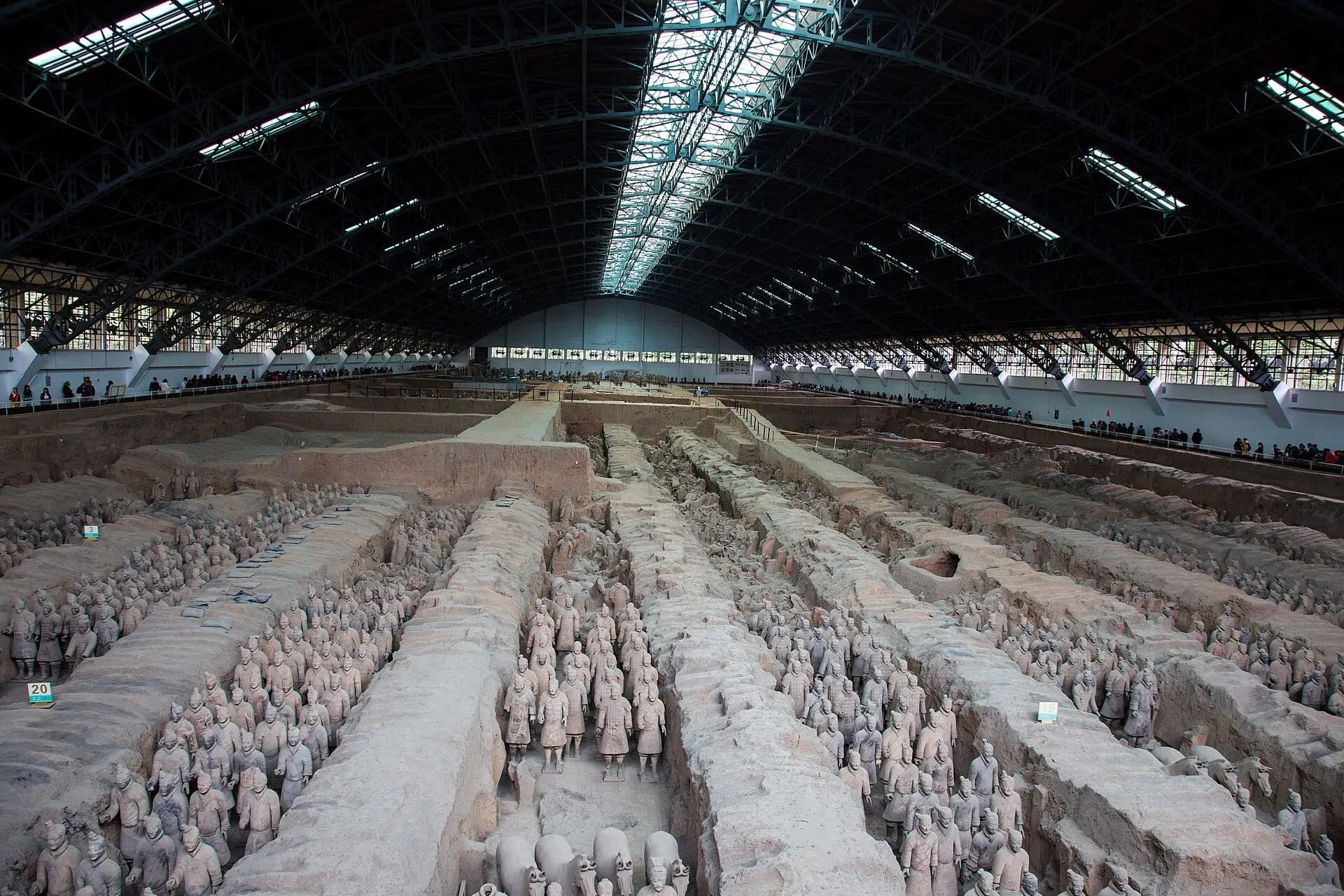
Terracotta Army (兵马俑)
The 2,200-year-old army of 8,000+ life-size clay soldiers guarding the tomb of the First Emperor, discovered 1974. 1 h east of the city. ¥120. Allow 3–4 hours.
Wikimedia Commons · CC
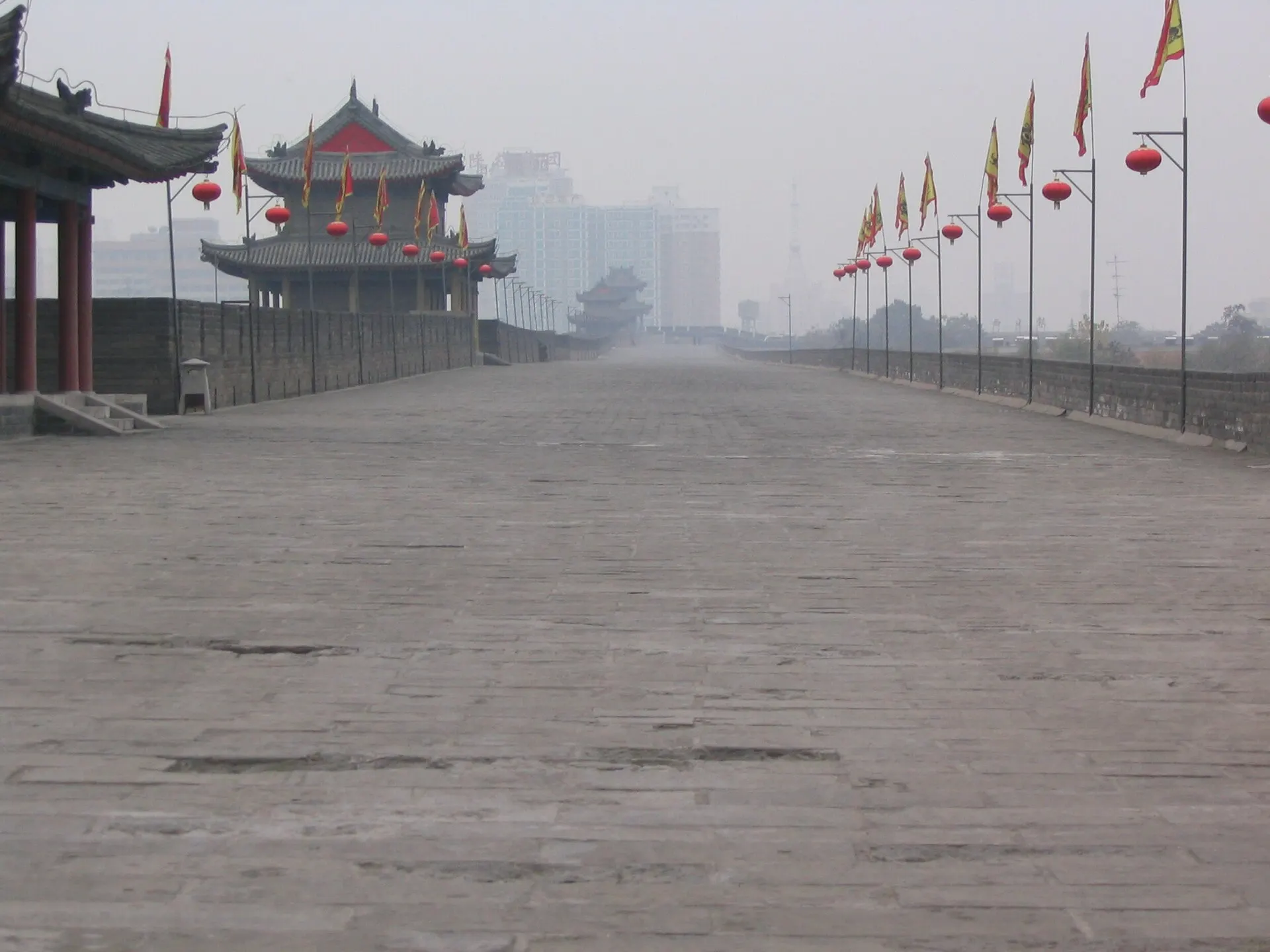
Xi'an City Wall (城墙)
The best-preserved ancient city wall in China, a 14-km Ming-dynasty rectangle you can bike end-to-end in 2 h. ¥54. Sunset is the magic time.
Wikimedia Commons · CC
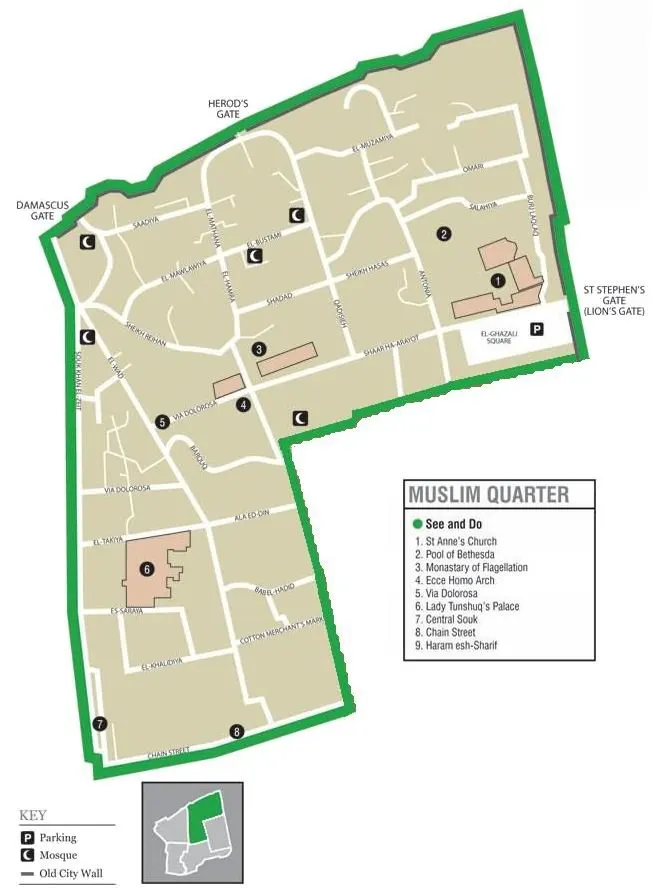
Muslim Quarter (回民街)
A 1,000-year-old Hui Muslim quarter of street food, the Great Mosque, and the Drum Tower. The culinary and atmospheric heart of Xi'an. Free to walk.
Wikimedia Commons · CC
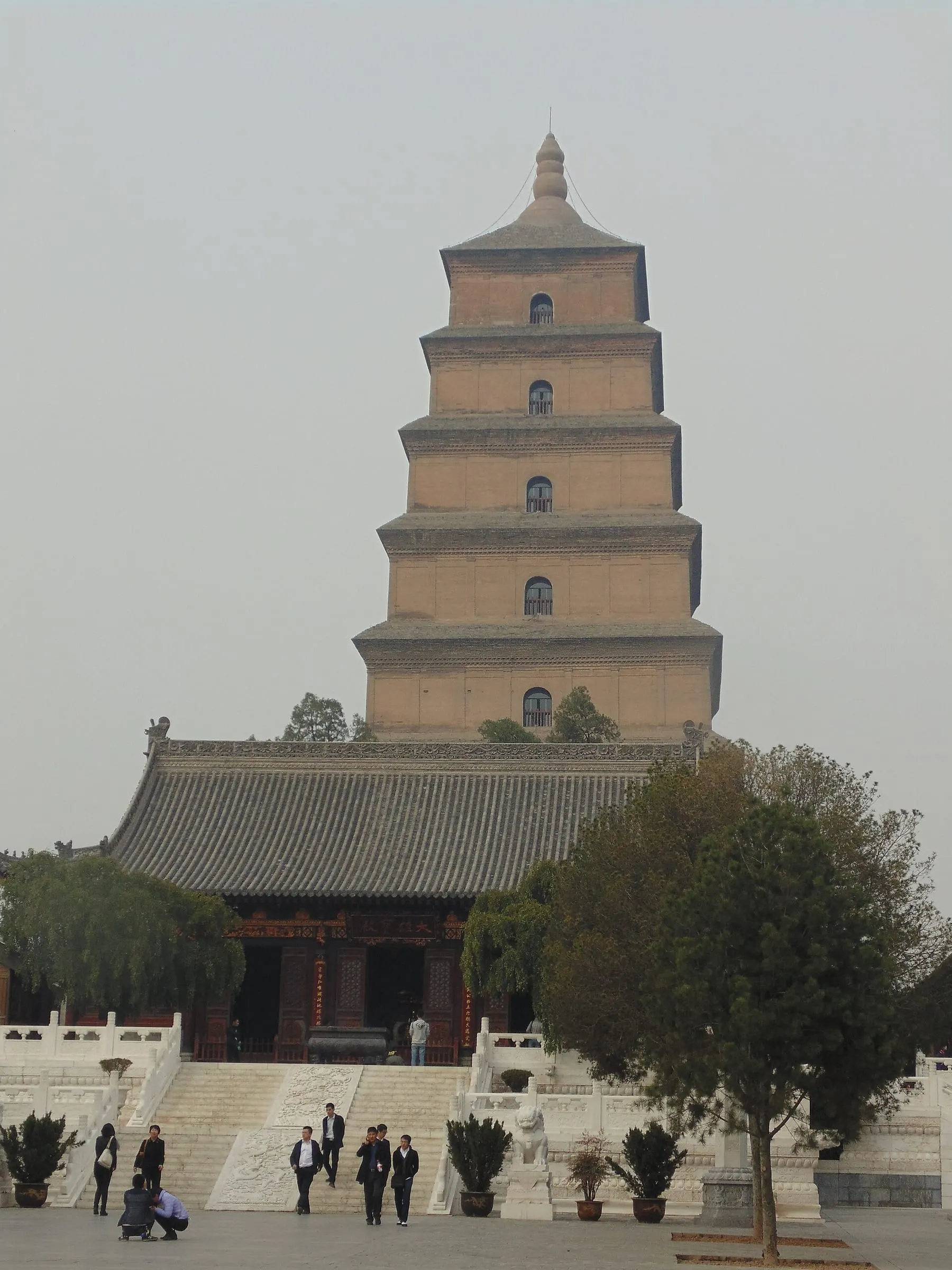
Big Wild Goose Pagoda (大雁塔)
A 7-storey Tang-dynasty Buddhist pagoda (652 CE) built to house scriptures Xuanzang brought from India. ¥30; the North Square fountain show at night is free.
Wikimedia Commons · CC
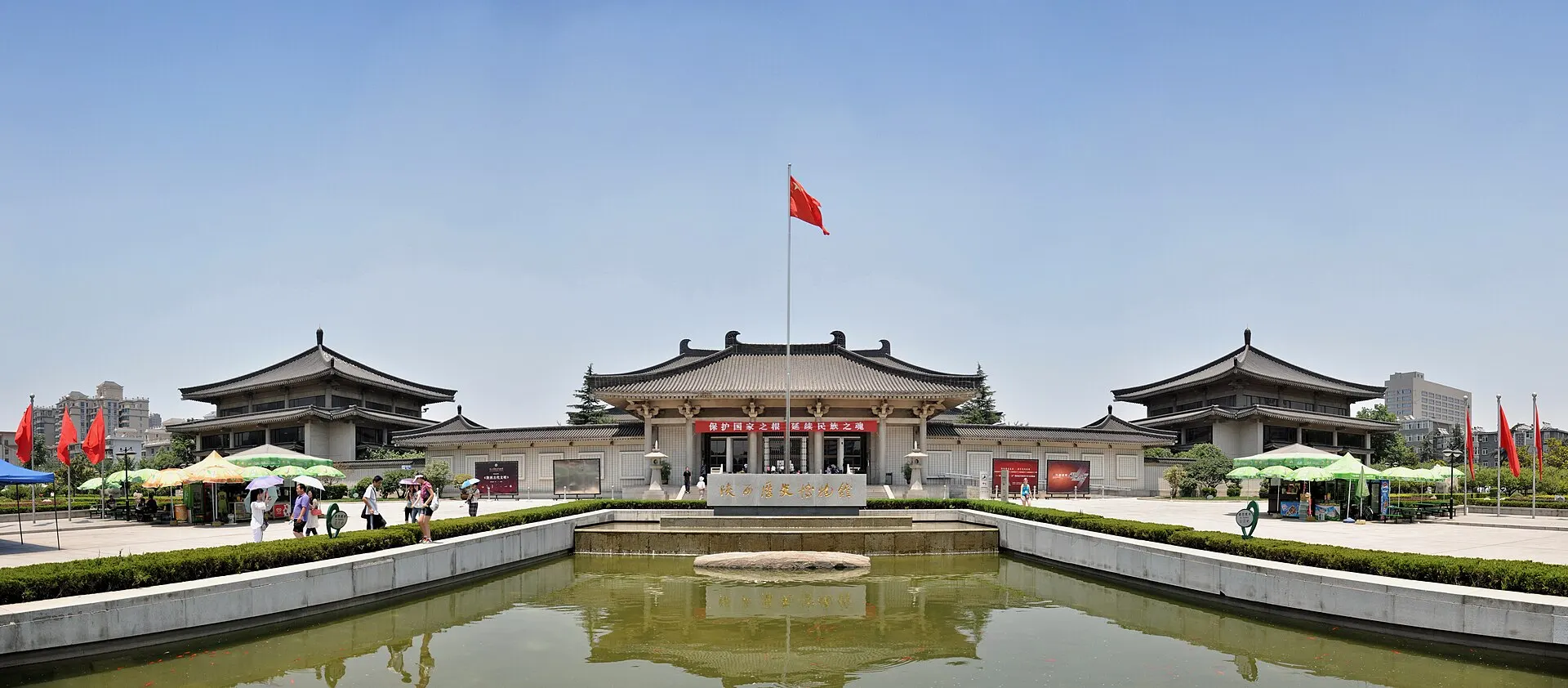
Shaanxi History Museum
One of the great museums of China — the treasures of 13 dynasties, from Zhou bronzes to Tang gold. Free (book ahead) or ¥30 for the special hall. Allow 3 hours.
Wikimedia Commons · CC
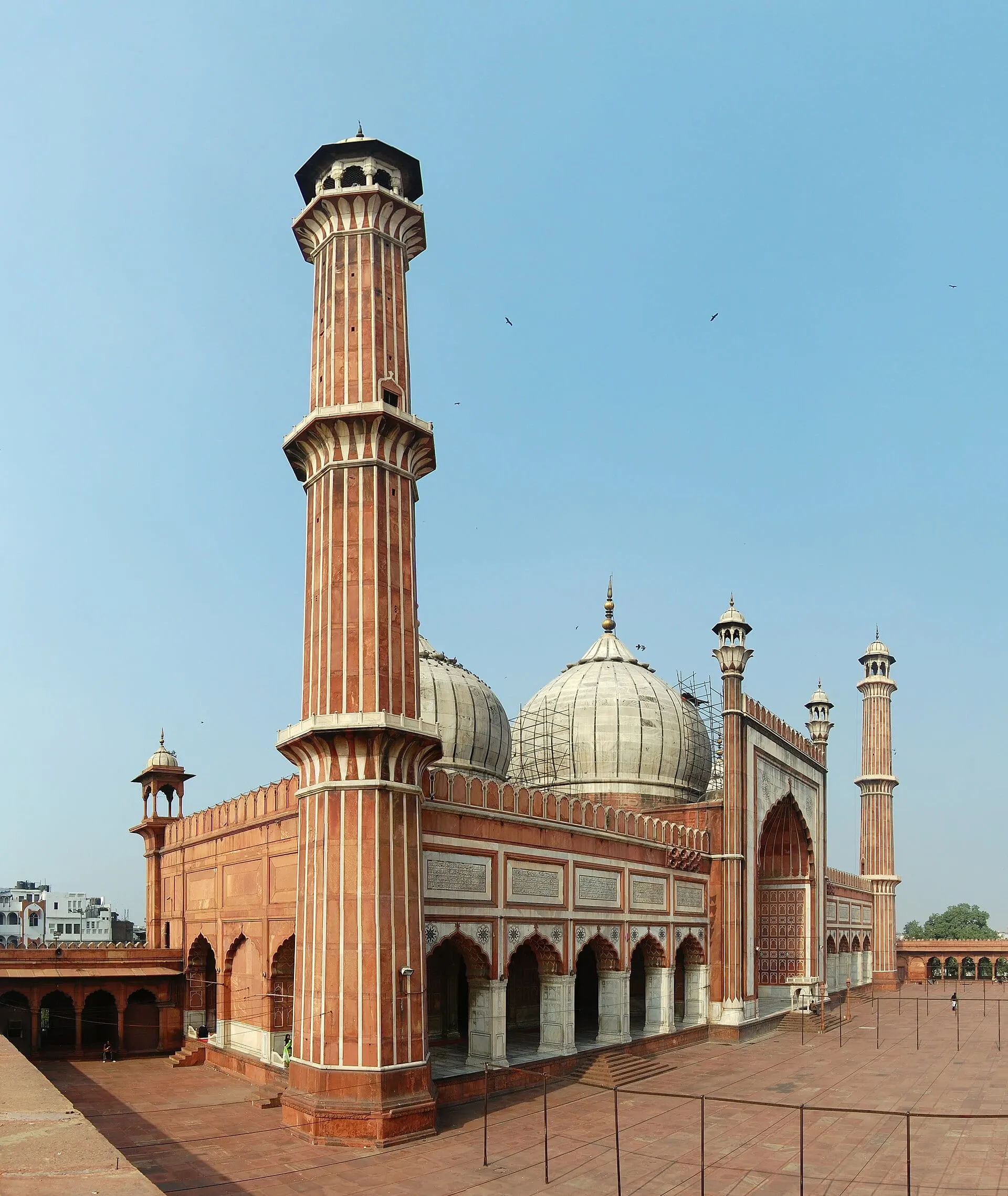
Great Mosque (大清真寺)
A 1,300-year-old mosque built in Chinese temple architecture — pagodas, gardens, and pavilions rather than domes. One of the most beautiful and unusual mosques in the world. ¥25.
Wikimedia Commons · CC
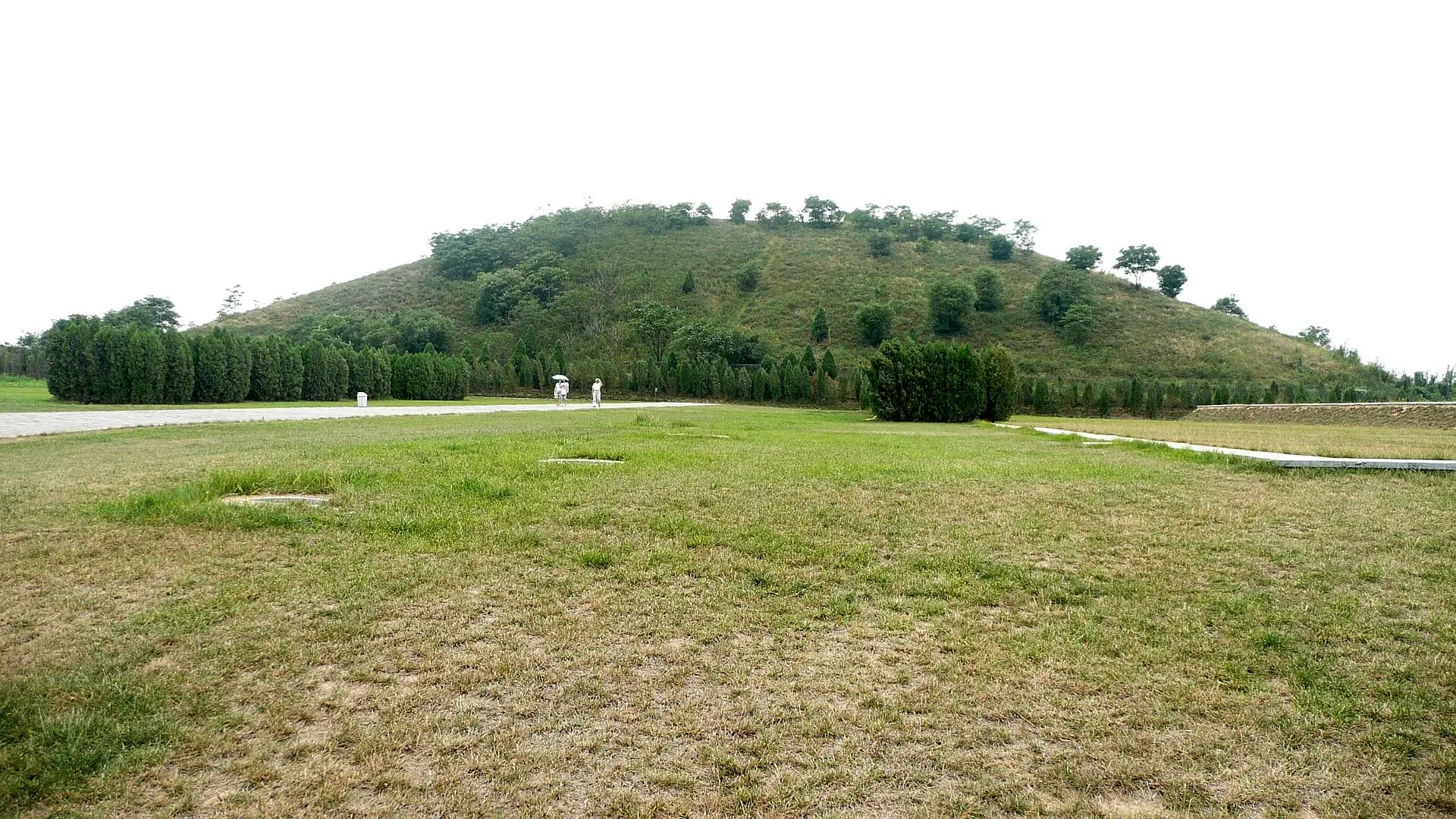
Han Yang Ling Mausoleum
The tomb of the Han emperor Jingdi, with miniature terracotta figures, chariots, and animals in glass-floored pits — the intimate, uncrowded counterpart to the Terracotta Army. ¥60. Near the airport.
Wikimedia Commons · CC
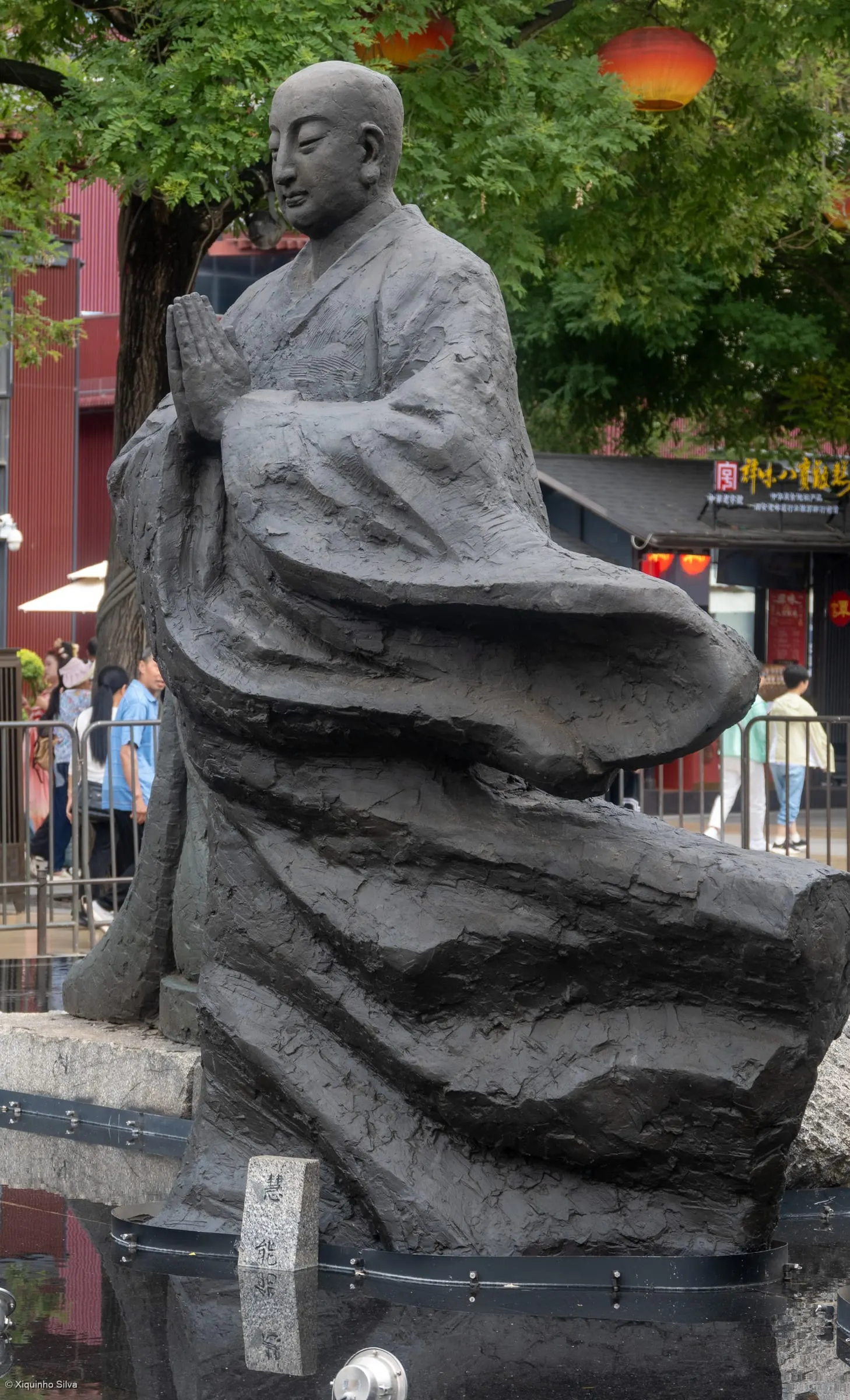
Grand Tang Mall (大唐不夜城)
A spectacular 1.5-km pedestrian avenue of Tang-style pavilions, illuminated arches, live Tang performances, and food stalls — the city's signature night walk. Free.
Wikimedia Commons · CC
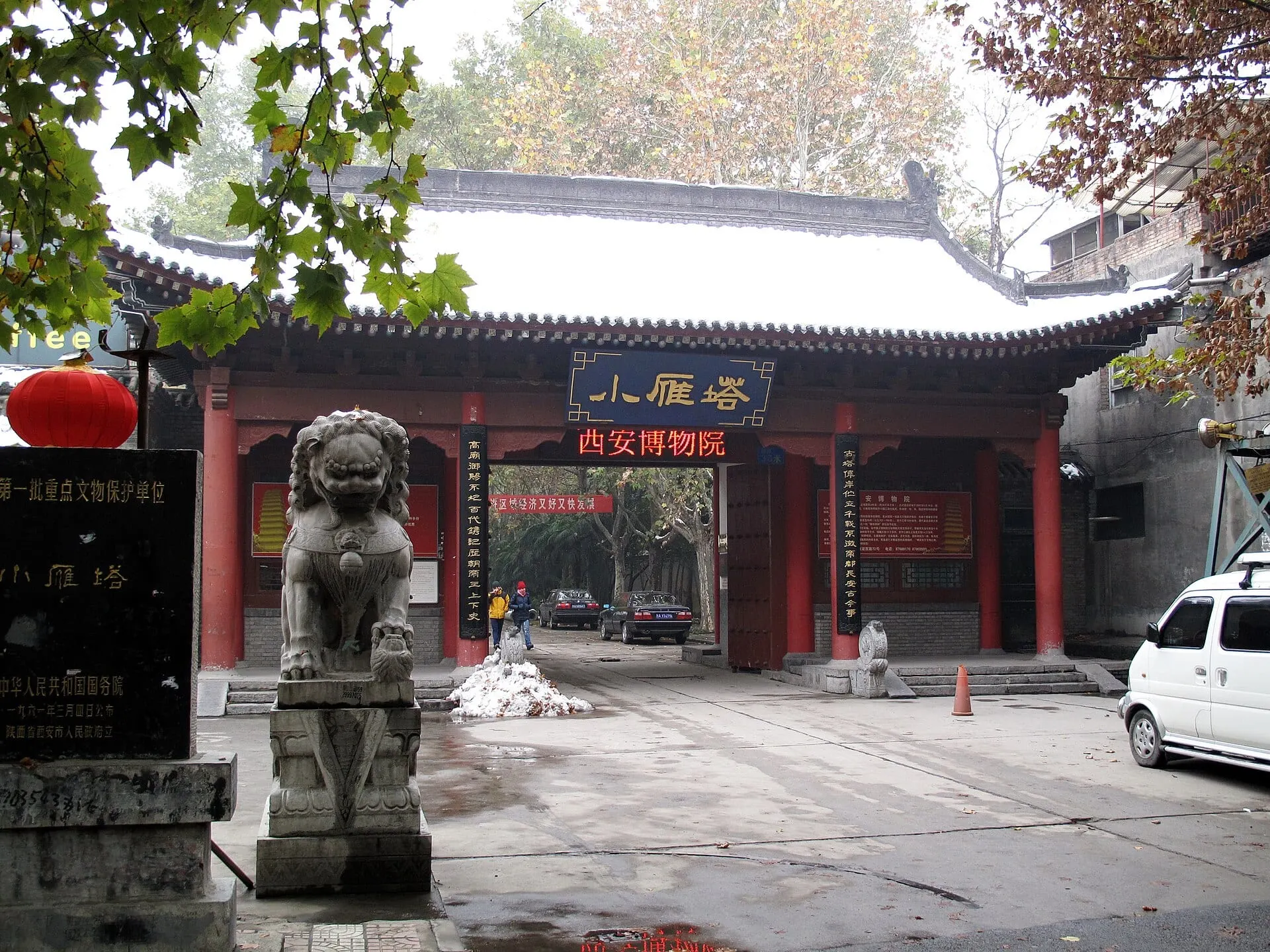
Small Wild Goose Pagoda and Jianfu Temple
A smaller, more intimate Tang pagoda (707 CE) and its temple garden, a quieter counterpart to the Big Wild Goose Pagoda. The pagoda was truncated by a 16th-century earthquake. Free.
Wikimedia Commons · CC
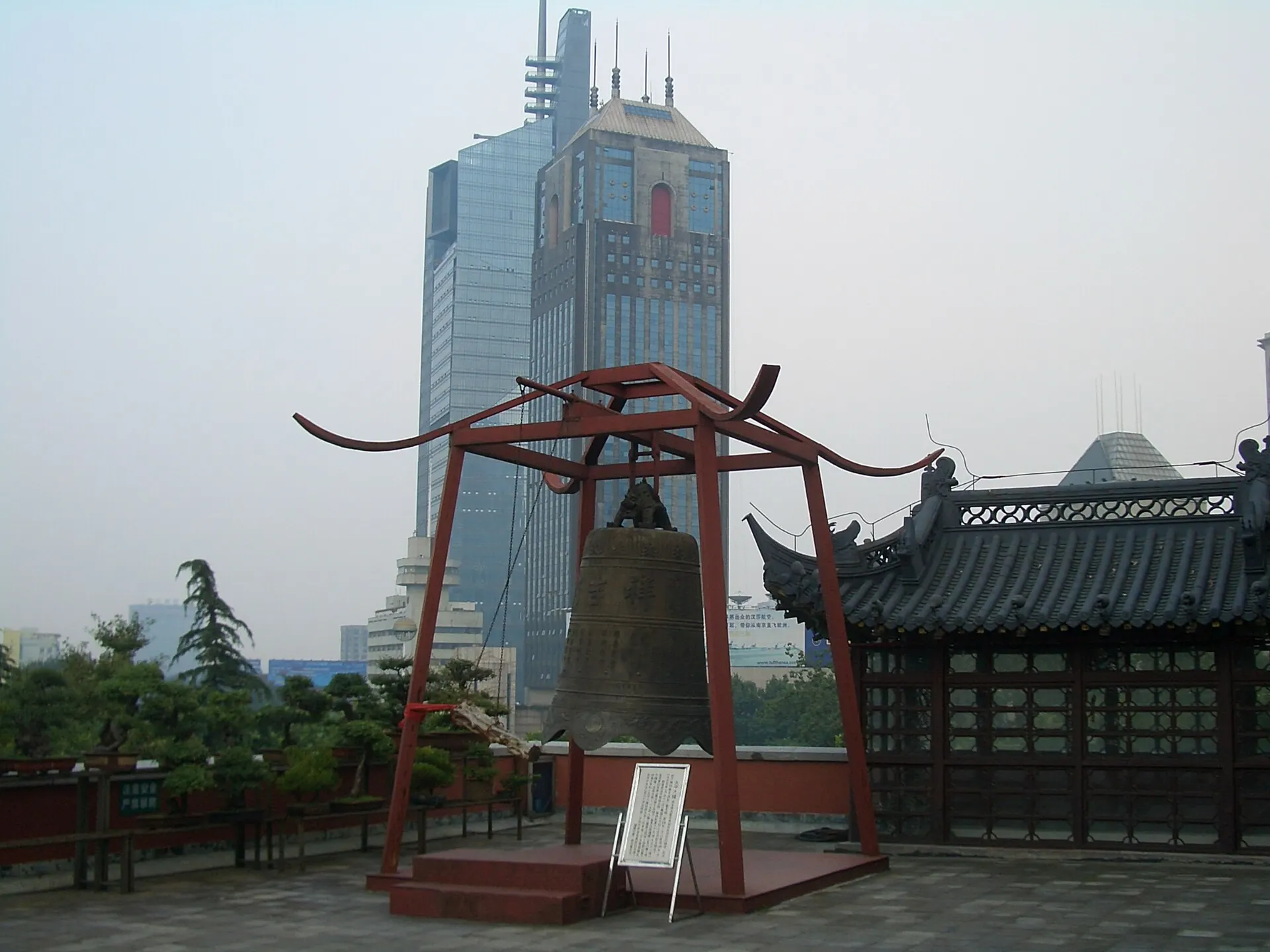
Drum and Bell Towers
The Ming-dynasty towers at the centre of the old city — the Drum Tower marks the Muslim Quarter entrance, the Bell Tower marks the city centre crossroads. Climb either for ¥30 at sunset.
Wikimedia Commons · CC
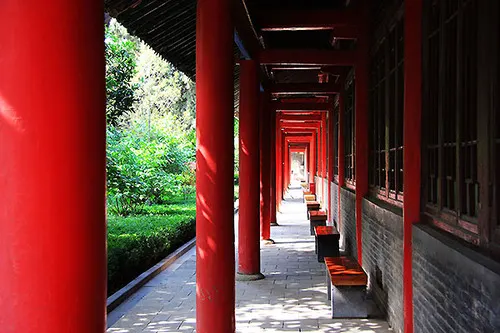
Forest of Steles (碑林博物馆)
A museum of over 3,000 stone steles — the largest collection of ancient Chinese stone inscriptions, including the Nestorian Stele and the Confucian classics. A scholar's treasure. ¥65.
Wikimedia Commons · CC
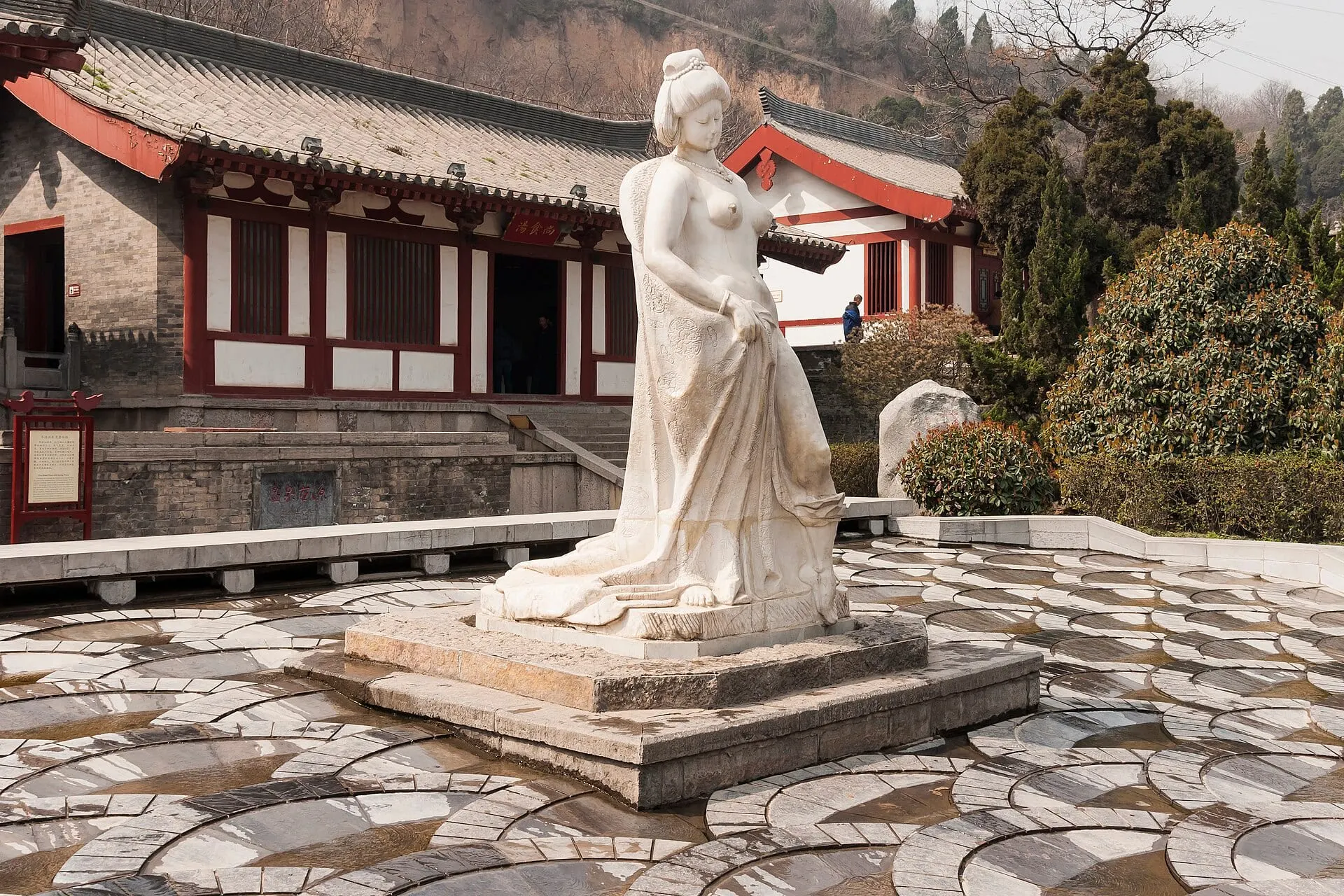
Huaqing Palace and Mount Li
A Tang-dynasty imperial hot-spring palace at the foot of Mount Li, famed for the Xuanzong–Yang Guifei romance and the 1936 Xi'an Incident. Combine with the Terracotta Army. ¥120, plus the evening 'Song of Everlasting Sorrow' show.
Wikimedia Commons · CC
Frequently asked questions
- Is the Terracotta Army worth the trip?
- Yes — it is one of the most significant and spectacular archaeological finds of the 20th century and a genuine world-class sight. The vast Pit 1 (the hangar of thousands of soldiers in formation) is the famous image, but Pit 3 (the command headquarters, smaller and uncrowded) and the bronze-chariot hall reward the closer look. Allow 3–4 hours, go early to beat the crowds, and combine with the Huaqing Palace. It is 1 hour east of the city by tourist bus 306 or a guided tour.
- How long do I need in Xi'an?
- Two full days covers the essentials: Day 1 the city wall bike ride, the Muslim Quarter, and the Grand Tang Mall night scene; Day 2 the Terracotta Army. Three days adds the Shaanxi History Museum, the Wild Goose Pagodas, and a Tang Dynasty show. A fourth day adds Mount Huashan or the Han Yang Ling. Most first-time China itineraries give Xi'an 2–3 days as the third leg of the Golden Triangle (Beijing, Xi'an, Shanghai).
- Can I bike the city wall?
- Yes, and it is the single best activity in Xi'an. The wall is a 14-km Ming-dynasty rectangle around the old city, fully intact and rideable; rent a bike at the South Gate (or any of the four main gates) for ¥45 for 2 hours (a tandem or electric bike is more), and ride the full loop. Sunset is the magic time — the lanterns are lit, the light is golden, and the view over the Bell Tower and the rooftops is the iconic Xi'an panorama. The wall closes around 8 pm in summer; closed in heavy rain.
- How do I get to the Terracotta Army from Xi'an?
- Two main ways. The independent route is tourist bus 306 (the You5) from the Xi'an railway station east square, ¥30 return, every 15 minutes, 1 h each way — the cheapest and most flexible option. The easier route is a half-day guided tour from Xi'an (US$50–80 including transport, entry, and guide), bookable through any hotel or Trip.com. A DiDi or taxi is ¥120–150 each way. The site opens at 8:30; go early. Most travellers combine the Army with the nearby Huaqing Palace on the same day.
- Do I need a visa for Xi'an?
- As of late 2025, citizens of 45+ countries including the US, UK, Canada, Australia, and most of the EU enter China visa-free for up to 30 days for tourism, extended through December 31, 2026. Xi'an is also a 144-hour (6-day) visa-free transit city for 54 countries arriving and departing via different international airports, with an onward ticket. Check the current list at en.nia.gov.cn. Your passport must have six months' validity.
- What should I eat in the Muslim Quarter?
- Everything you can. The Quarter is one of the great street-food districts in Asia, and the must-tries are roujiamo (the chopped-meat 'Chinese hamburger' in a baked bun), yangrou paomo (the lamb stew you crumble flatbread into), biang biang mian (the wide hand-pulled belt noodles with chilli oil), grilled lamb skewers (chuanr), persimmon cakes, pomegranate juice, and the eight-treasure rice. Eat where the locals queue, graze from stall to stall, and save room — the variety is enormous. The food is Hui halal and cumin-and-savoury rather than chilli-hot, a completely different profile from coastal Chinese food. The Quarter is busiest and best from late afternoon to midnight.
- Is Xi'an safe for tourists?
- Yes — Xi'an is one of the safer major cities in China, with low violent crime and a relaxed atmosphere. The Muslim Quarter and the old city are comfortable to walk at any hour, and the tourist infrastructure is well-developed. The main practical issues are the summer heat (July–August can hit 35°C+), the occasional spring dust storms, and the intense crowds at the Terracotta Army in peak season. Tap water is not potable; drink bottled or boiled. Standard city precautions apply in the busiest markets. Xi'an's residents are warm and proud of their history.
- What is the best time of year to visit Xi'an?
- April–May and September–October. Spring is mild, dry, and green; autumn is cool, clear, and the best light of the year. Both are the ideal windows for the wall bike ride and the outdoor sights. Summers (July–August) are hot (35°C+) and humid. Winters (December–February) are cold (−5 to 5°C) but dry, sunny, and uncrowded, with the city wall especially atmospheric under snow. Avoid the first week of October (National Day Golden Week) at all costs — the Terracotta Army and the city wall are mobbed and the queues are hours long. April–May and September–October are the consensus best.
- How do I get from the airport to the city?
- Xi'an Xianyang International Airport (XIY) is 40 km northwest of the city. The airport metro Line 14 reaches the city centre in about 1 hour for ¥16 — the cheapest reliable option. The airport bus runs to the Bell Tower and main hotels for ¥25. A taxi or DiDi is ¥120–150 and takes 45–60 minutes depending on traffic. Most international arrivals use the metro or a pre-arranged hotel transfer. Allow 1.5 hours door-to-door. Confirm which Xi'an station your onward train uses — Xi'an North (the HSR hub) and Xi'an (the city-centre station) are far apart.
- What is the Great Mosque and why is it unusual?
- The Great Mosque of Xi'an, founded in 742 CE during the Tang dynasty, is one of the largest and most beautiful mosques in China — and architecturally almost unique, because it is laid out and decorated entirely like a Chinese Buddhist temple rather than a Middle Eastern mosque. There are no domes or minarets; instead there are pagodas, gardens, pavilions, courtyards, and Chinese calligraphy, and the prayer hall is a Chinese-roofed timber building. It is a remarkable fusion of Islamic function and Chinese form, a product of the Silk Road cosmopolitanism of Tang Chang'an. Entry is ¥25, dress modestly, and respect the prayer times (no entry during salat). It sits tucked inside the Muslim Quarter and is one of the architectural highlights of any China trip.
- What is the Grand Tang Mall and is it worth an evening?
- The Grand Tang Mall (Da Tang Bu Ye Cheng, 'Tang dynasty city that never sleeps') is a 1.5-km pedestrian avenue south of the Big Wild Goose Pagoda, lined with Tang-style pavilions, illuminated arches, costumed Tang-dynasty performers, street food, and light shows. Opened in the 2010s, it has become the signature Xi'an night experience and one of the most spectacular urban nightscapes in China — a kind of immersive Tang-dynasty theme avenue. It is free, busy from dusk, and genuinely spectacular, especially the Tang-music and dance performances, the illuminated phoenix street, and the Big Wild Goose Pagoda fountain show at the north end. Walk it after dinner for the full effect; it is the 21st-century expression of Xi'an's Tang golden-age identity.
- Can I take a high-speed train from Xi'an to other Chinese cities?
- Yes — Xi'an is a major HSR hub on the main north-south and east-west axes. The fastest connections: Beijing 4.5–5.5 hours, Shanghai 6–7 hours, Luoyang 1.5 hours (for the Longmen Grottoes), Chengdu 3.5–4 hours, Lanzhou 3 hours (the start of the Hexi Corridor toward Dunhuang), and Pingyao 3 hours. The trains are clean, fast, and reliable; book on Trip.com or 12306.cn with your passport. The high-speed rail makes a Beijing–Xi'an–Luoyang–Shanghai historic-corridor itinerary straightforward, and Xi'an is the natural start of a Silk Road route west to Lanzhou, Jiayuguan, and Dunhuang.
- Is Xi'an a good destination for families with kids?
- Yes — Xi'an is one of the best family cities in China. The Terracotta Army is genuinely awe-inspiring for children (thousands of life-size soldiers, each with a different face), the city wall bike ride is a 2-hour adventure, the Muslim Quarter is a sensory feast of street food, and the Big Wild Goose Pagoda fountain show and the Grand Tang Mall lights are spectacular evening entertainment. The Shaanxi History Museum and the Han Yang Ling mausoleum bring the history alive for older children. The city is flat, walkable inside the wall, and safe; the main caution is the summer heat and the crowds at the Army in peak season. Most family China itineraries include Xi'an as the 'history' leg of the Golden Triangle, and kids love it.
- What is biang biang mian and why is the character so famous?
- Biang biang mian is Xi'an's signature noodle dish — wide, thick, hand-pulled belt noodles (sometimes called 'belt noodles') topped with chilli oil, vinegar, garlic, and greens, served dry rather than in soup. The name 'biang' is onomatopoeic (the sound of the dough hitting the table as it is pulled), and the Chinese character for 'biang' is the most complex in the language — 57 strokes, with a mnemonic rhyme schoolchildren learn to remember it, and so obscure it is not in most dictionaries. The noodles themselves are chewy, savoury, and one of the great carbohydrate experiences in China. Eat them at any noodle shop in or near the Muslim Quarter; they are cheap (¥15–30) and a Xi'an essential.
- How do I pay in Xi'an without a Chinese bank account?
- As of 2024, both Alipay and WeChat Pay accept foreign Visa and Mastercard. Download the app before you travel, link your card, top up the in-app balance (¥1,000–2,000 is plenty), and scan merchant QR codes everywhere from the Terracotta Army to a Muslim Quarter skewer stall. Carry ¥200–400 in cash for the smallest vendors and temple donations. ¥100 ≈ US$14 in mid-2026. Tipping is not expected. ATMs at Bank of China and ICBC accept foreign cards if you need a cash top-up. Cashless payment is near-universal in Xi'an, including the street food (though the tiniest stalls may still prefer cash).
- What should I pack for Xi'an?
- Layers for the variable weather: light breathable clothing for the hot humid summer (35°C+, June–August), a warm jacket and thermal layers for the cold dry winter (down to −5°C at night, December–February), comfortable walking shoes for the city wall, the Terracotta Army, and the Muslim Quarter (10,000+ steps a day), and sun protection (hat, sunscreen, water) for the exposed wall and the Army pits. A light dust mask for the occasional spring dust storms. Modest clothing (covered shoulders) for the mosques and temples. A translation app (Pleco, Baidu Translate) for the street food and the local Shaanxi dialect. A power adapter (China uses the Australian/Chinese two-flat-pin and the three-pin).
- Is Xi'an worth visiting in winter?
- Yes, with caveats. Winter (December–February) is cold (−5 to 5°C) but dry and sunny, the crowds at the Terracotta Army drop sharply (no Golden-Week queues), the prices fall, and the city wall under a dusting of snow is one of the most atmospheric sights in China. The Muslim Quarter food is at its most comforting (hot yangrou paomo and grilled skewers in the cold), the museums are quiet, and the Tang night scene still runs. The downside is the cold, the short days, and the occasional dust storm. For a history-focused, uncrowded, lower-cost trip, winter is underrated; for the wall bike ride and the outdoor sights in comfort, come April–May or September–October. Pack warm layers.
- What is the Shaanxi History Museum and should I visit?
- The Shaanxi History Museum is one of the great museums of China and the single best orientation to Xi'an's 3,100-year history. It holds the treasures of the 13 dynasties that ruled from Xi'an — Shang and Zhou bronzes, Qin engineering and seals, Han silk and lacquer, Tang gold, silver, and the celebrated sancai (three-colour) ceramics, and the Buddhist and Silk Road artefacts. The building is a Tang-style palace, the collection is world-class, and three hours here before or after the Terracotta Army transforms your understanding of what you are seeing. Entry is free for the main halls but you must book ahead online (it sells out), or ¥30 for the special Tang-treasures hall. It is the essential complement to the archaeological sites, and a must-do for any history-curious visitor.
- Is Xi'an expensive compared to Beijing or Shanghai?
- No — Xi'an is noticeably cheaper than Beijing or Shanghai. A mid-range hotel room is ¥400–700/night (vs ¥800–1,500 in Shanghai), a noodle or paomo meal is ¥15–40, the street food in the Muslim Quarter is ¥5–20 a skewer, the city wall and bike rental together are ¥90, and the Terracotta Army is ¥120. A comfortable mid-range day runs ¥600–1,000 including the Terracotta Army day trip; a budget day ¥300–500. The luxury end (the Sofitel, the Hilton, fine dining) is comparable to the eastern cities, but the mid-range and budget tiers are substantially cheaper, and the street food and the wall bike ride are among the best-value experiences in China.
- Can I visit the Terracotta Army independently without a tour?
- Yes — easily. Take tourist bus 306 (the You5) from the Xi'an railway station east square: ¥30 return, every 15 minutes, 1 hour each way. Buy the Terracotta Army entry (¥120) at the gate or online in advance. The site is well-signed in English, and the three pits, the bronze-chariot hall, and the circular cinema are all walkable. Allow 3–4 hours. A guided tour (US$50–80) is convenient and adds interpretation, but it is by no means necessary — the independent route is cheaper, more flexible, and very doable. Go early (8:30 opening) to beat the peak-season crowds, and combine with the Huaqing Palace if time allows.
- What is the Han Yang Ling and how is it different from the Terracotta Army?
- The Han Yang Ling is the tomb of the Han emperor Jingdi (reigned 157–141 BCE), about 50 years after the Terracotta Army, and it is the intimate, uncrowded, and often more rewarding counterpart. Instead of the First Emperor's life-size soldiers, Jingdi's tomb held thousands of miniature (60-cm) terracotta figures — soldiers, courtiers, pigs, dogs, sheep, and grain stores — originally with movable wooden arms and dressed in silk clothes that have rotted away, leaving naked painted figures. The museum is built over the pits with glass floors so you walk above the excavations, and the lighting and intimacy make it far more atmospheric than the crowded Terracotta Army. ¥60, near the airport — combine with arrival or departure. Many travellers who find the Terracotta Army overwhelming prefer the Han Yang Ling.
- Can I drink the tap water in Xi'an?
- No — tap water in Xi'an is not potable; drink bottled, boiled, or properly filtered water. Bottled water is cheap (¥2–3) and available everywhere, and hotels provide kettles. Avoid ice in budget restaurants. Brushing teeth with tap water is generally fine, but cautious travellers use bottled. The hot tea in every restaurant is made with boiled water and is safe. The local beer (the Shaanxi Han OS and Snow brands) is safe and pairs well with the wheaty, cumin-heavy local food. The air quality, once a concern, has improved, but the spring dust storms can temporarily raise PM10 levels.
- What is the Xi'an Incident of 1936 and its historical significance?
- The Xi'an Incident of December 1936 is one of the pivotal events of modern Chinese history. The Nationalist general Zhang Xueliang, stationed in Xi'an, kidnapped his own commander Chiang Kai-shek and forced him to agree to a united front with the Communist Party against the Japanese invasion — ending the civil war, enabling the Communist survival, and setting the course for the 1949 revolution. The incident happened at the Huaqing Palace hot springs outside Xi'an (where you can still see the bullet holes in Chiang's escape route), and it is commemorated at the site. For a visitor with an interest in modern Chinese history, the Huaqing Palace — already worth visiting for its Tang-dynasty Xuanzong-Yang Guifei romance layer — gains a second, 20th-century layer that shaped the fate of the nation. Combine it with the Terracotta Army day trip.
- What is the Drum Tower and Bell Tower, and should I climb them?
- The Drum and Bell Towers are the two Ming-dynasty (14th-century) wooden towers at the centre of Xi'an's old city, and they are the landmarks you navigate by. The Bell Tower marks the exact centre, where the city's two main axes cross, and it rings the dawn; the Drum Tower, a short walk west, marks the time at dusk and sits at the entrance to the Muslim Quarter. Both are open to climb (¥30 each, or a combined ticket) for panoramic views over the rooftops and the wall, and the Drum Tower at sunset, with the Muslim Quarter lighting up beneath it, is one of the classic Xi'an views. Most visitors climb one (the Drum Tower for the Quarter view, the Bell Tower for the four-axis crossroads) and photograph both. They are the orienting points for any walking tour of the old city.
- What is the Tang Dynasty Show and dumpling banquet?
- The Tang Dynasty Show is a staged evening performance of Tang-era court music, dance, and costume — the flowing sleeves, the painted faces, the instruments and choreography reconstructed from Tang murals and texts — usually paired with a 'dumpling banquet,' a multicourse meal of 15–20 different shaped and filled dumplings served in sequence. The Tang Paradise and the Shaanxi Opera House are the main venues; tickets are ¥220–400 for the show plus banquet. It is tourist-oriented, yes, but it is also a genuine, beautifully staged window into the Tang golden age, and the dumpling banquet is a fun, memorable meal. Most visitors do it once as the evening entertainment after a day of the wall and the Quarter; book through your hotel or Trip.com. It is the closest you can come to a Tang court evening in the modern city.
- What is the best area to stay in Xi'an?
- Inside the city wall, near the Bell Tower and the Muslim Quarter — this puts the wall bike ride, the Quarter street food, the Great Mosque, and the Drum and Bell Towers within an easy walk, and the metro reaches everything else. The luxury hotels (the Sofitel, the Hilton, the Crowne Plaza) cluster around the Bell Tower and the South Gate; mid-range Western and Chinese hotels fill the gaps inside and just outside the wall. For atmosphere, the boutique courtyard hotels near the South Gate or in the Quarter's lanes give a taste of old Xi'an. South of the wall, the Big Wild Goose Pagoda and Grand Tang Mall area is newer and livelier, with the Tang night scene. Budget travellers have excellent hostels (¥50–80 dorm beds) in the Bell Tower area. A central base makes the wall ride and the Quarter effortless.
- How accessible is Xi'an for travellers with disabilities or mobility limits?
- Xi'an is reasonably accessible by Chinese standards. The metro is modern with lifts at most stations, the major museums and the Terracotta Army have accessible routes and ramps, and the big hotels have accessible rooms. The main challenges are the older lanes of the Muslim Quarter (uneven paving, crowded), the steep climbs of the city wall stairs (though the wall-top bike path itself is flat once you are up), and the Mount Huashan day trip (genuinely difficult for limited mobility — skip it). For the Terracotta Army, the site is large but mostly flat and wheelchair-navigable with assistance. Plan with hotels and the museum directly, use the metro and DiDi rather than long walks, and focus on the city sights and the Terracotta Army for the most accessible experience. China's accessibility infrastructure is improving but uneven; confirm before booking.
- What is the Big Wild Goose Pagoda fountain show and when is it?
- The Big Wild Goose Pagoda North Square holds one of the largest musical fountain shows in Asia — a vast synchronised water-and-light display set to music, free, in the plaza at the base of the 652 CE Tang pagoda. The show runs nightly (typically 8 pm in summer, earlier in winter, with additional afternoon shows on weekends), lasts about 20 minutes, and draws crowds of locals and visitors. The pagoda, lit behind the fountains, is the backdrop. It is a fun, free, slightly kitsch modern spectacle layered onto a sacred Tang site, and it pairs perfectly with a walk through the adjacent Grand Tang Mall illuminated avenue. Check the current show times with your hotel, as they shift seasonally and pause for weather.
- What is the Famen Temple and is it worth the long day trip?
- The Famen Temple, 120 km west of Xi'an (a 2-hour drive or a day tour), is one of the holiest Buddhist sites in China — it holds a finger bone relic of the historical Buddha, discovered in 1987 in a sealed underground crypt along with Tang imperial gold, silver, silk, and ceramic offerings. The crypt treasures (the Tang tea set, the silver-gilt reliquaries, the glassware) are extraordinary and now displayed in the museum. The site is dominated by the modern 148-metre folded-stupa 'hands' monument completed in 2009, a striking piece of contemporary Buddhist architecture, alongside the older Tang temple. For a visitor interested in Buddhism or Tang art, Famen is worth the long day; for those short on time, the Shaanxi History Museum and the Wild Goose Pagodas in the city cover the Tang-Buddhist layer more accessibly. Combine Famen with the Qianling Tang tombs if you make the western day trip.
- Can I see the Terracotta Army being excavated?
- Partially. The three pits are at different stages of excavation: Pit 1 (the vast soldier hall) is the most excavated and the iconic image, with the soldiers standing in their restored battle formation; Pit 2 is partly excavated, with figures in various states of restoration and the famous kneeling archer; Pit 3 (the smallest, the command headquarters) is fully excavated. Ongoing conservation work — reassembling broken figures, restoring the original painted surfaces (which flake off within minutes of exposure to air) — is visible in the pits and in the conservation lab. There are also the two magnificent bronze chariots (half-scale, with gold and silver detail) in their own hall. The site is still an active archaeological project 50 years after the 1974 discovery, and you are seeing the excavation in progress — that is part of the experience.
- What is the local Shaanxi dialect and will I manage with Mandarin?
- The Xi'an (Guanzhong) dialect is a northwestern variety of Mandarin — it shares the grammar and much of the vocabulary of standard Mandarin, but the tones, pronunciation, and local slang are quite distinct, and a heavy Guanzhong speaker can be hard for a standard Mandarin speaker to follow. In practice, every Xi'an resident also speaks standard Mandarin (putonghua), so as a visitor you will be understood and can manage fine. English is spoken at the top hotels, the Terracotta Army, and the major tourist restaurants; a translation app (Pleco for Mandarin, Baidu Translate for voice) covers the street food and the local shops. The dialect you will hear in the Muslim Quarter and on the street is part of Xi'an's character — locals appreciate a few words of effort, but standard Mandarin is all you need.
- What souvenirs should I buy in Xi'an?
- Xi'an's best souvenirs reflect its Silk Road and craft heritage. Top choices: a rubbing from the Forest of Steles (a print of a great calligrapher's work, sold at the museum — meaningful, portable, and genuinely local); miniature Terracotta Army figures (the souvenir stalls near the Army sell them; choose the hand-finished ones); Tang sancai (three-colour) ceramic replicas of the famous horses and camels; replica Tang silk and embroidery; jade and pearl jewellery from the licensed shops; Hui Muslim crafts (the embroidered caps, the brassware) from the Muslim Quarter; and the local food products (cumin, dried persimmon cakes, the flatbread for paomo, black vinegar). Avoid the mass-produced 'antiques' (almost all modern) and bargain lightly at the markets but not the food stalls. The Forest of Steles rubbing is the most authentically Xi'an bring-home; carry receipts for customs.
- What is the Daming Palace and is it worth visiting?
- The Daming Palace was the imperial palace complex of the Tang dynasty — the vast residence and administrative centre of the Tang emperors, three times the size of the Forbidden City in Beijing, and the seat of Tang power for 220 years. It was destroyed in the Tang collapse and largely forgotten, but since the 2000s it has been developed into the Daming Palace National Heritage Park, a huge (3.2 sq km) archaeological park on the northeast of the city with the restored foundations, a superb museum (the Daming Palace Museum), reconstructed gates and pavilions, and landscaped grounds. For a visitor interested in the Tang golden age, the Daming Palace is the imperial-scale complement to the Shaanxi History Museum's artefact-scale view, and the park is a pleasant, uncrowded place to walk. Allow a half-day, combine with the nearby Big Wild Goose Pagoda. It is the Tang layer in spatial form, and the model reconstructions in the visitor centre help you picture Chang'an at its peak.
- What is the best overall advice for a first trip to Xi'an?
- Allow 2–3 days, bike the city wall at sunset, eat everything in the Muslim Quarter, and go early to the Terracotta Army. Walk the Grand Tang Mall at night, visit the Shaanxi History Museum for orientation, and climb one of the Towers for the view. Read a Tang poem or two before you go — Bai Juyi's 'Song of Everlasting Sorrow' for the Huaqing Palace, Li Bai's drinking poems for the Quarter — and the layers of history will come alive. Link your foreign card to Alipay or WeChat Pay, install a translation app and a VPN, and let the city's 3,100 years set the pace. Xi'an is the cradle of Chinese civilisation, the Silk Road's start, and one of the most historically concentrated cities on earth; come for the Terracotta Army, stay for the wall and the street food, and you will understand why it is the unmissable third leg of the Golden Triangle.
- Is Xi'an a good destination for solo travellers?
- Yes — Xi'an is very solo-friendly. The walled old city is compact and walkable, the street food is built for solo grazing, the hostels in the Bell Tower and Quarter area are social and well-organised for meeting other travellers and booking Terracotta Army tours, the metro and DiDi make transport easy, and the city is safe at any hour. A solo traveller can bike the wall, eat through the Muslim Quarter, visit the museums, and take the Terracotta Army day trip with no friction. The main challenge is the language outside the central tourist zones — a translation app and pre-saved Chinese addresses help. The Xi'an hostel scene is one of the best in China for solo travellers to connect, and the city's relaxed, proud, food-loving character suits solo exploration well.
- What is the Bell Tower and what is the best time to see it?
- The Bell Tower is the Ming-dynasty (1384) wooden tower at the exact centre of Xi'an, where the city's two main avenues cross at the heart of the walled old city — it is the landmark you navigate by and the visual anchor of the historic core. It housed the city bell that marked the dawn, and you can climb it (¥30) for a panoramic view over the four avenues radiating to the wall gates. The best time is dusk and early evening, when the tower is illuminated and the traffic swirls around it and the nearby Drum Tower — the two together make the iconic Xi'an night view. Most visitors photograph it from the crossing and climb either the Bell or the Drum Tower (the Drum for the Quarter view) rather than both. It is the orienting point for every walking tour of the old city.
- How much does a Xi'an trip cost?
- Xi'an is one of the better-value major cities in China. A backpacker day runs ¥300–450: a hostel bed (¥50–80), Muslim Quarter street food and noodle meals (¥80–150), the city wall and bike rental (¥90), and a museum or the Quarter. A mid-range day runs ¥600–1,000: a 4-star hotel inside the wall (¥400–700), restaurant dinners, the Terracotta Army day trip (¥120 entry + ¥30 bus + a meal), and the Tang show. A luxury day runs ¥2,000+ for the Sofitel, fine dining, and private guiding. The two big one-off costs are the Terracotta Army and, if you choose it, the Tang show with dumpling banquet. Plan ¥600–1,000/day mid-range for a comfortable 2–3 day stay, less for budget. The wall bike ride and the Muslim Quarter grazing are among the best-value experiences in China.
- Can I do a Silk Road trip starting from Xi'an?
- Yes, and Xi'an is the natural eastern start. A classic 10–14 day route runs Xi'an (2–3 days) → Lanzhou (the Bingling Si caves) → the Hexi Corridor and Jiayuguan (the Great Wall's western fortress) → Dunhuang (the Mogao Caves and the singing sands) → Turpan (the ancient cities and the Flaming Mountains) → Urumqi and the Tian Shan → Kashgar (the Uyghur old town and Sunday market). The modern high-speed rail reaches Lanzhou (3 h) and Jiayuguan and Dunhuang on the regular rail, with flights for the longer western legs. The route crosses the gradient from Han Chinese heartland through Hui and Tibetan regions to the Turkic Muslim far west, and it is one of the great cultural and historical journeys in Asia. Even a shorter Xi'an–Lanzhou–Dunhuang stretch (7–8 days) gives the essence. Book with a specialist Silk Road operator for the western permits and logistics.
- What is the difference between the Big and Small Wild Goose Pagodas?
- Both are Tang-dynasty Buddhist pagodas and both are UNESCO-listed as part of the Silk Road site, but they have different characters. The Big Wild Goose Pagoda (Dayan Ta, 652 CE, 7 storeys, 64 m) is the more famous — it was built to house the scriptures the monk Xuanzang brought back from India, it sits in the southern city near the Grand Tang Mall and the spectacular North Square fountain show, and it is the busier, more tourist-oriented site. The Small Wild Goose Pagoda (Xiaoyan Ta, 707 CE, originally 15 storeys, truncated to 13 by a 1556 earthquake) is smaller, quieter, and more intimate, set in the leafy garden of the Jianfu Temple, with the excellent Xi'an Museum on the same grounds. For atmosphere and calm, the Small Wild Goose Pagoda is the better choice; for the full Tang-pagoda-plus-fountain-show-plus-Grand-Tang-Mall experience, the Big Wild Goose Pagoda. Many visitors see both on a single southern-city afternoon.
- What is the Huaqing Palace and the Yang Guifei romance?
- The Huaqing Palace (Huaqing Gong) is the Tang-dynasty imperial hot-spring palace at the foot of Mount Li, 30 km east of Xi'an on the way to the Terracotta Army, and the setting of one of the most famous love stories in Chinese history: the romance between the Tang emperor Xuanzong and his consort Yang Guifei, immortalised in Bai Juyi's 'Song of Everlasting Sorrow.' The palace's hot-spring pools (including Yang Guifei's, the empress's, and the emperor's) are preserved, and the site gains a 20th-century layer as the location of the 1936 Xi'an Incident. The evening outdoor performance of 'The Song of Everlasting Sorrow' (Changhen Ge), staged on the palace's lake with hundreds of performers, is a spectacular re-telling of the romance and one of China's great outdoor shows. Combine the palace with the Terracotta Army on a single day trip east; book the evening show in advance.
- Is Xi'an a good destination for older travellers?
- Yes — Xi'an is excellent for older travellers who take the pace easily. The walled old city is flat and walkable, the city wall bike ride can be done on an electric bike or skipped for a walk on the wall, the Muslim Quarter and the Great Mosque are gentle strolling, the Shaanxi History Museum and the Terracotta Army are well-paved and accessible, and the hotels inside the wall are convenient. The main cautions are the summer heat, the spring dust, and the Golden-Week crowds — come April–May or September–October, and skip the Mount Huashan hike unless fit. The Terracotta Army involves a lot of walking; rent the wheelchair-accessible shuttle if needed, and go early. The Tang show and the Grand Tang Mall night walk are comfortable evening entertainment. A relaxed 3-day Xi'an stay is ideal for older visitors and a highlight of most grand-tour itineraries.
- What is the best way to see the Terracotta Army without the worst crowds?
- Go early and out of peak season. The site opens at 8:30 am; be at the gate for the first entry and head straight to Pit 1 before the tour buses arrive around 10 am. The worst crowds are the October Golden Week, the May holiday, and the summer school holidays — avoid these if at all possible. Within the site, Pit 1 (the famous hangar) is always the most crowded; Pit 3 (the smallest, the command headquarters) and Pit 2 are quieter and often more rewarding for close-up viewing, and the bronze-chariot hall and the circular cinema disperse visitors. A weekday in the shoulder season (April, late October, November) with an 8:30 am arrival gives you the site at its most navigable. The crowds are part of visiting China's most famous sight, but timing is the single biggest lever on the experience.
- What is the Qujiang district and the Big Wild Goose Pagoda area?
- The Qujiang New District, south of the old wall and centred on the Big Wild Goose Pagoda, is Xi'an's contemporary cultural quarter — a planned district of Tang-style public spaces, new museums, lakes, and the spectacular Grand Tang Mall illuminated avenue. It is where the city projects its Tang golden-age identity in built form: the pagoda and its fountain show, the Tang Paradise (a reconstructed Tang imperial garden), the Shaanxi History Museum, the Qujiang Lake parks, and the Grand Tang Mall together form the largest concentration of Tang-themed public space in China. For a visitor, the Qujiang area is the evening destination (the Mall, the fountain show, the lakeside walks) and the home of the best of the modern museums. It complements the walled old city's historical density with a modern, spacious, large-scale expression of the same Tang pride, and an afternoon-to-evening here after a day in the old city is the full Xi'an experience.
- Can I visit Xi'an as a visa-free transit stop?
- Yes. Xi'an is one of China's 144-hour (6-day) visa-free transit cities for citizens of 54 countries, including the US, UK, Canada, Australia, and most of the EU, when you arrive in and depart from China via different international airports (or eligible ports) with a confirmed onward ticket to a third country. This lets you spend up to 6 days in the Xi'an region without a visa — enough for the Terracotta Army, the city wall, the Muslim Quarter, and a day trip. Many travellers use it as a stopover between Europe and East Asia or Southeast Asia. Register the transit at check-in with your airline, present the onward ticket, and confirm current eligible nationalities at en.nia.gov.cn. For longer stays, the 30-day unilateral visa-free policy covers 45+ countries.
- What is the best area to stay in Xi'an?
- Stay inside the city wall for the best experience. The Bell Tower and Drum Tower area is the most central, with walking access to the Muslim Quarter and the South Gate. Mid-range hotels run ¥300-600 per night. The South Gate area has boutique hotels in restored courtyard homes. For luxury, the high-rise hotels around the Giant Wild Goose Pagoda in Qujiang offer five-star amenities. Avoid staying near the airport or North HSR Station — both are 40-60 minutes from the old city.
- Is the Terracotta Army manageable with young children?
- Yes, with planning. Bring a stroller for children under five — the site involves a lot of walking. Pit 1 is awe-inspiring for kids 6+, and Pit 2 with close-up figures often engages younger visitors more. The bronze chariot hall is air-conditioned. Arrive at 8:30 AM opening time and do Pit 1 first, then the quieter pits. Bring snacks, water, and sun protection. Most children under 10 will last about 2 hours before attention fades, so prioritize the highlights.
- How does Xi'an food compare to Sichuan and Beijing cuisine?
- Xi'an cuisine is wheat-based, not rice-based — the city's defining dishes are noodles, breads, and lamb, reflecting its Silk Road heritage. Signature dishes that define the city include yangrou paomo (lamb soup with torn flatbread), biangbiang noodles (wide belt noodles with chili oil), and cumin-lamb skewers from the Muslim Quarter. Xi'an food is less spicy than Sichuan, relying on cumin, black vinegar, and salt rather than the Sichuan peppercorn and chili bean paste that numb the mouth. Compared with Beijing, it is heartier, more street-focused, and less reliant on imperial banquet conventions — the Muslim Quarter is the essential eating street, best visited in the early evening when the lanterns come on and the smoke from the lamb-skewer grills fills the air. Try the cold sesame noodles (liangpi) and the stuffed roujiamo flatbread sandwich for a complete introduction to the city's street-food culture.
- Is Xi'an worth visiting?
- Yes, Xi'an is one of China's essential destinations and worth visiting for any traveller interested in history. It was the imperial capital for 13 dynasties, the eastern terminus of the Silk Road, and the largest city in the world during the Tang dynasty (618-907 CE). The Terracotta Army alone — 8,000 life-sized warrior figures guarding the tomb of China's first emperor — is one of the greatest archaeological discoveries of the 20th century and worth the trip by itself. Beyond the warriors, Xi'an offers the best-preserved ancient city wall in China (you can cycle the full 14 km on top), the atmospheric Muslim Quarter with its street-food lanes and the 1,300-year-old Great Mosque, and the Shaanxi History Museum, one of China's finest. The city is a physical timeline: Qin, Han, Tang, Ming, and Muslim Silk Road layers stacked in one walkable walled centre. Most visitors rank it alongside Beijing as the two essential historical cities in China.
- How many days should I spend in Xi'an?
- Three full days is the sweet spot. Day 1: the Terracotta Army first thing in the morning (arrive by 8:30 AM to beat the tour buses), returning for lunch in the Muslim Quarter, then an afternoon walk on the city wall. Day 2: the Shaanxi History Museum in the morning (book ahead), the Big Wild Goose Pagoda and the Qujiang district in the afternoon, and the Tang Dynasty music-and-dance show or the Grand Tang Mall in the evening. Day 3: the Great Mosque and a deeper walk through the Muslim Quarter markets, the Bell and Drum Towers, and a final evening feast of yangrou paomo (lamb soup with torn bread) and cumin-lamb skewers. Two days is workable but tight — Day 1 for the warriors and the wall, Day 2 for the museum and the Muslim Quarter, skipping the Tang show. Four days lets you add a day trip: Mount Huashan (one of China's most dramatic mountain hikes, 30 minutes by HSR) or the Han dynasty Yangling Museum (fewer crowds than the Terracotta Army, equally fascinating).
- Can I visit the Terracotta Army without a guide?
- Yes, the Terracotta Army is entirely visitable independently. From Xi'an, take the public bus 306 (Tourist Bus 5) from the east side of the train station square (¥7, 60 minutes), or a DiDi (¥150-200, 50 minutes). At the site, English signage in all three pits is clear, and the audio guide (¥40, available in English at the entrance) provides detailed commentary on the warriors, the excavation history, and the Qin dynasty context. A guide adds depth — they explain the rank distinctions in the terracotta figures, the engineering of the bronze chariots, and the unresolved mysteries of the tomb — but is not essential for understanding what you are seeing. Book entry tickets online in advance through Trip.com (English) or the official museum site (Chinese); bring your passport. The site is 30 km east of the city; allow 3-4 hours on site and a full half-day including transport.
- What is the best time of day for the Terracotta Army?
- Arrive at the 8:30 AM opening time for the best experience. The first 90 minutes (8:30-10:00 AM) have the smallest crowds and the best light in Pit 1 (the main hangar), where the morning sun angles through the high windows. By 10:00 AM the tour buses from Xi'an arrive en masse and Pit 1 becomes shoulder-to-shoulder along the front railing. Visit the pits in reverse order for the quietest experience: Pit 3 (the command headquarters, smallest and quietest) first, then Pit 2 (the mixed-force pit with the famous kneeling archer), and Pit 1 last when the initial rush has spread out. The bronze chariot exhibition hall and the circular cinema are air-conditioned and can be visited at any time. Avoid weekends and Chinese holidays entirely if your schedule allows — the difference between a Tuesday in November and a Saturday in August is the difference between contemplative awe and a crush.
- Is Xi'an expensive for tourists?
- Xi'an is one of the better-value major tourist cities in China, cheaper than Beijing and significantly cheaper than Shanghai. Hostel beds in the city centre run ¥50-80, mid-range hotels inside the city wall ¥300-500, and the top hotels (the Sofitel, the Hilton) ¥700-1,200. Street food in the Muslim Quarter — a lamb skewer, a roujiamo (meat-stuffed flatbread), a bowl of biangbiang noodles — runs ¥10-30 per item, and a full meal of yangrou paomo or hotpot ¥50-100 per person. The Terracotta Army entry is ¥120 (the single largest cost), the city wall ¥54, and the Shaanxi History Museum free with advance booking. A comfortable mid-range day — a good hotel, street food and one restaurant meal, the Terracotta Army, and the wall — runs ¥600-900. Backpackers can manage on ¥250-400 a day. Xi'an delivers one of the best value-to-experience ratios of any major world-heritage city.
- How do I get to the Terracotta Army from Xi'an?
- The easiest budget option is Tourist Bus 306 (also labelled Bus 5), which departs from the east side of Xi'an Railway Station square every 10-15 minutes from 7:00 AM. The fare is ¥7 each way, the journey takes about 60 minutes, and the bus drops you at the museum car park. Ignore anyone at the station claiming the bus is cancelled — they are touts for overpriced private tours. Alternatively, a DiDi or taxi costs ¥150-200 each way (50 minutes) and is the most comfortable option for two or more people. Private drivers through hotels or Viator run ¥400-700 for a half-day including waiting time. The high-speed train is not practical: the station nearest the museum (Lintong) is still a 20-minute taxi from the site. Go early — the 7:00 AM bus gets you to the museum before the 10:00 AM tour-bus crush.
- Is Xi'an safe for tourists?
- Yes — Xi'an is a safe city for tourists, with violent crime against foreigners extremely rare. The walled old city, the Muslim Quarter, and the areas around the Bell Tower are well-populated into the evening and safe to walk through at night. The standard precautions apply: use DiDi rather than unlicensed taxis after dark, watch your belongings in the crowded Muslim Quarter food lanes (pickpocketing is the most common petty crime), and avoid the aggressive tea-house touts around the Bell Tower who invite tourists for a 'traditional ceremony' that ends with an inflated bill. The Muslim Quarter is safe but intensely crowded — keep your phone and wallet in a front pocket. Solo women report feeling comfortable in the city, though the Muslim Quarter after 10:00 PM on weekends can be rowdy. Xi'an is a well-established stop on the international tourism circuit and the infrastructure reflects it.
- How do I get from Xian Airport to the city?
- Xi'an Xianyang International Airport (XIY) is 40 km northwest of the city centre. The airport metro Line 14 connects directly to the city centre in about 60 minutes for ¥16 — it is the cheapest reliable option and runs from approximately 6:00 AM to 11:00 PM, with trains every 8–12 minutes. The Line 14 terminus in the city is at Bei Kezhan (the North Railway Station), where you can transfer to Line 2 to reach the Bell Tower and the city centre (another 20 minutes). The airport shuttle bus runs to the Bell Tower area and the main hotels for ¥25 and takes 60–90 minutes depending on traffic — it is less convenient with luggage than the metro but drops you closer to the central hotels. A metered taxi or DiDi to the city centre costs ¥120–150 and takes 45–60 minutes — this is the best option for groups or travellers arriving late at night when the metro is closed. Avoid the unlicensed drivers who approach you inside the arrivals hall; use the official taxi queue outside or book through the DiDi app. Allow about 90 minutes door-to-door for the metro or taxi to the Bell Tower area. Confirm which Xi'an station your onward train uses — Xi'an North (the HSR hub, connected by metro Line 2) and Xi'an (the city-centre conventional station, connected by metro Line 4) are 40 minutes apart. Most international visitors use the metro or a DiDi for the airport transfer.
- How do I buy Terracotta Army tickets in advance?
- Book online through Trip.com (English interface, accepts foreign cards, small service fee) or through the official Emperor Qinshihuang's Mausoleum Site Museum WeChat mini-program (Chinese-only, requires a Chinese phone number) at least 1–3 days ahead during peak season. Entry costs ¥120 (March–November high season) or ¥90 (December–February low season), and the ticket is tied to your passport number — you must bring your passport on the day and show it at the gate. Tickets are released seven days ahead, and during the October Golden Week and the May holiday they sell out days in advance, so pre-book as early as possible. If Trip.com shows sold out, your hotel concierge can often source tickets through local tour operators for a ¥20–40 surcharge. The site is closed on Chinese New Year's Eve and may have reduced hours on public holidays. Students with a valid ISIC card and seniors over 60 with a passport showing age qualify for a half-price ¥60 ticket, but this discount is often only available at the gate, not online. The ticket includes access to all three pits, the bronze-chariot exhibition hall, and the circular cinema. Book the optional audio guide (¥40, English available) at the entrance — it is not included in the online ticket.
- What is the best time to visit the Terracotta Army?
- Arrive at the 8:30 AM opening time on a weekday in April, late October, or November for the best experience — the first 90 minutes (8:30–10:00 AM) have the smallest crowds, the cleanest light in Pit 1 where the morning sun angles through the high windows, and a genuinely contemplative atmosphere before the tour buses arrive. By 10:00 AM the bus groups from Xi'an hotels arrive en masse and Pit 1's front railing becomes shoulder-to-shoulder. The worst times are weekends year-round, the October Golden Week (first week of October), the May Labour Day holiday, and the July–August summer school holidays — during these periods the site can feel like a music festival, with long queues for the shuttle bus from the car park, crowded pits, and waiting times that eat into your day. If you must visit in peak season, go on a Tuesday or Wednesday (the quietest days), arrive for opening, visit the pits in reverse order (Pit 3 first, then 2, then 1), and be prepared for crowds. Late afternoon (3:00 PM to closing at 6:00 PM) is the second-best window — the day-trippers have largely left and the late light is golden. Winter (December–February) is cold but dramatically less crowded, and the Army under a dusting of snow is a rare and beautiful sight. Avoid visiting on Mondays if the museum is closed (it is typically open on Mondays but check ahead). The single biggest lever on your Terracotta Army experience is when you arrive — 8:30 AM on a weekday in the shoulder season is the golden ticket.
- Can I bike the Xian city wall?
- Yes, and it is the single best activity in Xi'an. The Ming-dynasty wall is a 14-km rectangle around the old city, fully intact and rideable, with bike rental stations at the South Gate (the main rental point, best selection of bikes), the East Gate, the West Gate, and the North Gate. A standard single-speed bike costs ¥45 for 2 hours, a tandem bike costs ¥90, and an electric bike costs ¥120 — you need your passport or a photo of it as a deposit. The full loop takes about 90 minutes at a relaxed pace with stops for photographs, and the wall-top path is flat, wide, and paved, with no cars. Sunset (roughly 5:30–7:00 PM depending on the season) is the magic time: the lanterns along the wall are lit, the view over the rooftops and the Bell Tower in the centre of the city is gorgeous, and the temperature is pleasant. Ride clockwise from the South Gate for the best views of the city skyline and the Bell Tower. The wall closes around 8:00 PM in summer (last bike rental around 6:00 PM) and 6:00 PM in winter; it is closed in heavy rain or snow. You can also walk the wall if you prefer not to cycle, but the full loop on foot takes 3–4 hours — most walkers do a short section between the South Gate and the East Gate and then descend. The wall bike ride is family-friendly (children's bikes and child seats are available), and there are drink stalls and toilets at each gate. Bring sunscreen and water in summer — the wall-top is fully exposed with no shade.
- How spicy is Xian food really?
- Xi'an food is not spicy by Sichuan or Hunan standards — it is savoury, cumin-heavy, and aromatic rather than chilli-hot. The defining flavours are cumin (from the Silk Road spice trade), black vinegar, garlic, salt, and toasted sesame, with chilli oil used more for colour and fragrance than for heat. The biang biang noodles come topped with a spoonful of chilli flakes and hot oil poured over them (the sizzle releases the aroma), but the dish is aromatic rather than burning. The yangrou paomo lamb soup is mild and savoury, the roujiamo meat is spiced with cumin and star anise but not chilli, and the grilled lamb skewers are dusted with cumin and salt. If you want heat, you add chilli paste or fresh chilli yourself from the condiment bowls on every table, and the locals often do. For visitors who associate Chinese food with the fiery mapo tofu of Sichuan or the chilli-laden dishes of Hunan, Xi'an cuisine is a revelation of a completely different flavour world — the Silk Road spice palette of cumin, coriander, and black vinegar inherited from the Hui Muslim culinary tradition. The food is accessible to almost every palate, including children and people who cannot handle spicy food. The one hot dish to watch for: the cold liangpi noodles in sesame-chilli sauce at the Muslim Quarter street stalls can be genuinely spicy depending on the vendor — ask for 'bù là' (not spicy) if you want to try them without the heat.
- What is the difference between the Big and Small Wild Goose Pagodas?
- Both are Tang-dynasty (618–907 CE) Buddhist pagodas UNESCO-listed as part of the Silk Road corridor, but they offer different experiences. The Big Wild Goose Pagoda (Dayan Ta, 652 CE, 7 storeys, 64 metres tall) is the more famous, built to house the Buddhist scriptures the monk Xuanzang brought back from his 17-year journey to India, and it anchors the lively southern Qujiang district with the Grand Tang Mall, the North Square fountain show (one of Asia's largest musical fountain displays, free nightly), and the Daci'en Temple. Climb the pagoda (¥30 additional on top of the ¥50 temple entry) for a panoramic view south over the modern city, and stay for the fountain show and the Grand Tang Mall illuminated avenue in the evening. The Big Wild Goose Pagoda area is busy, tourist-oriented, and spectacular at night — it is the full Tang-themed experience. The Small Wild Goose Pagoda (Xiaoyan Ta, 707 CE, originally 15 storeys, truncated to 13 by a 1556 earthquake, 43 metres tall) is smaller, quieter, more intimate, and set in the leafy, peaceful Jianfu Temple garden. The pagoda itself is more weathered and authentic-feeling than the Big Wild Goose Pagoda, the temple grounds are uncrowded and contemplative, and the excellent Xi'an Museum (free, book ahead) shares the same grounds with displays of Tang ceramics, Buddhist sculpture, and the history of the city. The Small Wild Goose Pagoda is the choice for atmosphere, calm, and a more intimate Tang-era experience away from the crowds; the Big Wild Goose Pagoda is the choice for the full Tang spectacle, the climb, the fountain show, and the Grand Tang Mall evening. Many visitors see both on a single afternoon — the Small Wild Goose Pagoda in the late morning for calm and the museum, then head south to the Big Wild Goose Pagoda area for the late afternoon climb, the fountain show at dusk, and the Grand Tang Mall at night.
- How do I use the Xian metro?
- The Xi'an Metro is a modern, clean, bilingual system with 8 lines (and expanding) that covers all major sights and connects the airport, the North HSR station, and the city centre. Fares are ¥3–7 depending on distance, and all stations have English signage, English announcements, and English-language ticket machines. To ride, use Alipay's transport QR code (switch your app location to China, tap 'Transport,' scan the QR at the gate), buy a single-journey ticket from the English-language machine (select English, tap your destination, pay by cash or Alipay/WeChat), or get a stored-value Changantong transit card (¥18 deposit) from the station service counter with cash. The metro runs from approximately 6:00 AM to 11:30 PM. The most useful lines for visitors: Line 2 (north-south artery connecting the North HSR Station, the Bell Tower, the South Gate, and the TV Tower area), Line 1 (east-west through the city centre and the Textile City area), Line 3 (connects the eastern districts to the Big Wild Goose Pagoda and the Qujiang New District), Line 4 (serves the conventional Xi'an Railway Station, the Bell Tower, the Big Wild Goose Pagoda, and the South HSR Station), and Line 14 (the airport line connecting XIY Airport to the North HSR Station where you transfer to Line 2 for the city centre). Rush hours (7:30–9:00 AM and 5:30–7:00 PM on weekdays) on Lines 1 and 2 are busy but not as crushingly crowded as Beijing or Shanghai. DiDi is the best supplement for trips the metro does not cover well — download the app or use it inside Alipay/WeChat, set your destination, and pay via your linked foreign card. Taxis are cheap (flagfall ¥9) but the language gap is significant. The Bell Tower area and the walled old city are compact and walkable; the metro, DiDi, and walking cover everything a visitor needs.
- Is one day enough for Xian?
- One day is extremely tight but you can cover the absolute essentials: take an early-morning train or flight in, go straight to the Terracotta Army (arrive by 8:30 AM, spend 3 hours), return to the city by early afternoon, bike a short section of the city wall from the South Gate (1 hour), walk through the Muslim Quarter for a late-afternoon food crawl, and catch the Grand Tang Mall lights and the Big Wild Goose Pagoda fountain show in the evening before a late train or flight out. You will miss the Shaanxi History Museum, the Great Mosque, the deeper Tang sites, and the relaxed pace that makes Xi'an special — this is a sprint, not a visit, and it works only if you are already transiting through Xi'an on a high-speed rail schedule. Two full days is the realistic minimum: Day 1 for the Terracotta Army and the city wall, Day 2 for the Shaanxi History Museum, the Muslim Quarter (properly), and the Tang evening scene. Three days is the sweet spot that lets you add the Han Yang Ling mausoleum, the Big and Small Wild Goose Pagodas, and a Tang Dynasty Show, without feeling rushed. Most Golden Triangle itineraries (Beijing–Xi'an–Shanghai) give Xi'an 2–3 full days, and that allocation exists for a reason — the city's depth rewards the time, and a one-day sprint undersells one of the most historically concentrated cities in China. If you genuinely have only one day, book a private driver for the Terracotta Army to save the bus-transfer time, pre-book your Army ticket online, skip the city wall bike ride in favour of a walk along the South Gate section, and focus on the Army, the Quarter, and the Tang night scene as your three non-negotiables.
References
Related guides & destinations
Guide
China Wheelchair Accessibility Guide 2026: Realistic Expectations
China is improving on accessibility but is far behind the West. Modern airports and 4-star+ hotels are accessible; ancient streets, older me
Guide
China Travel Statistics 2026: Inbound Tourism by the Numbers
132.5 million inbound visitors in 2025, 38+ visa-free countries, $50–$300+ daily budgets, 47,000 km of HSR, and a top-10 Global Peace Index