Beijing Travel Guide 2026
China's 3,000-year-old capital. The Forbidden City, the Great Wall, and the hutongs that make Beijing feel like a village of 20 million.
Last updated:
TL;DR
| Best time to visit | April–May, September–October (avoid Golden Week in early October) |
|---|---|
| Daily budget | $60 (backpacker) / $150 (mid-range) / $400+ (luxury) |
| Currency | CNY (¥) — foreign cards accepted at hotels, malls, and most restaurants |
| Language | Mandarin (English widely spoken in tourist areas) |
| Time zone | China Standard Time (UTC+8) |
| Last updated | 2026-06-14 |
What is Beijing: Why Beijing Belongs on Every China Itinerary?
Beijing (北京, Běijīng, literally 'Northern Capital') has been the seat of Chinese power for more than 700 years, and a major capital for over a millennium. The current municipality is enormous — over 16,000 square kilometres, the size of Belgium — but almost everything a visitor wants is packed into a 30-km ring inside the Second to Fifth Ring Roads. The city's contradictions are its appeal: a 21st-century skyline of CCTV towers and glass towers rises above hutong alleys where retirees play chess under 600-year-old locust trees. With more than 21 million residents, Beijing is the political, educational, and cultural capital of the People's Republic and arguably the most historically layered city in East Asia. For the inbound traveler, Beijing is the easiest big city in China to navigate. The metro, while crowded, has full English signage and reaches every major sight. A growing share of the population, especially under-40, speaks functional English. Cashless payment has fully arrived — Alipay and WeChat Pay accept foreign Visa/Mastercard cards via in-app wallet top-up since 2024, and almost no restaurant or shop will refuse you for not having a Chinese bank account. Most Western passport holders can enter visa-free for up to 30 days under China's unilateral visa-free policy launched in late 2024, making a Beijing trip easier than it has been in two decades. The headline sights — the Forbidden City, the Great Wall, the Summer Palace, and the Temple of Heaven — are UNESCO World Heritage sites and almost universally considered essential. But Beijing rewards slower travelers. A hutong morning spent watching tai chi, an evening Peking duck banquet, a side trip to the Ming Tombs, and a single show of Beijing opera will leave a more durable impression than racing through the top-10 list. Plan for at least three full days; five is the sweet spot.
What is the history of Beijing: From Ji to the Modern Megacity?
Beijing's recorded history begins around 1045 BCE with the State of Ji, a vassal of the Zhou. The city was a frontier capital for much of its early life, sitting on the uneasy boundary between Han Chinese agricultural civilization and the steppe empires to the north. The name 'Beijing' — Northern Capital — only became standard after 1421, when the Yongle Emperor of the Ming dynasty moved the seat of government here from Nanjing. The Ming built the Forbidden City (1406–1420), the Temple of Heaven, and most of the surviving city walls. They also began reconstructing the Great Wall in earnest, replacing earlier rammed-earth fortifications with brick. The Manchu Qing dynasty (1644–1912) inherited the city and added the Summer Palace and the Old Summer Palace (Yuanmingyuan), the latter destroyed by Anglo-French troops in 1860. The last emperor abdicated in 1912 from inside the Forbidden City. The 20th century was turbulent. The May Fourth Movement began at Tiananmen in 1919, sparking the New Culture Movement. The 1937 Japanese occupation left deep scars, commemorated at the Museum of the War of Chinese People's Resistance. On October 1, 1949, Mao Zedong proclaimed the People's Republic from the Tiananmen rostrum, making Beijing the capital of the new China. The 1989 protests in the same square remain politically sensitive but the square itself remains a major tourist site. The 2008 Olympics were a coming-out party for modern Beijing, and the 2022 Winter Olympics cemented the city's status as the world's first dual Olympic host.
What is the geography and climate of Beijing, and when should I visit?
Beijing sits on the North China Plain at the northwestern edge, where the plains meet the Jundu and Taihang mountains. The city is largely flat, ringed by mountains on three sides — the Yan Mountains to the north and west, the Taihang to the southwest. Elevation in the urban core is around 43 metres above sea level. Summer humidity is moderate, but winters are cold, dry, and surprisingly sunny. Climate is continental monsoon. Summers (June–August) are hot and humid, with July highs averaging 31°C and frequent afternoon thunderstorms. Winters (December–February) are dry and cold — January's daily mean is -3°C, and overnight temperatures can drop below -15°C. Spring and autumn are short, dry, and the best time to be outside. The brief autumn window after the National Day holiday (mid-October to mid-November) is the most photogenic: the leaves of the Fraxinus chinensis (Chinese ash) turn gold across the Forbidden City and Summer Palace. The two travel windows to know: April 5–May 5 (spring blossoms at the Temple of Relics and Yuyuantan Park) and September 15–October 31 (autumn colour, clear skies). Avoid the first week of May (Labour Day holiday) and the first week of October (National Day Golden Week) — hotels triple in price, the Forbidden City sells out daily, and the Great Wall sections become wall-to-wall crowds. Winters are underrated: snow on the Great Wall, fewer tourists, and dramatically lower hotel rates.
How to Get to Beijing: Flights, Trains, and Overland
Most international visitors arrive by air at Beijing Capital International Airport (PEK), the older hub 25 km northeast of the city, or Beijing Daxing International Airport (PKX), the newer mega-hub 46 km south that opened in 2019. PEK handles the majority of international flights; PKX is dominated by China Southern, China Eastern, and SkyTeam carriers. Both airports are connected to the city by express subway lines. From PEK, take the Capital Airport Express (¥25, 20 minutes to Dongzhimen, then transfer to metro). From PKX, the Daxing Airport Express (¥35) reaches Caoqiao in 40 minutes. Beijing's high-speed rail network is excellent for domestic connections. Beijing South (Beijingnan) is the main hub for Shanghai (4.5–6 hours, G-class trains, ¥550 second class), Tianjin (30 minutes, ¥55), and Jinan (1.5 hours). Beijing West (Beijingxi) handles trains to Xi'an (4.5–6 hours), Zhengzhou, Luoyang, and most southwest-bound routes. Beijing North (Beijingbei) is the terminus for the Beijing-Zhangjiakou HSR to the Winter Olympics venues, the Great Wall at Badaling, and onward to Hohhot and Inner Mongolia. Long-distance buses are still used by domestic travelers but rarely make sense for foreign tourists with a metro-and-rail-equipped alternative. From cities in Hebei, Shanxi, or Inner Mongolia, sleeper buses and conventional trains remain common. Note that China does not yet have open intercity buses to neighbouring countries from Beijing, so overland arrivals from Mongolia require a Trans-Mongolian train to Beijing or Hohhot first.
How do I get around Beijing: Metro, Taxi, DiDi, and Bike Share?
The Beijing Subway is the workhorse of the city. Twenty-seven lines, 500+ stations, and over 800 km of track — the longest metro system in the world. All signs and announcements are in Mandarin and English, fares are flat ¥3–9 depending on distance, and trains run 5:00–23:00. The most useful lines for tourists: Line 1 (Tiananmen, Wangfujing, the Forbidden City), Line 2 (the ring line, Beijing Station, Qianmen), Line 4 (Beijing South Railway Station, Summer Palace exit at Beigongmen), Line 5 (Temple of Lama), Line 8 (Olympic Park), and the Airport Express. Taxis are metered and cheap by Western standards — flagfall ¥13 for the first 3 km, then ¥2.3/km. Have your destination written in Chinese characters to avoid the language gap. DiDi (China's Uber) is the easiest option for non-Mandarin speakers: the app accepts foreign phone numbers, the in-app translator handles driver chat, and the fare is paid through the app. DiDi Express, Premier, and Taxi are the main product lines. Cashless payment is now universal. Alipay and WeChat Pay both work for foreign cards as of 2024; bind a Visa or Mastercard in the app, top up the in-app wallet, and scan merchant QR codes like a local. Cash (CNY) is still accepted and is useful for street food, small shops, and temple donations. Bike share is everywhere — Meituan (yellow) and HelloRide (blue) bikes are scattered across the city and cost ¥1.5 per 30 minutes; scan with Alipay or WeChat.
Where should I stay in Beijing?
The Dongcheng (East City) and Xicheng (West City) districts are the imperial core and the most convenient base for first-time visitors. Within them, four neighborhoods stand out. **Wangfujing** (东城区): Adjacent to the Forbidden City, packed with mid-range to luxury hotels (Peninsula, Regent, Hilton, Novotel), and a 10-minute walk to Tiananmen. Good for sightseeing-heavy itineraries. **Hutong belt — Nanluoguxiang / Yandai Xie / Beiluoguxiang** (西城区): The most atmospheric place to stay. Traditional courtyard hotels (Siheyuan) have been converted into boutique inns like the Hidden Garden, Lu Song Yuan, and The Opposite House. Walking distance to the Drum Tower, Houhai, and the Bell and Drum towers. **Sanlitun / Chaoyang** (朝阳区): The embassy district, the expat hub, and the nightlife capital. The Opposite House, Rosewood, and East hotels are walking distance to Taikoo Li, the bar street, and Sanlitun SOHO. Best for second-time visitors and foodies. **Beijing South Railway Station area** (丰台区): Cheaper, modern hotels, good for late train arrivals or early departures. Less atmospheric but functional. For luxury, the Peninsula Beijing, Rosewood Beijing, and Aman at Summer Palace are top tier. For mid-range, try the Hilton Wangfujing, Novotel Xinqiao, or the boutique Siheyuan courtyard hotels. For backpackers, the hostel cluster around Tiantan (Temple of Heaven) and Dongdan offers beds from ¥80–150.
What are the top attractions in Beijing?
**The Forbidden City (故宫)** is non-negotiable. The world's largest palace complex, 72 hectares and 980 buildings, served as the home of 24 emperors from 1420 to 1912. Buy tickets online at least 7 days in advance (¥60 off-season, ¥80 in peak), enter through the Meridian Gate, exit at the Gate of Divine Prowess on the north side, then climb Jingshan Park for the postcard view. Allow at least 3 hours; the Treasury Gallery and Clock Exhibition Hall in the western wing are usually empty. **The Great Wall** is an obvious must, but choosing the right section matters. Badaling is the most famous and most crowded — skip it. Mutianyu (慕田峪) is 70 km from the city, well restored, with cable car, chair lift, and the famous toboggan slide down. Jinshanling (金山岭) is 130 km east, less restored, with multi-hour hiking. Jiankou (箭扣) is the wild, unrestored option for serious hikers. Plan a full day including the 2-hour drive each way. **The Temple of Heaven (天坛)** is the most beautiful single building in Beijing — the Hall of Prayer for Good Harvests, a triple-eaved circular blue-roofed structure from 1530. The surrounding park is full of locals doing tai chi, kite-flying, and amateur opera at dawn. ¥15 entry to the park, ¥20 for the main hall complex. Combine with a side visit to the nearby Hongqiao Pearl Market. **The Summer Palace (颐和园)** is a 290-hectare garden-palace built by the Empress Dowager Cixi. The Long Corridor (728 metres, painted scenes) and the Marble Boat are musts. ¥30 in season, ¥20 in winter. Take Metro Line 4 to Beigongmen (北宫门) for the back gate. **Tiananmen Square** itself is a vast open space, dominated by the Monument to the People's Heroes and Mao's Mausoleum. Free to enter, passport required, security check on all four sides. To the south is Qianmen, a restored Qing-era shopping street.
What local food should I try in Beijing?
Beijing's culinary identity is imperial and hearty: wheat-based, garlic-flavoured, with a heavy reliance on sauces, vinegar, and sesame. The four iconic dishes are Peking duck (北京烤鸭), jiaozi dumplings (饺子), zhajiangmian noodles (炸酱面, soy-bean-paste noodles), and lamb hotpot (涮羊肉). **Peking duck** is the city's single most famous dish. The canonical restaurants are Quanjude (全聚德, founded 1864, more traditional) and Da Dong (大董, more modern, leaner duck). Expect to pay ¥200–500 per duck. The ritual: chef carves tableside, you take a thin pancake, smear hoisin, add scallion and cucumber, roll and eat. Skin first, then meat. Order one duck for two people. **Hutong dining** is where to find the local experience. The Bell and Drum Tower area and Yandai Xie Street are full of small places. Try Hai Wang (海王) for old-school zhajiangmian, Dongbei ren for northeastern dumplings, and any tiny place with a hand-scrawled menu for ¥20 lunches. **Wangfujing Snack Street** is touristy but iconic — tanghulu (candied hawthorn on a stick), jianbing (savoury crepes), baozi, and the famous (infamous?) scorpion and sea-horse skewers. Most visitors try it once. **For higher-end modern Chinese**, try the two-Michelin-starred Xin Rong Ji (新荣记) for a tasting menu of regional Chinese cuisines, or Jing Yaa Tang (京雅堂) for imperial cuisine with a contemporary twist. Vegetarians can find Buddhist restaurants (素斋) at the Temple of Heaven and Yonghe Temple. Vegan options have improved in 2024–2025 with the rise of plant-based chains like Wujie (无界). Muslim travellers will find authentic Hui cuisine in Niujie (牛街) — the lamb skewers, sha cha noodles, and sour-soup mutton are exceptional.
What is a good 1- to 3-day itinerary for Beijing?
**One Day in Beijing (the sprint itinerary)**: Start at 6:30 am with the flag-raising ceremony at Tiananmen Square, then enter the Forbidden City at 8:30 am (the moment the gates open) and work north. Exit at the north gate, climb Jingshan Park for the panorama, descend to the hutongs, lunch at a courtyard restaurant near Yandai Xie. Afternoon: take Metro Line 2 to Jishuitan and connect to the Dongzhimen → Huairou bus to Mutianyu Great Wall — but only if you've pre-booked a driver or tour; better to do the Wall on a separate half-day. Return by 7 pm, dinner of Peking duck at Quanjude Hufang Lu branch. **Three-Day Classic Itinerary**: *Day 1 — Imperial Beijing.* Tiananmen (early), Forbidden City (3 hours), Jingshan panorama, hutong walk, Houhai at dusk, drum-and-bell tower views at night. *Day 2 — Great Wall Day.* Mutianyu full-day with car or small-group tour (6 am departure, 2 pm return), lunch in a local courtyard restaurant near Mutianyu, evening free in Sanlitun for dinner and shopping. *Day 3 — Imperial Gardens and Culture.* Temple of Heaven at dawn (locals doing tai chi), then Summer Palace half-day (Long Corridor, Seventeen-Arch Bridge, Marble Boat), afternoon at the National Museum of China or the Palace Museum's Treasure Gallery, evening Beijing opera show at the Liyuan Theatre or a Peking duck banquet. **Five-Day Deep Dive** adds the 798 Art District, the Ming Tombs and Sacred Way, the Olympic Park at sunset, the Summer Palace at sunrise, and at least one hutong cooking class (try Black Sesame Kitchen or the Hutong Cuisine School).
What practical information do I need for Beijing: Visa, Money, Connectivity, and Language?
**Visa-free entry**: As of late 2024, citizens of 38+ countries (including the US, UK, Canada, Australia, most of the EU, Japan, South Korea) can enter China visa-free for up to 30 days. The policy is bilateral in some cases (e.g., France, Germany) and unilateral for others. Always confirm with the nearest Chinese consulate before booking. The visa-free stay can be extended once for another 30 days at the Public Security Bureau. For longer stays, the M (tourist) or L (longer-tourist) visas require an invitation letter and a Chinese sponsor. **Money**: CNY (¥) is the only legal tender. Notes are ¥1, 5, 10, 20, 50, 100; coins for ¥1 and 0.5, 0.1. ¥100 ≈ US$14 in mid-2026. Most tourist-facing places accept foreign Visa/Mastercard via Alipay or WeChat Pay — link the card in the app, top up the in-app balance, and scan QR codes. Cash is still king in small shops, food streets, and for taxi tips. ATMs at ICBC, Bank of China, and HSBC will accept foreign cards but the per-transaction limit is usually ¥2,500–3,000. Tipping is not customary in Beijing and may be refused. **SIM and WiFi**: Buy a local SIM at the airport (China Mobile, China Unicom — bring passport) for ¥100–200/month with 30+ GB of data. China uses no Google, no Facebook, no Instagram, no WhatsApp, no X. Use a VPN before arrival (Astrill, ExpressVPN, NordVPN) to stay connected to the open internet. Most hotels and cafes have free WiFi, but a personal SIM is more reliable. Airalo and other eSIM brands sell China data packages. **Language**: Mandarin (Putonghua) is the lingua franca. English is spoken at mid-range and above hotels, top-tier restaurants, and in Sanlitun. Outside the central tourist zones, English is rare — bring a translation app (Pleco for Android, Microsoft Translator for iOS), or pre-write your destinations in Chinese. The Beijing subway is fully bilingual. A handful of useful phrases: 你好 (nǐhǎo, hello), 谢谢 (xièxie, thank you), 多少钱 (duōshǎo qián, how much), 卫生间在哪里 (wèishēngjiān zài nǎlǐ, where is the bathroom).
What are the best day trips from Beijing?
Beijing's location makes it the perfect base for half-day and full-day excursions. **The Great Wall at Jinshanling** (金山岭, 2.5 hours east): The best hiking section, with restored and wild stretches mixing for 10 km. Most visitors go on a small-group hiking tour (Beijing Hikers, 1-to-wild sections). **The Ming Tombs and Sacred Way** (明十三陵, 1 hour north): The burial place of 13 of the 16 Ming emperors, set in a 40-sq-km valley. The Spirit Way (a 7-km avenue of stone animals and officials) is the highlight. Combine with the nearby Juyongguan Great Wall for a full day. **Chengde Mountain Resort** (承德避暑山庄, 4 hours by train or 5 hours by car): The Qing emperors' summer retreat, a UNESCO site with 72 hectares of lakes, mountains, and Tibetan-style temples. The Putuo Zongcheng Temple is a miniature Potala Palace. **Tianjin** (天津, 30 minutes by HSR): A historic port city with European concession-era architecture, the famous Tianjin Eye Ferris wheel on the Hai River, and the Clay Figure Zhang workshop. Easy day trip. **The Fragrant Hills and Biyun Temple** (香山, 1 hour west): Best in autumn (late October) when the maple leaves turn crimson. A hiking day combined with the Temple of Azure Clouds. **Datong and the Yungang Grottoes** (大同, 1.5 hours by HSR): The 5th-century Buddhist cave complex with 51,000 statues. A long day but doable with the 7 am HSR and a 9 pm return.
What cultural etiquette and practical tips should I know?
Beijing is more conservative than Shanghai or Hong Kong but increasingly relaxed for foreign visitors. The big no-nos: never photograph military personnel, police, or government buildings. The Tiananmen area, embassies, and certain metro stations are photo-restricted. The queue for the flag-raising ceremony at Tiananmen is one of the most orderly public events on Earth — be on the north side by 4:30 am in summer for the 5:00 am ceremony. **Dress modestly** at temples — long trousers, covered shoulders. The Temple of Heaven and Yonghe Temple have the strictest rules. Many sights have security scanners at the entrance; no lighters, large knives, or tripods. **Tipping**: not customary and may even be refused. The few exceptions: high-end restaurants and hotel porters will accept 5–10% tips in CNY. **Health**: Beijing's air quality has improved dramatically since 2015. Average AQI in 2025 is 70–90 (moderate). Sensitive visitors should check the AQI on aqicn.org or the Apple Weather app and carry an N95 mask. Tap water is not potable; bottled water is cheap and everywhere. The public hospital system is excellent but English-speaking services are limited outside the major international clinics (Beijing United Family Hospital, International SOS). **Safety**: Beijing is one of the safest big cities in the world. Petty crime is rare. Watch for the classic 'tea house scam' (young women inviting foreign men to a tea ceremony with a multi-thousand-yuan bill) — politely decline and walk away. The infamous 'Beijing belly' affects most visitors on day 2–3; stick to cooked food and bottled water for the first 48 hours.
What is the Central Axis and why does it define Beijing?
Beijing’s Central Axis (Zhongzhouxian) is the 7.8-kilometre north-south line that has organised the city for 750 years and is the single most powerful way to understand its layout. Running from the Yongdingmen gate in the south, through the Temple of Heaven and the Qianmen gate, across Tiananmen Square, through the Forbidden City, up over Jingshan and the Drum and Bell Towers, to the Bell Tower at the north, the axis is the spine of imperial Beijing — every major monument sits on it, and the symmetry, the hierarchy, and the cosmological order of the imperial capital are all expressed along it. It was added to the UNESCO World Heritage list in 2024, recognising its status as the most complete and best-preserved expression of the Chinese ideal-city tradition. For a visitor, walking the axis — or segments of it — is the master key to Beijing. Start at the south (Yongdingmen, the Temple of Heaven) and walk north through Qianmen, across Tiananmen, into and through the Forbidden City, up Jingshan for the panorama, and on to the Drum and Bell Towers — a full day that strings together the city’s greatest sights in their intended sequence. The symmetry, the gate-then-courtyard-then-gate progression, and the way the city opens and closes along the line are the architectural expression of Chinese imperial power and cosmology. The hutongs flanking the axis are the dense old neighbourhoods that give Beijing its texture, and the recent restoration of the Yongdingmen gate and the Qianmen pedestrian street has revived the southern end. Understanding the axis turns a list of monuments into a coherent, walkable, 750-year-old urban masterpiece.
What are the hutongs and the old Beijing alleyways?
The hutongs (胡同) are the narrow alleyways of the old Beijing courtyard-house neighbourhoods, and they are the social and architectural texture that makes Beijing distinct from any other world capital. A hutong is a lane lined with siheyuan — traditional one-storey courtyard houses arranged around a central yard — and a hutong neighbourhood is a dense grid of these lanes, alive with bicycles, chess-playing retirees, street vendors, and the small shops and workshops of the old city. At their mid-20th-century peak there were roughly 7,000 hutongs housing most of Beijing’s population, and they were the setting of the city’s distinctive neighbourhood culture — the courtyard social life, the street food, the pigeon-coops, the dialect. Most hutongs were demolished in the decades of expansion, and the surviving ones around the Drum and Bell Towers, Nanluoguxiang, and the Beihai-Shichahai lake district are now among the city’s most beloved districts. Many siheyuan have been converted into boutique hotels (the courtyard inns), cafes, galleries, and the small restaurants that give the old city its flavour, while others remain working residential courtyards. For a visitor, a hutong walk — the lanes around the Drum Tower, Houhai, and Nanluoguxiang — is one of the essential Beijing experiences, the dense, human-scale, 700-year-old city beneath the towers. Cycle a hutong, eat in a courtyard, drink tea in a lane, and you experience the Beijing that the imperial monuments and the skyscrapers cannot give you. The hutongs are under constant development pressure, so seeing them now matters.
What is the 798 Art District and Beijing’s contemporary culture?
The 798 Art District (798 Yishu Qu), in the Dashanzi area of northeast Beijing, is the city’s flagship contemporary-art district and one of the most important cultural sites in China — a vast complex of disused 1950s East German-designed military factory buildings converted since 2002 into a maze of galleries, studios, cafes, bookshops, and design shops. The industrial architecture (the Bauhaus-influenced saw-tooth factory roofs, the brick walls, the propaganda slogans) makes a dramatic setting for the contemporary art, and the district holds hundreds of galleries ranging from the commercial superstars (Pace, Gagosian offshoots, the UCCA Center for Contemporary Art) to the small independent and experimental spaces. It is the closest thing Beijing has to a bohemian quarter, and the art on show — the political, the pop, the conceptual, the photography — is the genuine, sometimes provocative contemporary culture of the new China. Beyond 798, Beijing’s contemporary culture spans the Caochangdi art district (further out, the Ai Weiwei-era independent galleries), the National Art Museum of China, the Today Art Museum, the Minsheng Art Museum, and the growing independent music, theatre, and film scenes of the Gulou hutongs and the university districts. The city is also China’s literary and intellectual capital, home to the great writers (Lao She, Wang Shuo, Yan Lianke), the bookshops (the Page One, the Wan Sheng), and the universities (Peking University and Tsinghua) that produce the cultural and political elite. For a visitor, a day at 798 and an evening in a Gulou live-music venue or a hutong bookshop reveals the creative, contemporary Beijing that the imperial itinerary misses, and it is one of the most rewarding dimensions of the city.
What is Beijing opera and the performing-arts heritage?
Beijing opera (Jīngjù, Peking Opera) is the most refined of the Chinese operatic forms, a 200-year-old synthesis of song, dance, mime, acrobatics, and stylised combat that developed in the Qing imperial court and became the national art. A Beijing opera performance is a total theatre: the elaborately painted face masks that encode character type (red for loyalty, white for treachery, black for integrity), the piercing falsetto singing, the acrobatic fight scenes, the high-pitched strings and percussion of the accompanying ensemble, and the codified gestures of the four role types (sheng, dan, jing, chou). The stories are drawn from history and folklore — the Three Kingdoms, the Journey to the West, the Water Margin — and the form demands years of training from childhood. It was declared a Masterpiece of the Oral and Intangible Heritage of Humanity by UNESCO. For a visitor, a Beijing opera performance is a striking, sometimes overwhelming, and genuinely beautiful experience, and the Liyuan Theatre (the foreigner-friendly nightly show with English subtitles), the Huguang Guild Hall (the more traditional venue with a tea ceremony), and the Chang’an Grand Theatre (the full-length local shows) are the main venues. Beyond opera, the performing arts span the acrobatic shows (the Chaoyang Theatre), the cross-talk comedy (xiangsheng, the Deyun Society), the classical music and ballet at the National Centre for the Performing Arts (the Paul Andreu ‘Giant Egg’), and the contemporary theatre of the Penghao and the Drum Tower venues. An evening of Beijing opera or acrobatics is the essential traditional-performing-arts experience, and it is a window into a 200-year-old living art form that the city is proud of and works to preserve.
What is the Olympic legacy and the modern Beijing?
Beijing is the world’s first dual Olympic host — the 2008 Summer Games and the 2022 Winter Games — and the Olympic legacy is a visible, walkable layer of the modern city. The 2008 centrepieces — the Bird’s Nest (the Herzog & de Meuron Olympic Stadium), the Water Cube (now the Ice Cube), the Olympic Park, and the CCTV Headquarters (the gravity-defying OMA tower, the most famous modern building in China) — transformed the north of the city and gave Beijing its modern architectural icons. The 2022 Winter Games made Beijing the snow-and-ice capital for a season, repurposing the 2008 venues (the Water Cube to the Ice Cube) and building the Big Air Shougang ski jump against the dramatic backdrop of the old Shougang steel mills. The Olympic Forest Park, built for 2008, is now the city’s great green lung. Beyond the Olympics, the modern Beijing is a vast, fast-changing, technologically advanced metropolis of 21 million. It is China’s political capital (the Zhongnanhai leadership compound, the Great Hall of the People, the ministries), its tech-and-startup hub (Zhongguancun, the ‘Silicon Valley of China,’ and the AI and internet giants), its educational centre (Peking University, Tsinghua, the Chinese Academy of Sciences), and its transport hub (the two giant airports, the expanding metro, the national high-speed rail). The air quality has improved dramatically since the 2000s (the 2008 ‘Blue Sky’ Olympics was the catalyst), the metro has become one of the longest in the world, and the city has greened and modernised at a pace few cities can match. For a visitor, the Olympic Park, the CCTV Tower, the Sanlitun and Guomao modern districts, and the Olympic Forest Park reveal the 21st-century Beijing that complements the imperial and the hutong city.
What mistakes do first-time visitors commonly make in Beijing?
The most common mistake is underestimating the scale of Beijing and trying to walk between distant sights. The municipality is the size of Belgium, and even the central sights are far apart; use the metro, DiDi, and the airport express, and cluster your days by district (the imperial core one day, the Wall another, the hutongs and 798 another) rather than criss-crossing. The second mistake is under-allocating time at the Forbidden City and the Great Wall — both need a full half-day or more, and rushing them wastes the journey. Book the Forbidden City at least 7 days ahead (it sells out), and choose the Great Wall section carefully (Mutianyu for most, Jinshanling for hikers, avoid Badaling). A third mistake is visiting in the wrong season without preparation — summers are hot and humid, winters are bitterly cold, and the spring can bring dust storms; the best windows are April–May and September–October, and any other season needs the right clothing. Fourth is missing the hutongs and the slow Beijing — the courtyard walks, the tea houses, the parks at dawn, the local restaurants — in favour of a monuments checklist; the hutong texture is the soul of the city. Fifth is not booking the headline sights in advance: the Forbidden City, the National Museum, the Mao Mausoleum, and the popular Wall sections all require advance reservation, and turning up on the day often means no entry. Sixth is relying on no VPN or the wrong one; Google, WhatsApp, and the Western apps are blocked, and a working VPN set up before arrival is essential. Finally, do not skip the food — the Peking duck, the dumplings, the hutong breakfasts, the imperial cuisine — in favour of international restaurants; Beijing’s food is one of the great regional cuisines, and a hutong courtyard meal is as essential as the Forbidden City.
What is the seasons calendar and how to time a Beijing trip?
Beijing has four sharply distinct seasons, and timing matters more here than in most Chinese cities because the climate range is large and the crowds are seasonal. Spring (March–May) is the consensus first-best window: mild (10–22°C), dry, with blossoms at the Temple of Heaven and Yuyuantan Park, manageable crowds before the May holiday, and good light. The one drawback is the occasional dust storm in March and April, carried off the Gobi. Summer (June–August) is hot (up to 38°C), humid, and crowded with domestic tourists on school holidays; the Great Wall and the Forbidden City are at their busiest, but the summer also has the long evenings and the lake-side hutong life at Houhai. The autumn (September–November) is the consensus best window: the air is clearest, the temperatures comfortable (10–22°C), the ginkgo and ash leaves turn gold across the imperial sites, and the crowds thin after the October holiday. Winter (December–February) is cold (down to −10°C at night), dry, and often hazy, but it is the most atmospheric season: snow on the Great Wall and the Forbidden City roofs is one of the most beautiful sights in China, the domestic crowds vanish, the hotel rates drop, and the hotpot and the dumpling houses are at their most comforting. Avoid the first week of October (National Day Golden Week) at all costs — every sight is mobbed and hotel rates triple. The single best months for most travellers are mid-April and mid-to-late October: good weather, manageable crowds, and the city at its most beautiful. Pack for the season — Beijing’s range is wide, and the right clothing makes the difference between a great trip and a miserable one.
What is the religion and spiritual life of Beijing?
Beijing has been a religious crossroads for 800 years, and its spiritual landscape layers the major Chinese traditions — Confucianism, Daoism, Buddhism, folk religion — with the imperial cosmology and the later Christian and Muslim presence. The imperial religion is the foundation: the Temple of Heaven (Tiantan), where the Ming and Qing emperors performed the annual sacrifices to heaven, is the supreme expression of the Chinese imperial-cosmological state, and the architecture (the circular blue-roofed Hall of Prayer for Good Harvests) encodes the ritual order. The Altar of the Earth, the Altar of the Sun, and the Altar of the Moon complete the imperial ritual map. Daoism, the indigenous Chinese religion, is represented at the Dongyue Temple (the Temple of the Eastern Peak) and the White Cloud Temple (Baiyunguan, the headquarters of Chinese Daoism), both active and atmospheric. Buddhism is the most visible popular religion: the Yonghe Lama Temple (Lama Temple) is the largest Tibetan Buddhist temple outside Tibet and one of the most active temples in the city, with its 26-metre Maitreya statue and its constant incense; the Guangji Temple and the Fahai Temple (with its Ming murals) are the other major sites. Confucianism is commemorated at the Beijing Confucius Temple and the Imperial College (Guozijian), the highest educational institution of the empire. The city has a significant Muslim Hui community centred on the Niujie mosque (the oldest in Beijing, founded 996, in Chinese-temple architecture), and a Christian heritage dating to the Jesuits (the Matteo Ricci legacy, the North Cathedral, the Xishiku Church). For a visitor, an incense-heavy hour at the Yonghe Lama Temple or the Temple of Heaven reveals the living spiritual depth beneath the political capital, and the coexistence of the major traditions in one city is a hallmark of Chinese civilisation.
What is the history and meaning of the Forbidden City?
The Forbidden City (Zǐjìnchéng, the Palace Museum) is the 72-hectare, 980-building imperial palace at the centre of Beijing, the seat of the Ming and Qing dynasties from 1420 to 1912, and the largest and best-preserved wooden palace complex in the world — a UNESCO site and the single most important imperial monument in China. It was built in 14 years from 1406 to 1420 by the Yongle Emperor, the third Ming emperor who moved the capital from Nanjing to Beijing, and it was laid out along the Central Axis to encode the imperial-cosmological order: the sequence of gates and halls (the Meridian Gate, the Gate of Supreme Harmony, the Hall of Supreme Harmony where the emperor held audience), the symmetry, the yellow-glazed roofs reserved for the emperor, the numerical symbolism (9,999½ rooms) all express the Son of Heaven’s position at the centre of the world. Twenty-four emperors — 14 Ming and 10 Qing — ruled from here for 492 years. For a visitor, the Forbidden City is non-negotiable, and it rewards a careful half-day. Enter through the Meridian Gate, walk the central axis through the three great ceremonial halls, visit the side palaces and the Treasure Gallery and the Clock Museum (the western-wing collections, usually quiet), and exit at the north Gate of Divine Prowess into Jingshan Park for the postcard panorama. The scale is the point — the succession of vast courtyards and halls, each larger and more golden than the last, is a physical demonstration of imperial power, and the details (the marble terraces, the bronze lions, the ceiling coffering) reward the close look. Book at least 7 days ahead (it sells out), go early in the morning, and allow at least 3 hours. The Forbidden City is the architectural heart of Beijing and the most complete expression of the Chinese imperial idea.
What shopping, crafts, and souvenirs should I seek in Beijing?
Beijing’s shopping runs the full range from the imperial and traditional to the cutting-edge contemporary, and the right souvenirs reflect the city’s craft heritage. The headline traditional buys: the cloisonné (jǐngtàilán, the enamelled metalware perfected in the Ming, in the Beijing Enamel Factory and the craft shops); the freshwater pearl jewellery (the Hongqiao Pearl Market, famously aggressive on price but the genuine goods are there); the silk and the embroidered qipao; the jade and the carved lacquerware; the calligraphy and the inkstones from the Liulichang antiques street; and the traditional teapots and the Chinese tea from the Maliandao tea market (the largest in northern China). For the art and craft, the Panjiayuan flea market (the weekend antiques-and-curio market, a Beijing institution) and the craft shops of the hutongs are the places to browse. On the contemporary side, the 798 Art District is the place for contemporary Chinese prints, design objects, and the gallery shop souvenirs; the Sanlitun and Guomao malls hold the global luxury and the Chinese designer brands; and the bookshops (the Page One, the Wangfujing Bookstore) carry the English-language books on China. For edible souvenirs, the Beijing snacks (the tanghulu candied hawthorn kits, the rose cakes, the Daoxiangcun pastries) and the local teas (the jasmine, the Longjing) are the portable choices. Avoid the cheapest tourist-trap silk and pearl shops — quality and authenticity vary wildly, and a guide who gets a commission is steering you to the expensive shops. Buy from the craft workshops and the established markets, bargain lightly, carry receipts, and prefer modern work over the ‘antiques’ (genuine antiques need an export seal).
What is the literature, film, and intellectual heritage of Beijing?
Beijing has been the literary and intellectual capital of China for much of the last 800 years, and the heritage transforms a visit. The modern literary giants are rooted here: Lao She (the Beijing novelist of the hutong life, whose ‘Teahouse’ and ‘Rickshaw Boy’ are the canonical depictions of the old city), Wang Shuo (the cynical, slangy voice of 1980s–90s Beijing), Yan Lianke, Yu Hua, and the contemporary novelists who set their work in the political and social ferment of the capital. The city’s writers have always drawn on the hutong texture, the political weight, and the northern dialect — the Beijing voice is one of the most distinctive in Chinese literature, and Lao She’s Teahouse, performed regularly at the Capital Theatre, is the essential Beijing theatrical experience. Beijing is also the centre of Chinese cinema — the Beijing Film Academy produced the Fifth Generation (Zhang Yimou, Chen Kaige) and the Sixth Generation (Jia Zhangke, Wang Xiaoshuai) who reshaped world cinema, and the city is the setting and the production base for much of contemporary Chinese film. The intellectual life centres on the great universities (Peking University, founded 1898, and Tsinghua, the science-and-engineering powerhouse) and the Chinese Academy of Sciences, the training ground of the cultural and political elite. For a visitor, reading Lao She’s ‘Rickshaw Boy’ or watching a Jia Zhangke film before arriving deepens the experience immeasurably, and a Teahouse performance or a wander through the Peking University campus reveals the literary and intellectual depth beneath the political capital. Beijing is not only the seat of power; it is the mind of modern China.
Top attractions
The Forbidden City
The imperial palace from 1420 to 1912. 980 surviving buildings across 72 hectares. Allow 3-4 hours.
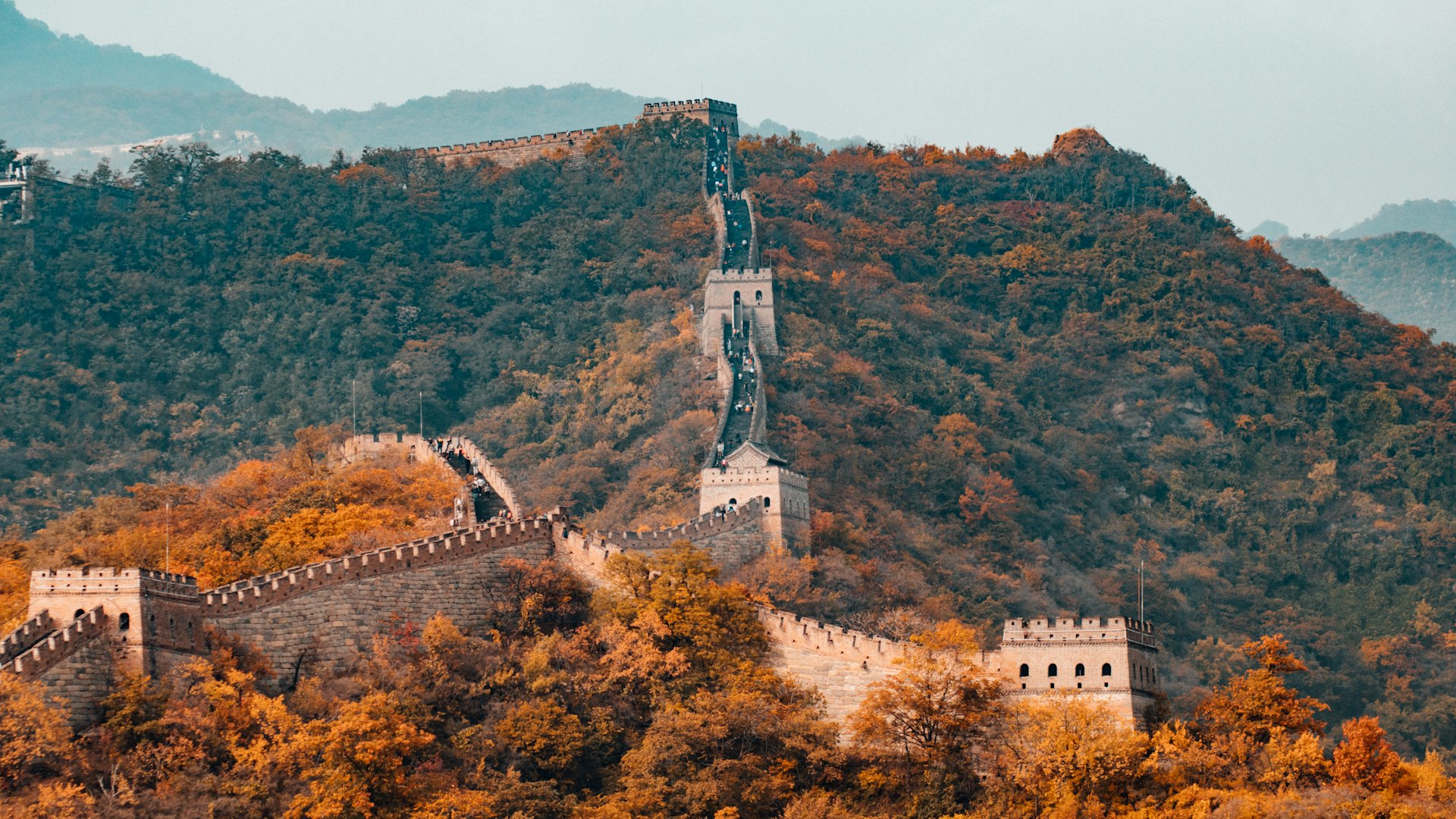
The Great Wall (Mutianyu section)
The best-preserved section, 70 km from central Beijing. Less crowded than Badaling. Cable car + toboggan slide available.
Tiananmen Square
The world's largest public square. Free to enter, but bring passport.
The Summer Palace
A 290-hectare imperial garden with the Long Corridor and the Marble Boat. Easy half-day trip.
Hutong walking (Nanluoguxiang)
Narrow alleyways with traditional courtyard homes, now lined with cafes and small shops. Best at dusk.
Temple of Heaven
A 15th-century complex where Ming and Qing emperors prayed for good harvests. The Hall of Prayer for Good Harvests is iconic.
Olympic Park (Bird's Nest & Water Cube)
The 2008 Olympic stadium and aquatics center lit up at night. Modern Beijing in one photo.
798 Art District
A converted 1950s military factory complex that is now Beijing's main contemporary art zone with 200+ galleries and cafes.
Beijing National Stadium (Bird's Nest)
Stainless-steel lattice stadium designed by Herzog & de Meuron for the 2008 Olympics. Lit up dramatically after dark.
Ming Tombs
The burial complex of 13 Ming dynasty emperors, set in a 40-sq-km valley. The underground Spirit Way is the highlight.
Houhai Lake
A lakeside bar and restaurant district inside a former imperial garden. The most popular evening hangout in central Beijing.
Wangfujing Snack Street
Beijing's most famous food street. Try jianbing, chuan'r, tanghulu, and — if you dare — scorpion skewers.
Yonghe Temple (Lama Temple)
The largest Tibetan Buddhist temple outside Tibet, founded in 1694. The 26-metre statue of Maitreya Buddha is jaw-dropping.
Jingshan Park
A hilltop park directly north of the Forbidden City. The single best panorama of the imperial roofline at sunset.
Peking Duck (Da Dong or Quanjude)
Beijing's signature dish. Roast duck carved tableside and eaten in thin pancakes with hoisin, scallion, and cucumber.
Frequently asked questions
- Do I need a visa to visit Beijing as a US, UK, or EU citizen?
- Yes and no. As of late 2024, citizens of 38+ countries (including the US, UK, Canada, Australia, Germany, France, Italy, Spain, Japan, South Korea) can enter China visa-free for up to 30 days for tourism. You still need a valid passport with at least 6 months of validity and one blank page. The visa-free policy is updated frequently — confirm the current status with the nearest Chinese consulate or on china-embassy.gov.cn before booking. For longer stays, the M (tourist) visa requires an invitation letter and is harder to obtain in 2026 than before.
- How many days do I really need in Beijing?
- Three full days covers the highlights: one day for the Forbidden City and Tiananmen, one for the Great Wall (Mutianyu is best), and one for the Summer Palace, Temple of Heaven, and a hutong walk. Five days lets you add the Olympic Park, 798 Art District, the Ming Tombs, and an evening of Peking duck or Beijing opera. A week unlocks day trips (Jinshanling, Chengde, Tianjin) and the city's deeper cultural layer. Anything less than 2 full days and you will feel rushed — most visitors regret not allocating more time.
- Which Great Wall section should I visit?
- Mutianyu (慕田峪) is the best for most visitors — well restored, 70 km from the city, less crowded than Badaling, with cable car, chair lift, and a toboggan slide. Badaling is the most famous but the most touristy — skip it on weekends. Jinshanling (金山岭) is the choice for serious hikers, with a 10-km mixed restored/wild trek. Jiankou (箭扣) is the wild, unrestored option for experienced hikers with proper gear. The recently restored Huanghuacheng (黄花城) combines Wall with a reservoir and is a quiet alternative. Always allow 6–8 hours round-trip from central Beijing.
- How do I pay in Beijing if I do not have a Chinese bank account?
- As of 2024, both Alipay and WeChat Pay accept foreign Visa and Mastercard cards. Open the app (download before you travel — Google Play access requires a VPN), link your card under 'Tour Card' (Alipay) or 'Services > Wallet' (WeChat), top up the in-app balance (¥1,000–2,000 is plenty for a week), and scan merchant QR codes like a local. Cash (CNY) is still widely accepted and useful for street food, small shops, and temple donations. Hotel concierge desks will exchange USD or EUR for CNY at slightly worse rates than banks.
- Is Beijing safe for foreign tourists?
- Yes — Beijing is one of the safest big cities in the world. Violent crime against foreigners is rare. The main scams to watch for: the 'tea ceremony' scam (young women inviting solo male travelers to a tea house with a multi-thousand-yuan bill — politely decline), unlicensed taxis at the airport (always use the official taxi line or DiDi), and the overcharging of unmarked snacks on Wangfujing Snack Street (check the menu price first). Petty pickpocketing is rare but not unknown on Line 1 during rush hour.
- What is the best month to visit Beijing?
- Late September to mid-October is the consensus best: temperatures are 15–22°C, skies are clear, the autumn colour is at its peak, and the summer heat is past. April is the second-best window for spring blossoms (Yuyuantan Park, Temple of Relics) and fewer crowds. Avoid the first week of May (Labour Day holiday) and the first week of October (National Day Golden Week) at all costs — hotels triple in price and the Forbidden City sells out. December–February is cold (-3 to 5°C) but the Wall with snow is magical and the city is uncrowded.
- How do I get from Beijing Capital (PEK) to my hotel?
- Three options. (1) Airport Express train (¥25) to Dongzhimen, then transfer to Metro Line 2 or 13. Total ~45 minutes. (2) Official taxi — flat ¥100 surcharge plus meter (about ¥120–180 to most central hotels). Use the official taxi line inside the terminal. (3) DiDi via the app — book a Premier or Express car, about the same as taxi. Avoid any driver who approaches you inside the terminal. From Beijing Daxing (PKX), the Daxing Airport Express to Caoqiao (¥35, 40 min) is the fastest. The metro closes at 23:00 — for late arrivals, a taxi or pre-booked DiDi is the only option.
- Can I use Google, Facebook, Instagram, and WhatsApp in Beijing?
- Not without a VPN. The Great Firewall blocks Google (including Gmail and Maps), Facebook, Instagram, WhatsApp, X, YouTube, TikTok (the international version is blocked but the Chinese Douyin works), and most Western news sites. Install and test a reputable VPN (ExpressVPN, Astrill, NordVPN, Mullvad) on your phone and laptop BEFORE arriving. Connection quality varies; test multiple servers. Apple Maps works without a VPN but is not as detailed in China as Baidu Maps or Amap (Gaode). For messaging inside China, use WeChat — almost everyone has it.
- Where is the best Peking duck in Beijing?
- For the traditional experience, Quanjude (全聚德) at Hufang Lu is the 1864 original and most ceremonial. For a more modern, leaner duck, Da Dong (大董) at the Dongzhimen flagship is widely considered the best in the city. For a splurge, try the duck at the Peninsula Beijing (duck from the imperial-era ovens) or Jing Yaa Tang. For a budget meal, the duck at any local Beijing restaurant (¥80–120) is usually excellent. Always book the day before, especially on weekends. One duck feeds two people; expect to pay ¥200–500 per duck at a mid-range restaurant.
- Is the Beijing subway easy to navigate for English speakers?
- Yes — it is one of the easiest in the world for non-Chinese speakers. All station names are announced in Mandarin and English, all signs are bilingual, and the system map is fully English. Buy a single-ride ticket from the vending machine (select English, then tap your destination on the map, pay cash or scan a QR code). The fare is flat ¥3–9 depending on distance. Trains run 5:00–23:00. During rush hour (7:30–9:30 am, 5:00–7:30 pm) Lines 1, 4, 5, 6, and 10 are extremely crowded. The official Beijing Subway app and Apple Pay / Alipay work at the gates.
- How much cash should I bring to Beijing?
- For most travelers, ¥1,000–2,000 in cash is more than enough. With Alipay/WeChat working at virtually every shop, restaurant, and attraction (after linking a foreign card), you can go almost cashless. Carry small notes (¥10, 20, 50) for street food, temple donations, taxi rides, and small shop purchases. Tip in cash if you wish, but tipping is not customary. Withdraw cash from ICBC or Bank of China ATMs as needed; most accept Visa/Mastercard. Note that ¥100 notes are the largest denomination — request smaller notes at the airport exchange.
- What should I pack for a Beijing visit?
- Season-dependent but universal items: comfortable walking shoes (Beijing sights involve 10,000+ steps per day), a light jacket or sweater (AC and winter are aggressive), an umbrella or light raincoat (summer thunderstorms), and modest clothing for temple visits (long trousers, covered shoulders). In winter: heavy coat, scarf, gloves, thermal layers — Beijing winters are cold and dry. In summer: light breathable clothing, sunscreen, an N95 mask for high-AQI days, and a small towel for the humidity. A reusable water bottle — Beijing tap water is not potable but filtered water is widely available in hotels.
- Can I visit Tiananmen Square and the Forbidden City on the same day?
- Yes — they are adjacent. Start at Tiananmen (free, passport required) early, ideally at sunrise for the flag-raising ceremony (5:00 am in summer, 7:30 am in winter). Then walk north to the Meridian Gate of the Forbidden City (¥60–80, book online at least 7 days in advance, especially in peak season). Plan 3–4 hours inside the Forbidden City, exit through the north gate, and climb Jingshan Park for the panoramic view. Total time: 6–7 hours, including lunch. Combine with a hutong walk in the afternoon. The Tiananmen flag-raising times are published on english.beijing.gov.cn.
- Is Beijing worth visiting in winter?
- Yes — winter is underrated. The cold is dry and bearable with proper layers. The Great Wall with snow is the most iconic photo in China, and you will have the Mutianyu section almost to yourself. Hotel rates drop 40–60% from summer. The downside: some sights close or have reduced hours (check the Summer Palace and Temple of Heaven for winter timetables), and outdoor walking before sunrise is brutally cold. Plan shorter outdoor itineraries and supplement with museums — the National Museum of China, the Palace Museum's Treasure Gallery, the National Art Museum, and the Capital Museum are all world-class and heated.
- What are the best day trips from Beijing?
- Top three: (1) The Great Wall at Jinshanling — 2.5 hours east, the most scenic hiking section, best for active travelers. (2) The Ming Tombs and Sacred Way — 1 hour north, the 7-km avenue of stone statues leading to the tomb of the Yongle Emperor, combined with the nearby Juyongguan Wall. (3) Chengde Mountain Resort — 4 hours by train, the Qing summer palace with 72 hectares of lakes and Tibetan temples. Closer half-day options: the Fragrant Hills (autumn colour), the Tanzhe Temple (the oldest Buddhist temple in Beijing, AD 307), and the ruins of Yuanmingyuan (the Old Summer Palace).
- Is it safe to drink the tap water in Beijing?
- No — tap water in Beijing is not potable for travelers. Use bottled water (cheap and everywhere), filtered water from hotel dispensers, or the hot water dispensers common in hotels and tourist sites (the Chinese boil water aggressively, so the hot tap is safe). Avoid ice in budget restaurants. Brushing teeth with tap water is generally fine, but if you have a sensitive stomach, use bottled. The air quality has improved significantly — by 2025, Beijing's annual average PM2.5 is under 40 µg/m³, but sensitive visitors should still check the daily AQI on aqicn.org or the Apple Weather app.
- How do I see Beijing opera or a traditional show?
- The Liyuan Theatre (梨园剧场) at the Qianmen Jianguo Hotel is the most famous venue, with nightly shows in English for foreign visitors (¥180–380). Performances are 1 hour, usually from 7:30 pm. Book through your hotel or via trip.com. For a more local experience, the Huguang Guild Hall (湖广会馆) near Hufang Lu has authentic shows with bilingual headsets and a tea ceremony included. The National Centre for the Performing Arts (NCPA, 國家大劇院) hosts classical music, opera, and dance — the building itself is a Paul Andreu-designed egg. Booking apps: damai.cn (Chinese), trip.com (English).
- How is the air quality in Beijing in 2025–2026?
- Much improved. Beijing’s air quality has transformed since the 2000s and the 2008 ‘Blue Sky’ Olympics, and by 2025 the annual average PM2.5 is under 40 µg/m³ (down from over 80 a decade earlier), with most days moderate-to-good. The winter heating season and the occasional spring dust storm can still produce hazy days, so sensitive visitors should check the AQI on aqicn.org or the Apple Weather app and carry an N95 mask for the worse days, but the city is no longer the pollution story it once was. The cleanest months are the summer and the early autumn; the worst are the still winter inversions. The improvement has been a major quality-of-life change for residents and a noticeable shift for repeat visitors, and the view from the Great Wall or Jingshan is far clearer than a decade ago.
- How do I book the Forbidden City and the major sights?
- Advance booking is now essential for the headline sights, and you should do it before you travel. The Forbidden City (the Palace Museum) requires online booking at least 7 days in advance via its official WeChat mini-program or the English ticketing site, with your passport; it sells out daily, especially in peak season, and there is no walk-up entry. The National Museum of China, the Mao Mausoleum, the Summer Palace, and the Temple of Heaven also require advance reservation (usually a day or two). The Great Wall sections (Mutianyu, Jinshanling) are bookable on arrival or through a tour. Carry your passport everywhere — it is required for sight entry, hotel check-in, and sometimes metro security. Your hotel concierge or a Trip.com booking can help with the WeChat-based systems if you do not read Chinese.
- Can I hike an unrestored section of the Great Wall?
- Yes, and for fit, adventurous visitors it is the best Wall experience. Jinshanling (130 km northeast) is the most popular hiking section, a 10-km mix of restored and wild towers with dramatic ridge views and far fewer crowds than Mutianyu or Badaling; a half-to-full-day hike. Jiankou (箭扣) is the genuinely wild, unrestored, dangerous section for experienced hikers with proper gear — steep, crumbling, and magnificent, but genuinely risky and not for casual walkers. Gubeikou, further out, is another wild option. For these, go with a guide or a reputable tour (Beijing Hikers is the established operator), carry water and a phone, wear strong shoes, and avoid them in rain, snow, or high wind. The wild Wall is one of the most spectacular experiences in China, but it demands respect and preparation; the restored sections (Mutianyu, Jinshanling) are the right choice for most visitors.
- What is the Beijing food beyond Peking duck?
- A great deal. Beyond the iconic Peking duck, eat the imperial cuisine (the fangshan court banquets at the Fangshan Restaurant in Beihai Park, the refined dishes of the Qing court), the Zhajiangmian soy-bean-paste noodles, the jiaozi dumplings (the dumpling houses of the hutongs and the Donglaishun Mongolian hotpot), the lamb hotpot (shuanyangrou, the copper-pot instant-boiled mutton), the Beijing-style roast lamb and the donkey-burgers (lvrou huoshao), the sesame flatbreads and the douzhi fermented mung-bean drink (an acquired taste), and the hutong street food of tanghulu candied hawthorn, jianbing crepes, and baozi buns. The Beijing cuisine is wheat-based, hearty, and northern, and the halal Hui food of the Niujie street (the lamb skewers, the beef pies) is excellent. For a splurge, the Michelin-starred TRB Hutong and the Da Dong modern duck are spectacular. A hutong courtyard dinner is as essential as the Forbidden City.
- Is Beijing a good destination for families?
- Yes — Beijing is excellent for families, especially with children aged 6 and up. The headline sights are awe-inspiring for children (the Forbidden City, the Great Wall, the Temple of Heaven), the hutong cycle rides and courtyard meals are kid-friendly, the Olympic Park and the Bird’s Nest are exciting, the Beijing Zoo (with its pandas) and the aquarium are reliable, and the parks (Beihai, Jingshan, the Summer Palace) have space to run and boat rides. The metro is stroller-manageable, the city is safe, and the food has mild options (dumplings, noodles, fried rice) for picky eaters. The main challenges are the summer heat, the winter cold, the long walks at the big sights, and the crowds in peak season; come April–May or September–October, pace the sightseeing, and build in rest afternoons. Most family China itineraries start in Beijing because the history is the most spectacular for children.
- What is the best way to use DiDi and the metro in Beijing?
- The Beijing Metro is the backbone — 27 lines, 800 km, bilingual, ¥3–9 a ride, works with Alipay/WeChat Pay QR codes or a Yikatong transit card, and reaches every major sight. It is the fastest way across the sprawling city, and the airport express connects PEK and the Daxing express connects PKX. DiDi (China’s Uber equivalent) is the complement for point-to-point trips: download the DiDi app or use the DiDi mini-program inside Alipay or WeChat, set your destination by map or by a Chinese address your hotel writes, and pay in-app via your linked card. DiDi accepts foreign phone numbers and has an in-app translator for driver chat. Taxis are metered and cheap but the language gap is real — have your destination in Chinese. For the Great Wall and the day trips, pre-book a car-with-driver or a tour. Walking is for the hutong districts and the imperial core; everything else, use the metro and DiDi.
- Can I visit Beijing as a visa-free transit stop?
- Yes. Beijing is one of China’s 144-hour (6-day) visa-free transit cities for citizens of 54 countries, including the US, UK, Canada, Australia, and most of the EU, when you arrive in and depart from China via different international airports (Beijing Capital PEK or Daxing PKX both qualify) with a confirmed onward ticket to a third country. The 6 days let you see the Forbidden City, the Great Wall, the hutongs, and a Peking duck dinner — many travellers use Beijing as a stopover between Europe and East Asia or Australia. Register the transit at check-in with your airline, present the onward ticket, and confirm current eligible nationalities at en.nia.gov.cn. For longer stays, the 30-day unilateral visa-free policy now covers 45+ countries.
- What is the Central Axis and how do I walk it?
- The Central Axis is the 7.8-km north-south line that has organised Beijing for 750 years and was inscribed by UNESCO in 2024 — the spine of the imperial city, running from Yongdingmen in the south through the Temple of Heaven, Qianmen, Tiananmen Square, the Forbidden City, Jingshan, and the Drum and Bell Towers to the north. Walking it (or segments of it) is the master key to the city: start at Yongdingmen and the Temple of Heaven, walk north through Qianmen and across Tiananmen, into and through the Forbidden City, up Jingshan for the panorama, and on to the Drum and Bell Towers — a full day that strings the greatest sights in their intended sequence. The symmetry, the gate-then-courtyard progression, and the cosmological order along the line are the architectural expression of imperial power, and walking the axis turns a list of monuments into a coherent urban masterpiece. It is the single most rewarding way to see central Beijing.
- How do I see the Great Wall without the crowds?
- Avoid Badaling (the most famous and the most crowded) and the first week of October and May. Mutianyu (70 km, well restored, cable car and toboggan, manageable crowds on a weekday) is the best choice for most visitors — go early, take the first cable car up, and you can have stretches to yourself before 10 am. Jinshanling (130 km, mixed restored and wild) is the hiker’s choice, with 10 km of dramatic towers and far fewer people — a half-to-full day. For genuine solitude, the wild sections (Jiankou, Gubeikou) with a guide give you the Wall essentially to yourself, but they demand fitness and care. Whatever you choose, go early or late, avoid the holidays, and book a driver or a small-group tour rather than the big-bus Badaling tours. The Great Wall with crowds is still spectacular; the Great Wall without them is unforgettable.
- Can I do a day trip from Beijing to Chengde or Tianjin?
- Yes, both are rewarding. Chengde, the Qing emperors’ summer retreat 250 km northeast, holds the Mountain Resort (a UNESCO site of 72 hectares of lakes, pavilions, and gardens) and the Eight Outer Temples, including the Putuo Zongcheng Temple — a scale replica of the Potala Palace, built in the 18th century for the visiting Panchen Lama. It is a full day by fast train or car (3–4 hours each way), worth it for the imperial and Tibetan-Buddhist architecture. Tianjin, only 30 minutes by high-speed train, is the easier day trip — a historic treaty-port city with European concession-era architecture (the Five Great Avenues), the Hai River waterfront, the famous Tianjin Eye Ferris wheel, and a distinctive food culture (the goubuli baozi, the jianbing crepes, the mahua fried dough). For most visitors, Tianjin is the more practical day trip and Chengde is the more spectacular; both deepen the regional picture around Beijing.
- What is the Drum and Bell Tower district and why walk it?
- The Drum and Bell Towers (Gǔlóu and Zhōnglóu) sit at the north end of the Central Axis, at the heart of the best-preserved hutong district in Beijing, and they are the anchor of the most rewarding old-city walk. The towers themselves — the Drum Tower (1420, with the reconstructed Ming drums and hourly drum performances) and the Bell Tower (1745, with its 63-tonne bronze bell) — are climbable for the view and the timekeeping history, but the real draw is the hutong grid around them: the lanes of Nanluoguxiang, the lake district of Houhai and Qianhai with its bars and boat rides, the courtyard hotels and the small museums, and the constant life of the old neighbourhood. A half-day walking the towers and the hutongs, ending with a lake-side dinner at Houhai, is the essential old-Beijing experience — the dense, human-scale, 700-year-old city that the imperial monuments and the skyscrapers cannot give you. It is the soul of Beijing.
- Is Beijing good for older travellers?
- Yes — Beijing is very manageable for older travellers who pace themselves. The imperial core (the Forbidden City, Tiananmen, the Temple of Heaven, the Summer Palace) is largely flat and well-paved, the metro is modern and accessible with lifts at most stations, the major hotels cater well to international guests, and the city is safe and comfortable. The main cautions are the summer heat and the winter cold (come April–May or September–October), the crowds and the long walks at the big sights (build in rest afternoons), and the Great Wall — the cable car at Mutianyu makes it accessible, while the hiking sections are not for limited mobility. The Forbidden City and the Summer Palace involve a lot of walking; pace them over two mornings rather than one. The hutong cycle rides and the courtyard meals are gentle and atmospheric. A relaxed 4–5 day Beijing stay is ideal for older visitors and a highlight of most grand-tour itineraries.
- What is the Nanluoguxiang and the hutong nightlife?
- Nanluoguxiang is the most famous restored hutong lane — a narrow, 800-metre alley of the old courtyard district, lined with boutiques, craft shops, cafes, bars, and small restaurants, and one of the most atmospheric evening walks in the city. It runs north-south through the Gulou hutong grid, connecting the Drum Tower district to the Ping’an Court area, and it is the gentrified showcase of the hutong revival. The crowds can be heavy in peak season and on weekend evenings, but the lane life, the lantern-lit courtyards, the craft beer bars, and the small restaurants make it one of the great urban evening walks in China. Pair it with the adjacent Drum and Bell Towers, the Houhai lake district, and the hutong courtyard dinner for a full old-Beijing evening. For a quieter hutong experience, the lanes of Beiluoguxiang, the area around the Confucius Temple, and the Beihai lake district are less commercialised.
- How do I handle the language barrier in Beijing?
- Mandarin (Putonghua) is the lingua franca, and it is the most spoken language on earth — but English outside the top hotels, the major museums, and the tourist restaurants is limited, and the Beijing dialect has a distinct flavour. The tools that matter: a translation app (Pleco for offline Mandarin dictionary and menu reading, Baidu Translate for live voice and photo translation), the addresses of your hotels and destinations saved in Chinese characters (your hotel will write them), and DiDi’s in-app translator for taxi and ride conversations. A few phrases — nǐ hǎo (hello), xièxie (thank you), duōshǎo qián (how much), wèishēngjiān zài nǎlǐ (where is the toilet) — cover most interactions. The Beijing metro is fully bilingual, the major sights have English signage, and the younger residents increasingly speak some English. Locals are patient with foreigners making an effort, and a smile and pointing go a long way.
- What is the best overall advice for a first trip to Beijing?
- Allow 3–5 days, book the Forbidden City and the headline sights at least 7 days ahead, and pick the Great Wall section carefully (Mutianyu for most, Jinshanling for hikers). Walk the Central Axis from the Temple of Heaven through the Forbidden City to the Drum Tower, spend an afternoon in the hutongs and a lakeside evening at Houhai, eat Peking duck and dumplings at proper local spots, and visit the 798 Art District and the Olympic Park for the modern layer. Go in April–May or September–October, install and test a VPN before arrival, link your foreign card to Alipay or WeChat Pay, and use the metro and DiDi rather than walking the vast distances. Build in slow time for the parks, the tea houses, and the courtyard meals. Beijing is the political and cultural capital, the most historically layered city in China, and one of the great capitals of world civilisation; come for the Great Wall and the Forbidden City, stay for the hutongs and the food, and you will understand why it is the unmissable first stop of any China trip.
- What is the Temple of Heaven and the imperial ritual?
- The Temple of Heaven (Tiāntán) is the 1492 Ming-dynasty complex where the emperors performed the annual sacrifices to heaven — the supreme ritual of the Chinese imperial-cosmological state, in which the Son of Heaven interceded with the celestial powers for good harvests and the legitimacy of his rule. The architectural centrepiece is the Hall of Prayer for Good Harvests, a circular, triple-eaved, blue-tiled wooden tower on a white-marble terrace, one of the most beautiful single buildings in China. The surrounding park is vast, full of locals practising tai chi at dawn, kite-flying, singing opera, and playing chess — it is the best place in Beijing to watch the city wake up. ¥15 to the park, ¥20 for the main-hall complex. Visit at sunrise for the tai chi and the morning light, and pair it with the start of a Central Axis walk. The Temple of Heaven is the architectural and ritual expression of the imperial state, and the morning park life is the modern Beijing at its most authentic.
- Can I drink the tap water in Beijing?
- No — tap water in Beijing is not potable; drink bottled, boiled, or properly filtered water. Bottled water is cheap (¥2–3) and available everywhere, and hotels provide kettles for boiling (the Chinese custom of drinking hot water means boiled tap is safe and everywhere). Avoid ice in budget restaurants. Brushing teeth with tap water is generally fine, but cautious travellers or those with sensitive stomachs use bottled. The ‘Beijing belly’ that affects many visitors in the first days is usually from the food adjustment rather than the water, but sticking to cooked food, bottled water, and hot tea for the first 48 hours minimises it. The air quality, once the headline concern, has improved dramatically and is now moderate most days, but sensitive visitors should still check the AQI and carry an N95 mask for the worse winter days.
- What is the Summer Palace and is it worth a half-day?
- Yes — the Summer Palace (Yíhéyuán) is a 290-hectare imperial garden-palace in the northwest of the city, the Qing emperors’ summer retreat, and one of the most beautiful imperial sites in China (a UNESCO site). The highlights are the Long Corridor (728 metres of painted wooden walkway along the lake), the Marble Boat (the Empress Dowager Cixi’s famously extravagant lakeside folly), the Seventeen-Arch Bridge, and the climb to the Tower of Buddhist Incense on Longevity Hill for the panorama over Kunming Lake. It is a relaxed, scenic, half-day escape from the dense imperial core, and the lake boat rides and the gardens are lovely. ¥30 in season (¥20 winter). Take Metro Line 4 to Beigongmen (the north gate). It is the imperial-garden counterpoint to the Forbidden City’s palace weight, and a favourite of the Beijing residents for a weekend outing.
- How much does a Beijing trip cost?
- Beijing is mid-priced for a major Chinese city — cheaper than Shanghai for hotels, more expensive than Xi’an or Chengdu. A backpacker day runs ¥300–450: a hostel bed (¥60–100), noodle and dumpling meals (¥80–150), the metro (¥20), and one sight (¥40–80). A mid-range day runs ¥700–1,200: a 4-star hotel (¥500–900), restaurant dinners including one Peking duck meal (¥200–400), the Forbidden City and the Wall day trip (¥150–300 plus transport), and the opera show. A luxury day runs ¥3,000+ for the top hotels (the Peninsula, the Aman), Michelin dining, and private guiding. The two big one-off costs are the Great Wall day trip and the Peking duck dinner. Plan ¥800–1,200/day mid-range for a comfortable 4–5 day stay, less for budget. The metro, the parks, and the hutong walks are among the best-value experiences in China.
- What is the Jingshan Park and the best Forbidden City view?
- Jingshan Park (Jǐngshān) is the small hill directly north of the Forbidden City, an artificial mound built from the earth excavated for the palace moats, and its summit pavilion (Wanchun) gives the single best panorama of the imperial roofline — the yellow-glazed tile sea of the Forbidden City sweeping south to Tiananmen, with the modern city beyond. It is the postcard view and the essential complement to a Forbidden City visit: enter the north Gate of Divine Prowess, walk through the palace, exit north, and climb the 10-minute path to the pavilion for the panorama. Best at sunset, when the light glows gold on the roofs. ¥2 entry — one of the great bargains in China. The hill is also a pleasant park of old cypress trees and a local gathering spot for tai chi and singing. No Beijing itinerary is complete without the Jingshan panorama.
- Is Beijing a good destination for solo travellers?
- Yes — Beijing is very solo-friendly. The metro and DiDi make the vast city navigable, the sights are easy to visit alone (book the Forbidden City and major sights ahead with your passport), the hutong walks and the courtyard meals are perfect solo experiences, the food is built for solo eating (a bowl of noodles, a basket of dumplings), and the hostels around Nanluoguxiang and Qianmen are social and well-organised for meeting other travellers and booking Wall tours. English is limited outside the top hotels, so a translation app and pre-saved Chinese addresses are essential, but the city is safe at any hour and the residents are patient with foreigners making an effort. The capital’s mix of imperial grandeur, hutong texture, contemporary art, and food suits solo exploration well, and the hostel scene is one of the best in China for solo travellers to connect.
- What is the Ming Tombs and is it worth visiting?
- The Ming Tombs (Míng Shísān Líng) are the burial complex of 13 of the 16 Ming emperors, set in a 40-square-km valley 50 km north of Beijing along the road to the Great Wall at Badaling. The site is anchored by the 7-km Spirit Way (Shendao) — an avenue of stone animal and official statues leading to the tombs, one of the great imperial processional avenues — and by the excavated Dingling tomb (the Wanli Emperor, the only one opened). It is atmospheric and historically significant, but it is often combined with a Wall trip as a rushed half-stop, which undersells it. For visitors interested in Ming imperial history, the Spirit Way and the Dingling descent are worth a dedicated half-day; for those short on time, skip it in favour of more time at the Wall or the city. The Sacred Way is the highlight — the stone guardians are among the finest funerary sculpture in China.
- What is the Yonghe Lama Temple and why visit it?
- The Yonghe Temple (Yōnghé Gōng, the Lama Temple or Palace of Harmony) is the largest and most active Tibetan Buddhist temple in Beijing — and the largest outside Tibet — a stunning complex of five great halls and courtyards, the former Qing imperial residence converted to a Tibetan Buddhist monastery in 1744. The highlight is the 26-metre (85-foot) Maitreya Buddha in the final hall, carved from a single block of white sandalwood and one of the most awe-inspiring single statues in China. The temple is constantly alive with incense, chanting monks, and pilgrims, and it is the most atmospheric and spiritually active site in the city. ¥25 entry. Walk the central axis through the halls to the Maitreya, light incense, and take in the living Tibetan Buddhist culture in the heart of Beijing. Pair it with the adjacent Confucius Temple and Imperial College for a half-day of imperial-and-religious Beijing. It is the spiritual counterpoint to the political capital.
- What is the difference between Beijing Capital (PEK) and Daxing (PKX) airports?
- Beijing has two major airports. Beijing Capital International Airport (PEK), 25 km northeast, is the older hub handling the majority of international and domestic flights, with the Airport Express metro (¥25, 20 min to Dongzhimen). Beijing Daxing International Airport (PKX), 46 km south, opened in 2019 with a stunning star-shaped Zaha Hadid design, handles China Southern, China Eastern, and SkyTeam carriers, and has its own Daxing Airport Express (¥35, 40 min to Caoqiao). Both have full international service; check which one your flight uses, as they are far apart and mixing them up is a common and costly mistake. The metro express links connect both to the city efficiently; taxis are ¥100–130 to the centre from either. Allow 60–90 minutes door-to-door.
- Is Beijing worth visiting in winter?
- Yes, and winter is underrated. December–February is cold (down to −10°C at night), dry, and often hazy, but the domestic crowds vanish, the hotel rates drop sharply, the hotpot and the dumpling houses are at their most comforting, and — most importantly — snow on the Great Wall and the Forbidden City roofs is one of the most beautiful sights in China, a postcard image that summer visitors never see. The ice skating on Houhai’s frozen lake and the winter temple festivals are uniquely seasonal pleasures. The downsides are the cold (pack serious layers), the shorter days, and the occasional hazy winter inversion. For a history-focused, uncrowded, photographic, lower-cost trip, winter is genuinely rewarding; for the comfortable outdoor sightseeing, come April–May or September–October. Beijing’s winters are a well-kept secret.
- What is the Qianmen and the Dashilar district?
- Qianmen and the adjacent Dashilar (Dàshílàr) district, just south of Tiananmen Square along the Central Axis, is the restored Qing-era commercial heart of old Beijing — a grid of hutong lanes lined with late-imperial shop-houses, traditional brand-name stores (the Tongrentang medicine shop, the Ruifuxiang silk store, the Neiliansheng shoe shop, the Quanjude duck restaurant’s 1864 original), teahouses, and small restaurants. Qianmen Main Street is the pedestrian showcase; the side lanes of Dashilar are the more authentic, less-touristy version with the old specialised shop streets (the silk market, the hat street, the lantern street). It is one of the best-preserved old-commercial districts in the city, and a walk here — browsing the century-old shops, eating the street food, taking in the hutong texture — is an essential old-Beijing experience. Pair it with the start of a Central Axis walk or an evening before a show at the nearby Liyuan Theatre.
- What is the Beijing dialect and will I manage with standard Mandarin?
- The Beijing dialect (Běijīng huà) is the prestige base of standard Mandarin (Putonghua) — they share the grammar and much of the vocabulary — but the local Beijing spoken style is distinct: a rapid, er-suffixed, heavily r-coloured cadence (the famous ‘érhuà’ that adds a rolled r to word endings), a large vocabulary of local slang, and a fast, casual delivery that even other Mandarin speakers find hard to follow at full speed. In practice, every Beijing resident also speaks clear standard Mandarin, so as a visitor you will be understood perfectly and can manage fine with standard Putonghua. English is spoken at the top hotels, the major museums, and the tourist restaurants, but drops off outside the central zones — a translation app (Pleco, Baidu Translate) and pre-saved Chinese addresses help. The Beijing dialect you hear in the hutongs and the markets is part of the city’s character, and locals appreciate a few words of effort.
- Is Beijing safe for solo female travellers?
- Yes — Beijing is one of the safest major cities in the world for solo women. Violent crime is essentially unknown, harassment is rare, and the city is comfortable to walk and use the metro at any hour. The standard precautions apply as anywhere: use DiDi rather than unlicensed taxis late at night, watch drinks in busy Sanlitun bars, and politely decline the classic ‘tea ceremony’ invitations from strangers that target foreigners generally. The hostels around Nanluoguxiang and Qianmen are social and safe for solo women, female-only dorm beds are available, and solo women regularly meet companions for Wall trips and hutong walks. Dress is not an issue — Beijing is casual and conservative, and visitors are unremarkable. The capital is genuinely one of the most comfortable cities in Asia for a solo female traveller to explore confidently.
References
Written by
NihaoVisit Editorial